

Billing & claims
Psychiatry RCM Software
Run the psychiatric revenue cycle end to end, from carve-out eligibility and treatment approvals to time-based claims, denials and patient balances.
Psychiatry RCM Software runs the full revenue cycle for a psychiatric practice, from the first booking to the last patient payment. It ties carve-out eligibility, treatment approvals, time-based coding, telehealth claims, remittances, denials and patient balances into one platform. Its reports show where psychiatric revenue is slowing down and why.



 6,500+ specialty providers

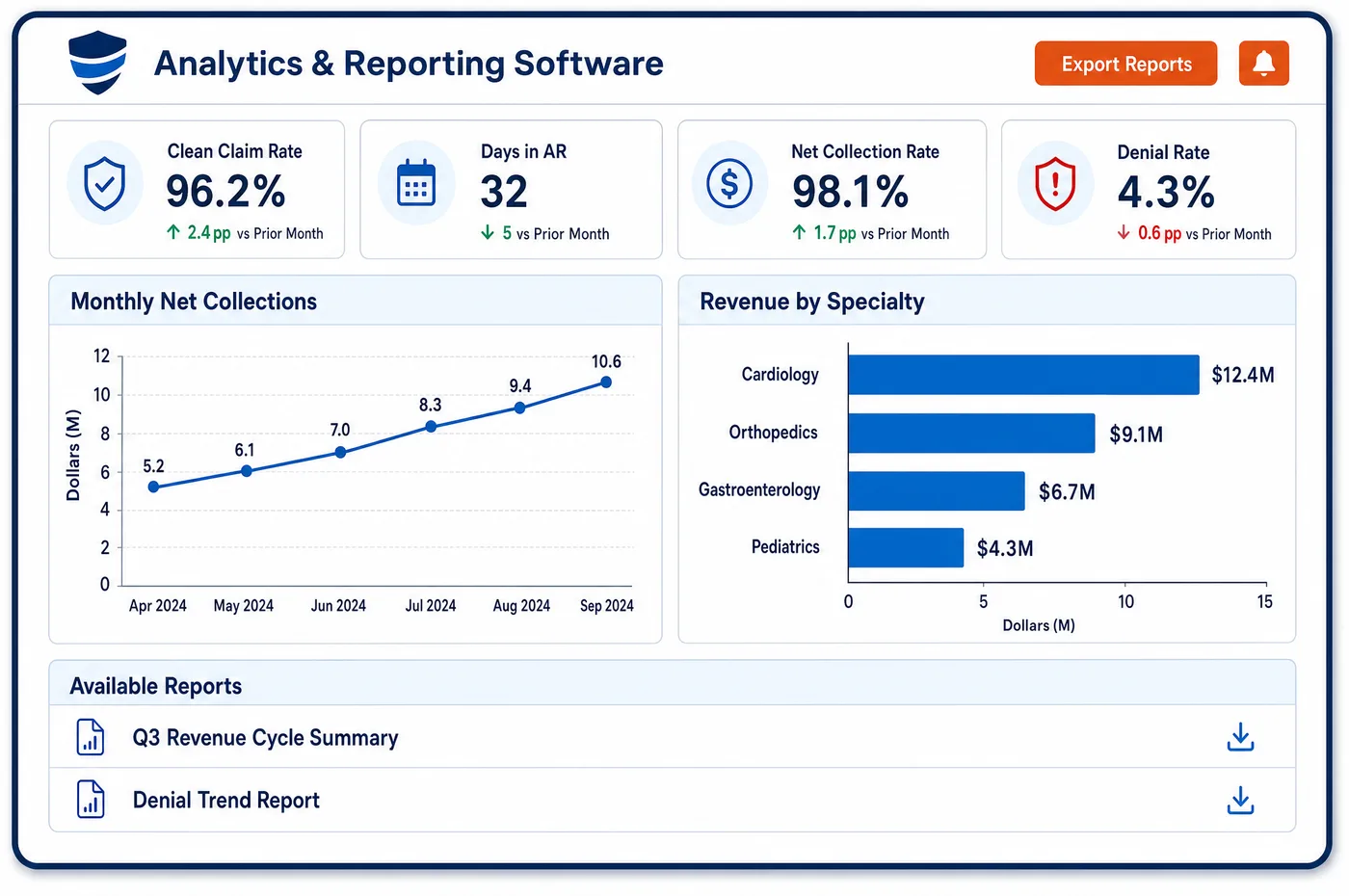
RCM in a Psychiatry Practice
A psychiatric revenue cycle has more handoffs than it looks. It starts at booking, where the right payer and any authorization are confirmed. It runs through the visit, where psychotherapy time, E/M level and telehealth details decide the code. Then the claim is built, checked and sent, often to a behavioral health company rather than the medical plan. Remittances post, denials are sorted by cause, and patient balances are collected, including self-pay visits and late cancellation fees. Psychiatry RCM software keeps all of those steps on one record, so a problem found at the end can be traced to where it started. A wrong-payer denial points back to registration. An add-on code denied for time points back to the note template. Leaders see the cycle as one set of measures: clean claims, denials by payer, days in AR, no-shows and authorization use.
Why Is RCM Different in Psychiatry?
Most psychiatric revenue problems start before the claim. A visit booked against the medical plan when a carve-out manages the benefit will deny no matter how well it is coded. A TMS session past the approved count will deny too. RCM in psychiatry has to begin at registration and clearance, not at the billing desk.
The middle of the cycle is driven by time. Psychotherapy codes depend on minutes, add-on codes depend on time kept apart from the E/M, and crisis, family and group codes each have their own rules. Telehealth adds place of service and modifier choices that vary by payer. Small errors repeat across many short visits, so one template problem can touch a large share of claims.
Psychiatric practices also run lean. Many are small groups or solo practices that weigh doing billing in-house against sending it to an outside service. Either way, the work is the same, and someone has to know the carve-outs, the time rules and the telehealth rules. Psychiatry RCM software gives an in-house team the tools to do that work, and gives every owner the reports to check it.
What Psychiatry RCM Software Handles
- Wrong-payer denials (CARC 109)
- A claim sent to the medical plan when a carve-out manages the benefit comes back with reason code 109. The RCM view links these denials to the registration that caused them, so the payer setup is fixed at the source. (X12 Claim Adjustment Reason Codes)
- Missing authorization (CARC 197)
- Denials for absent precertification are tracked by service, such as TMS, Spravato or intensive outpatient care. The pattern shows whether the gap sits in the clearance step or in session counting. (X12 Claim Adjustment Reason Codes)
- Psychotherapy time documentation (90832, 90834, 90837)
- One Medicare contractor's article requires start and stop times or total time for 90832, 90834 and 90837. Time-related denials are grouped by clinician, so the documentation template is fixed once. (CMS Medicare Coverage Database, Billing and Coding Article A57520: Psychiatric Diagnostic Evaluation and Psychotherapy Services)
- Incident-to behavioral health services
- Medicare lets auxiliary staff provide behavioral health services incident to a physician or NPP under general supervision. The cycle records which clinician each service is billed under, so the rule is applied the same way every time. (CMS MLN Booklet: Medicare & Mental Health Coverage (MLN1986542))
- Electronic remittance (X12 835)
- Remittances from medical plans and behavioral health payers post from the 835. Payments are compared with contracted rates for psychotherapy and E/M codes, and underpayments are flagged. (X12 Transaction Sets: 837 Claims and 835 Remittance)
- MIPS quality measures
- Psychiatrists in MIPS can report measures such as depression screening with a follow-up plan and depression remission. Rating scale data captured in the cycle supports those measures without a separate chart review. (CMS Quality Payment Program: Explore MIPS Measures)
How Does Psychiatry RCM Software Work?
1. Front end: payer and approval
Registration and clearance confirm the right payer, visit limits and any authorization before the visit. Many psychiatric denials are either prevented here or not at all.
2. Middle: code from the documentation
Charges are built from the note, with psychotherapy time, E/M level and telehealth details checked against payer rules. Errors are held for a fix before the claim goes out.
3. Claim: send and track
Clean claims go out electronically, and acknowledgments and status are tracked. The psychiatry medical billing workflow handles the claim mechanics inside the cycle.
4. Back end: post and work denials
Remittances post automatically, and denials route to queues by cause, value and filing deadline. Root causes feed back to the front end, where denial management for psychiatry fixes them at the source.
5. Patient balances and reporting
Copays, deductibles, self-pay balances and late cancellation fees are collected under the practice's policy. Leaders follow the cycle's measures on dashboards, by payer and by clinician.
Psychiatry RCM Software vs. Generic Software
| Area | Generic approach | Unlimited Systems |
|---|---|---|
| Where denials are fixed | One claim at a time in the billing office. | At the step that caused them, from registration onward. |
| Carve-out payers | Tracked in a spreadsheet beside the billing system. | Stored as payers on the record and used at every step. |
| Time-based codes | Checked only after a payer audit. | Checked against the note before the claim goes out. |
| KPIs | Monthly reports pulled from several systems. | Live dashboards by payer, clinician and visit type. |
| Billing oversight | Owners see only a monthly summary. | Owners see live denial, AR and collection reports. |
Who Uses It in a Psychiatry Practice
- Billing director: One view of the cycle, from authorizations to denials to patient balances, with work queues sorted by value and deadline.
- Physician owner: Clear measures of practice health: clean claim rate, days in AR, denials by payer and collections by payer type.
- Practice administrator: Reports that show which payers, clinicians or visit types slow the cycle, plus a payer mix view across medical plans, behavioral health payers and self-pay.
Psychiatry RCM Software FAQs
Psychiatry RCM software covers the whole revenue cycle: registration with the right payer, eligibility and authorization, coding from the note, claim submission, remittance posting, denial work and patient balances. Each step uses the same patient record, so a denial at the end can be traced back to the step where it started and fixed there.
Useful psychiatric RCM measures include clean claim rate, denial rate by payer, days in accounts receivable, no-show rate and authorization use for treatment courses. Collections by payer type, such as medical plan, behavioral health payer and self-pay, also matter because each behaves differently. Trends by clinician and visit type show where problems start.
Both models can work. In-house teams keep direct control and see problems early, while an outside billing service can cover gaps in staff. Either way, someone must know carve-outs, psychotherapy time rules and telehealth rules. Whichever model a practice chooses, live reports on denials, AR and collections let owners check how well the cycle is run.
Carve-outs are the usual cause: the plan on the card is not the company that pays for psychiatric care. If registration records only the medical plan, claims go to the wrong payer and return with reason code 109. Fixing the payer setup at registration, and checking eligibility with the behavioral health payer, stops the pattern instead of correcting claims one by one.
Telehealth adds choices at several steps. The booking must record where the patient will be, and the claim needs the right place of service, such as POS 10 for the patient's home. Some payers also want modifier 95 for video or 93 for audio-only. Those details carry from the schedule to the claim, so nobody re-enters them at billing.
Rating scale scores and screening results captured during visits support MIPS quality measures such as depression screening with follow-up, and depression remission. Because the data is stored as numbers rather than scanned forms, it can be reported without a separate chart review. The same data supports payer quality programs that track behavioral health outcomes.
Related Psychiatry Software
Billing & claims
RCM for related specialties
Sources
- X12 Claim Adjustment Reason Codes
- CMS Medicare Coverage Database, Billing and Coding Article A57520: Psychiatric Diagnostic Evaluation and Psychotherapy Services
- CMS MLN Booklet: Medicare & Mental Health Coverage (MLN1986542)
- X12 Transaction Sets: 837 Claims and 835 Remittance
- CMS Quality Payment Program: Explore MIPS Measures
- CMS MLN Booklet: Telehealth & Remote Patient Monitoring (MLN901705)
GET STARTED
See Unlimited Systems in Action
Whether you're actively evaluating new technology or simply preparing for your next vendor renewal, Unlimited Systems can help you understand where your current workflows may be creating avoidable revenue risk.