

Billing & claims
Psychiatry Charge Assembly Software
Turn psychiatric notes into complete charge lines: E/M with add-ons, evaluations, TMS and Spravato sessions, injectables and monthly care codes.
Psychiatry Charge Assembly Software gathers every documented psychiatric service for an encounter into coded charge lines. It pairs E/M codes with psychotherapy add-ons, adds interactive complexity when documented, builds TMS and Spravato session charges, and totals logged collaborative care time for the month when the practice is the billing practitioner, so each charge assembly is complete before validation.



 6,500+ specialty providers

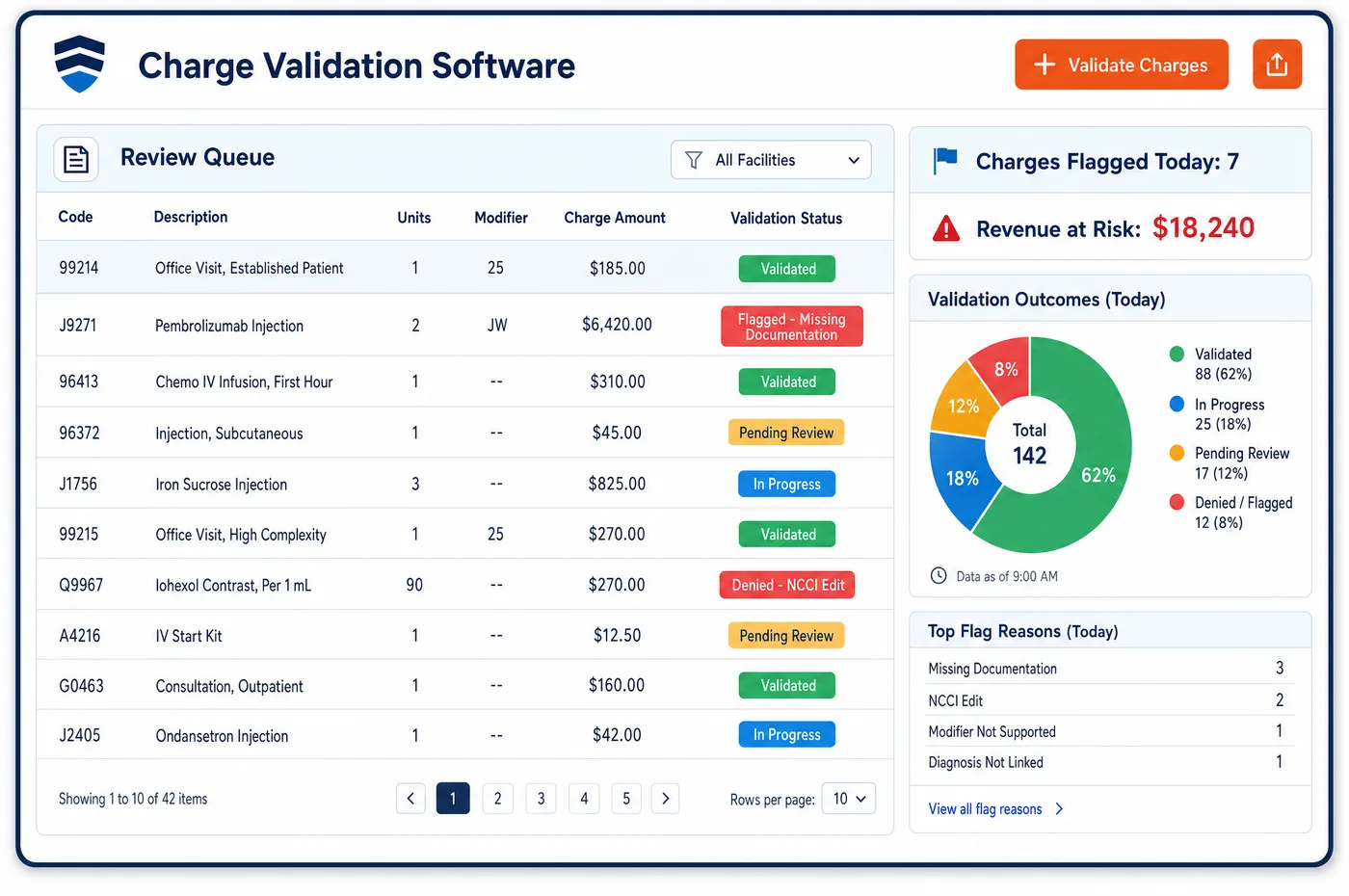
Charge Assembly in a Psychiatry Practice
Charge assembly in psychiatry starts from the note and the schedule. A medication visit with therapy becomes an E/M line plus an add-on, chosen from the therapy time in the note. A diagnostic evaluation becomes 90791 or 90792. A crisis visit becomes 90839, plus 90840 when it runs longer. A TMS session becomes 90867, 90868 or 90869, depending on the work done. A Spravato visit becomes G2082 or G2083 for Medicare, while other payers may want the drug and the visit billed apart. A long-acting injectable becomes a drug line with HCPCS units and NDC, plus the injection. Collaborative care is different again. Where the practice is the billing practitioner, care manager time adds up across the month and the charge is built when the month closes. Where it supplies the psychiatric consultant, the consultant's work is paid by contract instead. Psychiatry charge assembly software lays these lines out together, flags encounters that need a person, and passes the set on to validation.
Why Is Charge Assembly Different in Psychiatry?
A psychiatric encounter can hide several charges. A follow-up may include medication management, therapy, and interactive complexity when a parent or interpreter shapes the session. Each needs its own line, and each depends on what the note says. When charges are keyed from memory or a paper slip, add-ons get dropped and interactive complexity is rarely captured.
Some psychiatric charges are not tied to one visit. Collaborative care and other behavioral health integration codes are billed by the month by the treating practitioner, from time that care managers log across many contacts. Post-discharge follow-up calls are billed monthly too. Charge assembly has to hold these open, add up the time, and build the charge only when the month's threshold is met.
Treatments add drugs and devices. Spravato is billed differently by payer, and long-acting injectable antipsychotics need the right HCPCS code, units and NDC. A TMS course needs the right code for each type of session. Charge assembly for psychiatry turns all of this into lines that psychiatry charge validation can then check.
What Psychiatry Charge Assembly Software Handles
- E/M with psychotherapy add-on (90833, 90836, 90838)
- When the note shows therapy time apart from the E/M, the assembly adds the add-on that matches that time. The E/M and the add-on sit on the same encounter, so neither is lost. (CMS Medicare Coverage Database, Billing and Coding Article A57520: Psychiatric Diagnostic Evaluation and Psychotherapy Services)
- Interactive complexity (90785)
- Add-on code 90785 is added only when the note documents a qualifying communication factor, such as a caregiver whose behavior gets in the way of treatment. It rides with the evaluation or psychotherapy code it modifies. (CMS NCCI Policy Manual for Medicare Services, Chapter XI (Medicine, including Psychiatric Services))
- Psychiatric collaborative care (99492, 99493, 99494)
- When the practice is the billing practitioner, 99492 covers the first 70 minutes of care manager time in the first month, and 99493 the first 60 minutes in later months. Logged time adds up across the month, and 99494 is added for each further 30 minutes. (CMS MLN Booklet: Behavioral Health Integration Services (MLN909432))
- TMS session codes (90867, 90868, 90869)
- The first session with mapping becomes 90867, later sessions become 90868, and a session with a new motor threshold becomes 90869. Medicare contractor guidance expects 90867 once per episode and not alongside the other two. (CMS Medicare Coverage Database, Billing and Coding Article A57072: Transcranial Magnetic Stimulation)
- Spravato visit codes (G2082, G2083)
- For Medicare, a Spravato visit becomes G2082 for doses up to 56 mg or G2083 for doses above that. These codes include the observation period, so no separate observation charge is added. (Federal Register: CY 2020 Physician Fee Schedule final rule, esketamine codes G2082 and G2083 (84 FR 62568))
- Post-discharge follow-up contacts (G0544)
- Follow-up calls after a crisis discharge are logged as they happen. The charge is built once for the month and covers up to four calls. (CMS MLN Booklet: Medicare & Mental Health Coverage (MLN1986542))
How Does Psychiatry Charge Assembly Software Work?
1. Pull services from the note and schedule
Each finished encounter brings in what the note documents: codes, times, diagnoses and any drug given. Scheduled services that have no note yet are flagged instead of billed.
2. Pair primary and add-on codes
E/M codes are paired with the psychotherapy add-on the note supports, and interactive complexity is added when documented. Add-ons never stand alone.
3. Build treatment and drug lines
TMS sessions get the code for the work done. Spravato and long-acting injectables get payer-specific lines, with HCPCS units and the NDC where the payer requires it.
4. Total the monthly time codes
Collaborative care, general BHI and follow-up contact time is summed over the calendar month. The charge is built when the month closes and the time threshold is met.
5. Assign and review flagged encounters
Event-driven flags send unusual encounters to a person, such as a long session with no add-on. Charge assemblies can be searched and assigned as tasks, with the patient's billing history in view.
Psychiatry Charge Assembly Software vs. Generic Software
| Area | Generic approach | Unlimited Systems |
|---|---|---|
| Add-on capture | Add-ons depend on what the clinician remembers to mark. | Add-ons are built from the therapy time in the note. |
| Interactive complexity | Rarely captured at all. | Added when the note shows a qualifying factor. |
| Monthly codes | Care manager time tallied in a spreadsheet. | Time summed on the record and charged at month end. |
| Spravato and injectables | One charge format for every payer. | Lines built to each payer's billing method. |
| Review | Every encounter reviewed the same way. | Only flagged encounters go to a person. |
Who Uses It in a Psychiatry Practice
- Coder or charge entry specialist: Encounters that arrive with lines already built, and a short queue of flagged ones that need a human look.
- Collaborative care manager: Time logged on each contact that rolls up into the month's charge, with no separate tally to keep.
- Billing manager: Fewer missed add-ons and drug lines, and a charge capture process that hands clean sets to psychiatric claims and billing.
Psychiatry Charge Assembly Software FAQs
Psychiatry charge assembly software turns documented psychiatric services into coded charge lines. It pairs E/M codes with psychotherapy add-ons, adds interactive complexity when the note supports it, builds TMS, Spravato and injectable drug lines, and sums monthly care management time. The finished charge assembly then moves to validation before it becomes a claim.
The add-on is chosen from the therapy time the note records apart from the E/M work. Time in the 90833 band gets 90833, and longer sessions get 90836 or 90838. If the note does not show separate therapy time, no add-on is built, and the encounter is flagged for the clinician to review.
Collaborative care time is logged by the care manager on each contact during the month. When the practice is the billing practitioner, the month-end total decides the codes: 99492 for the first month, 99493 for later months, and 99494 for each extra block. Medicare's G2214 can cover a shorter month, and no charge is built when no threshold is met.
Spravato billing differs by payer. Medicare uses G2082 or G2083, which bundle the visit and the observation period. Other payers may want the drug on its own line with a separate visit code, or may cover the drug under the pharmacy benefit. Charge assembly builds the lines each payer expects for that patient.
A long-acting injectable needs a drug line with the right HCPCS code and units, an injection line, and the NDC where the payer asks for it. Charge assembly pulls the drug and dose from the note, converts the dose to billing units, and lines it up with the visit it belongs to.
Event-driven checks flag encounters that look incomplete or unusual, such as a long visit with no add-on, a TMS session with no matching authorization, or an injection with no drug line. Those go to a person as tasks. Encounters that look complete move on, so staff do not review every visit by hand.
Related Psychiatry Software
Billing & claims
In the revenue cycle
Charge Assembly for related specialties
Sources
- CMS Medicare Coverage Database, Billing and Coding Article A57520: Psychiatric Diagnostic Evaluation and Psychotherapy Services
- CMS NCCI Policy Manual for Medicare Services, Chapter XI (Medicine, including Psychiatric Services)
- CMS MLN Booklet: Behavioral Health Integration Services (MLN909432)
- CMS Medicare Coverage Database, Billing and Coding Article A57072: Transcranial Magnetic Stimulation
- Federal Register: CY 2020 Physician Fee Schedule final rule, esketamine codes G2082 and G2083 (84 FR 62568)
- CMS MLN Booklet: Medicare & Mental Health Coverage (MLN1986542)
GET STARTED
See Unlimited Systems in Action
Whether you're actively evaluating new technology or simply preparing for your next vendor renewal, Unlimited Systems can help you understand where your current workflows may be creating avoidable revenue risk.