

Billing & claims
Behavioral Health Charge Assembly Software
Turn documented therapy time, groups, program days, testing and Medicaid services into coded charge lines with the right units and modifiers.
Behavioral Health Charge Assembly Software turns what a clinician documented into coded charge lines. Session time becomes the right psychotherapy code. Groups, family sessions, program days, testing hours and timed Medicaid services become lines with the right units, rendering clinician and modifiers. The charge is built from the note, not typed from memory.



 6,500+ specialty providers

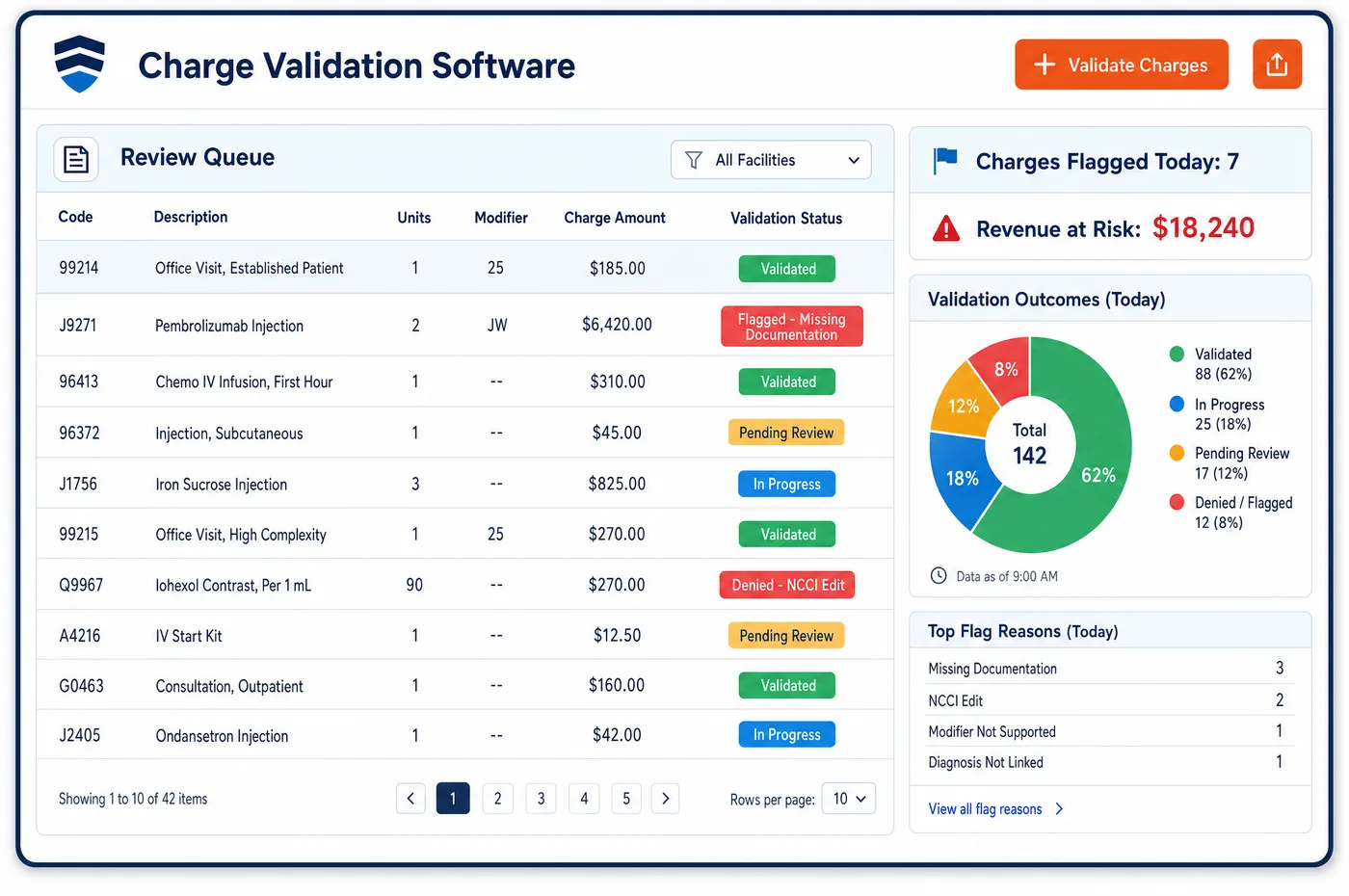
Charge Assembly in a Behavioral Health Practice
In behavioral health the note decides the charge. A therapist records start and stop times, and the time sets the code. A session where a parent's conflict disrupts care, or a child needs play to communicate, may add the interactive complexity add-on when the note supports it. A group becomes one line for each attending client. A program day may hold several psychotherapy units plus groups. Medicaid services such as community support or psychosocial rehabilitation are billed in units of time, so minutes are converted with the payer's rounding rule. Testing is split into evaluation and administration time, by the psychologist or a technician. Behavioral health charge assembly software reads each finished session and builds those lines with the rendering clinician, place of service and payer modifiers attached. Lines then pass to validation edits before any claim is built. Nothing depends on a clinician recalling a code at the end of a long day.
Why Is Charge Assembly Different in Behavioral Health?
Time is the backbone of the charge. Most therapy codes are time-based, and the bands are narrow at the edges. A session logged at 52 minutes bills as 90834, while one at 53 minutes bills as 90837. If the times in the note and the code on the charge disagree, the charge is wrong either way. Charge capture has to start from the documented time.
Units work differently across services. Group therapy is one unit per session no matter how long it runs. Many Medicaid services, such as psychosocial rehabilitation (H2017) in Ohio, are billed in 15-minute units with a rounding rule. Program days may carry several psychotherapy units. Getting the unit count wrong under-bills one day and draws an audit the next.
Several people may touch one service. A testing battery can include time from a psychologist and time from a technician. A program day includes groups run by different staff. Some payers want a supervisor's modifier on an associate's work. Each line has to name the right person and carry the modifiers their role needs.
What Behavioral Health Charge Assembly Software Handles
- Psychotherapy time to code (90832, 90834, 90837)
- Documented time picks the code, with 90832 for 16 to 37 minutes, 90834 for 38 to 52 and 90837 for 53 or more. Time may be recorded as start and stop times or as total time, and the charge line is built from it. (CMS Medicare Coverage Database, Billing and Coding Article A57520: Psychiatric Diagnostic Evaluation and Psychotherapy Services)
- Interactive complexity add-on (90785)
- Code 90785 is added to evaluations, individual psychotherapy and group psychotherapy when communication factors complicate the session. With timed codes the note must show time spent on those factors, and 90785 is not billed when the patient cannot communicate by any means. (CMS Medicare Coverage Database, Billing and Coding Article A57520: Psychiatric Diagnostic Evaluation and Psychotherapy Services)
- Group units and program groups (90853, G0410, G0411)
- A practitioner reports one unit of 90853 per date of service, while an outpatient facility reports one unit per separate group session. Group therapy in a PHP or IOP may be reported with 90853 or with the timed codes G0410 or G0411. (CMS NCCI Policy Manual for Medicare Services, Chapter XI (Medicine, including Psychiatric Services), revised 1/1/2026)
- Psychotherapy units in PHP and IOP
- Psychotherapy codes 90832 to 90838 provided in a Medicare partial hospitalization or intensive outpatient setting may be reported with more than one unit for a single date. Program charge lines add the units the day's notes support. (CMS NCCI Policy Manual for Medicare Services, Chapter XI (Medicine, including Psychiatric Services), revised 1/1/2026)
- Timed Medicaid units (H2017)
- In Ohio Medicaid, time-based HCPCS codes follow the midpoint rule, so a 15-minute code such as H2017 needs at least 8 minutes for one unit. Charge lines convert documented minutes to units with that rule. (Ohio Department of Medicaid: Behavioral Health State Plan Services Provider Requirements and Reimbursement Manual, version 1.28.1 (March 2026))
- Psychological testing (96130 to 96139)
- Testing evaluation (96130 to 96133) and test administration (96136 to 96139) are timed, and they must be distinct from a diagnostic evaluation on the same date. Time spent repeating information already gathered is not counted. (CMS NCCI Policy Manual for Medicare Services, Chapter XI (Medicine, including Psychiatric Services), revised 1/1/2026)
How Does Behavioral Health Charge Assembly Software Work?
1. Read the finished session
When the note is signed, its date, times, service type, rendering clinician and place of service are read in. Staff can hold sessions with unsigned notes back from billing.
2. Pick the code from documented time
Time sets the psychotherapy code, and timed Medicaid services convert minutes to units with the payer's rounding rule. Testing time is split into evaluation and administration.
3. Add only the add-ons the note supports
Interactive complexity and other add-on codes are added only when the note documents them. Prescriber visits with therapy pair the E/M code with the matching add-on.
4. Build group and program lines
Group sessions create one line per attending client. Program days create the psychotherapy units, groups and other services the day's notes support.
5. Attach modifiers and pass on
Payer modifiers for telehealth, education level or supervision are attached. Lines move to validation and then to medical billing for behavioral health.
Behavioral Health Charge Assembly Software vs. Generic Software
| Area | Generic approach | Unlimited Systems |
|---|---|---|
| Code choice | Clinician picks a code by habit. | Code set from the time in the note. |
| Units | Units guessed for timed Medicaid work. | Minutes turned into units with the payer's rule. |
| Groups | One charge typed for the whole group. | One line per client who came. |
| Testing | Testing billed as one lump sum. | Each person's testing time on its own line. |
| Add-ons | Added from memory, or missed. | Added only when the note supports them. |
Who Uses It in a Behavioral Health Practice
- Therapist: No code lookups at the end of the day, since the charge is built from the times already in the note.
- Testing psychologist: Time split by person and code, so the technician's time and the psychologist's time each bill the right way.
- Nurse practitioner or other prescriber: Medication visits with therapy built as an E/M line plus the matching psychotherapy add-on code, with separate therapy time recorded.
Behavioral Health Charge Assembly Software FAQs
Behavioral health charge assembly reads the documented time from the signed note and picks the code that fits. Under Medicare guidance, 90832 covers 16 to 37 minutes, 90834 covers 38 to 52 minutes and 90837 covers 53 minutes or more. Time can be documented as start and stop times or as total time.
Interactive complexity, code 90785, is added to evaluations, individual psychotherapy or group psychotherapy when communication factors complicate the session, such as caregivers whose conflict disrupts care. The note must document those factors, and with timed codes the time spent on them. It is not added when the client cannot communicate by any means.
A group session creates one charge line for each client who attended. Under NCCI, a practitioner reports one unit of group psychotherapy per date of service no matter how long the group runs, while an outpatient facility reports one unit per separate group session. The roster from the schedule supplies the list of attendees.
Many Medicaid behavioral health services are billed in timed units, and rounding rules vary by state. In Ohio Medicaid the midpoint rule applies, and H2017 is a 15-minute code, so at least 8 minutes are needed to bill one unit. Charge assembly converts documented minutes into units with each payer's rule.
Testing is split into evaluation services, 96130 to 96133, and test administration, 96136 to 96139, all of which are timed. Psychologist and technician time go on separate lines with the right codes. NCCI requires these services to be distinct from a diagnostic evaluation on the same date, so time is not counted twice.
For Medicare, psychotherapy provided in a partial hospitalization or intensive outpatient setting may be reported with more than one unit on a single date of service. Group therapy in those programs may be reported with 90853 or with G0410 or G0411. Program day lines are built from each note.
Related Behavioral Health Software
Billing & claims
In the revenue cycle
Charge Assembly for related specialties
Sources
- CMS Medicare Coverage Database, Billing and Coding Article A57520: Psychiatric Diagnostic Evaluation and Psychotherapy Services
- CMS NCCI Policy Manual for Medicare Services, Chapter XI (Medicine, including Psychiatric Services), revised 1/1/2026
- Ohio Department of Medicaid: Behavioral Health State Plan Services Provider Requirements and Reimbursement Manual, version 1.28.1 (March 2026)
GET STARTED
See Unlimited Systems in Action
Whether you're actively evaluating new technology or simply preparing for your next vendor renewal, Unlimited Systems can help you understand where your current workflows may be creating avoidable revenue risk.