

Front office
Behavioral Health Patient Scheduling Software
Book weekly therapy, groups, family sessions and program days with the right clinician, length and place of service.
Behavioral Health Patient Scheduling Software books each session with the clinician, length and setting the client and payer need. Weekly therapy repeats with the same clinician. Groups book with a roster, family sessions in their own block, and program days as structured blocks. Telehealth visits record where the client will be during the session.



 6,500+ specialty providers

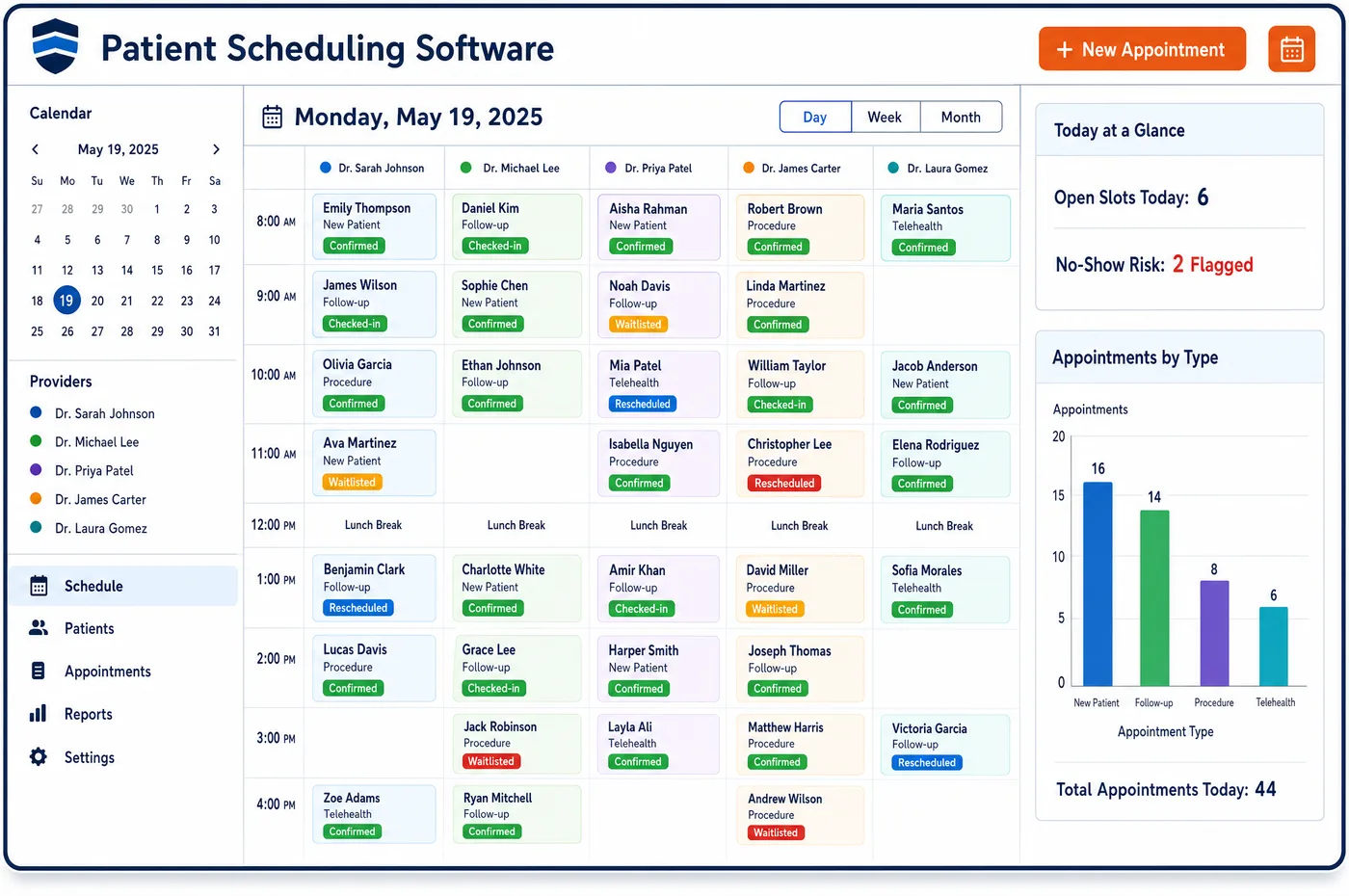
Patient Scheduling in a Behavioral Health Practice
Behavioral health schedules run on repetition. A client who starts therapy usually comes back at the same hour each week, with the same clinician, for a long stretch. Behavioral health patient scheduling software books that series from the treatment plan instead of one visit at a time. Slot lengths follow the code the clinician plans to bill, so a 90837 session gets a full hour. Groups are booked once, with each member checked in. Family sessions get their own block. Intensive outpatient and partial hospitalization days are built from group and individual blocks that match the program plan. Each booking checks the payer side too: is this clinician in network, enrolled with Medicare when needed, and inside the count approved during behavioral health financial clearance? Video visits record whether the client is at home or elsewhere, which sets the telehealth place of service. Cancellations offer the open hour to the waitlist.
Why Is Patient Scheduling Different in Behavioral Health?
Continuity is part of the treatment. Clients do better with the same therapist at a steady time, and a schedule that books one visit at a time leaves gaps that turn into dropouts. Recurring series, held slots and quick rebooking after a missed week protect the relationship. They are also what keeps a caseload full.
The person in the slot matters as much as the time. A payer may credential one counselor and not another, Medicare pays only enrolled clinicians, and a supervisee's sessions may not be billable under their own name. Booking a client with the wrong clinician creates a claim that cannot be paid, however good the session was.
Formats vary more than in most fields. One clinician might run individual sessions, a weekly group, a couples session and an evening program block. Each has its own code, length and billing unit. School-based sessions, home visits and telehealth add their own place of service. The scheduler has to hold all of it.
What Behavioral Health Patient Scheduling Software Handles
- Session length and the psychotherapy code (90832, 90834, 90837)
- Medicare billing guidance assigns 90832 to 16 to 37 minutes, 90834 to 38 to 52 and 90837 to 53 or more. Slots are built to the planned code, since psychotherapy under 16 minutes isn't reported with 90832 or any other psychotherapy code. (CMS Medicare Coverage Database, Billing and Coding Article A57520: Psychiatric Diagnostic Evaluation and Psychotherapy Services)
- Group psychotherapy (90853)
- NCCI counts group psychotherapy per session, not by time, and a practitioner reports one unit per date of service. Each group is booked as one session with a roster, and every attending client is checked in. (CMS NCCI Policy Manual for Medicare Services, Chapter XI (Medicine, including Psychiatric Services), revised 1/1/2026)
- Family sessions beside individual therapy (90846, 90847)
- Family psychotherapy can be reported with individual psychotherapy on the same date when it is a separate service in a separate time interval. The scheduler books the two as back-to-back visits, not one long one. (CMS NCCI Policy Manual for Medicare Services, Chapter XI (Medicine, including Psychiatric Services), revised 1/1/2026)
- Program days for intensive outpatient and partial hospitalization
- For Medicare, both programs run on a physician-certified weekly minimum of services under a written plan. Program days are booked as blocks of groups and individual sessions, so attendance can be checked against that plan. (CMS MLN Booklet: Medicare & Mental Health Coverage (MLN1986542, March 2026))
- Telehealth place of service (POS 02, POS 10)
- POS 10 means telehealth in the client's home, and POS 02 means telehealth somewhere other than home. The booking records where the client will be, so the claim carries the right code. (CMS: Place of Service Code Set)
- Medicare-enrolled clinicians
- Marriage and family therapists and mental health counselors have been able to bill Medicare on their own since January 1, 2024, once enrolled. The schedule shows which clinicians are enrolled, so Medicare clients are booked with someone who can bill. (CMS MLN Booklet: Medicare & Mental Health Coverage (MLN1986542, March 2026))
How Does Behavioral Health Patient Scheduling Software Work?
1. Book the series from the plan
When the treatment plan sets weekly therapy, the series is booked at a steady day and time. Each visit carries the clinician, length and payer.
2. Match clinician to payer
The booking shows whether the clinician is in network with the client's plan and enrolled with Medicare when that matters. Staff pick another clinician before the session, not after the denial.
3. Check the approved count
Each booking counts against any approved sessions. A visit past the count is held until a new approval comes through.
4. Send links and reminders
Video visits get a secure link, and every session gets a reminder by text or email through behavioral health patient engagement. Clients confirm or ask to move by reply.
5. Refill open hours
When a client cancels, waitlist clients are offered the hour by text. People waiting for a first assessment can move up this way.
Behavioral Health Patient Scheduling Software vs. Generic Software
| Area | Generic approach | Unlimited Systems |
|---|---|---|
| Recurring therapy | Booked one week at a time. | Weekly series set from the treatment plan. |
| Slot length | One length for every visit. | Length set by the code the clinician plans to bill. |
| Clinician and payer | Any open clinician is booked. | Network and Medicare enrollment shown at booking. |
| Groups and programs | Groups kept on a paper sign-in sheet. | Group rosters and program blocks on the schedule. |
| Telehealth | Links sent by hand, client location unknown. | Secure link sent and client location recorded. |
Who Uses It in a Behavioral Health Practice
- Scheduler: A steady weekly series for each client, with network status and approved counts in view before the slot is saved.
- Group facilitator: A roster for every group session, with each member checked in, so attendance and billing match.
- Clinical director: Caseloads and open hours across clinicians and sites, with place of service and session lengths passed on to behavioral health charge validation.
Behavioral Health Patient Scheduling Software FAQs
Behavioral health patient scheduling books therapy as a series from the treatment plan, at the same day and time with the same clinician. Each visit carries the length, payer and place of service. Missed weeks are rebooked quickly, and reminders go out before every session, which protects both continuity of care and the clinician's caseload.
The slot should fit the code the clinician plans to bill. Under Medicare billing guidance, 90832 covers 16 to 37 minutes, 90834 covers 38 to 52 minutes and 90837 covers 53 minutes or more. Building slots to those bands keeps the session long enough for the planned code without wasting time.
A group is booked as one session with a roster of clients. Each member is checked in, and only those who attend are billed. Under NCCI, group psychotherapy is reported per session rather than by time, and a practitioner reports one unit per date of service, so the roster doubles as the billing record.
Family psychotherapy can be billed with individual psychotherapy on the same date when it is a distinct service in a separate time interval. The scheduler books them as two visits back to back, each with its own code. The 90846 and 90847 descriptors each describe 50 minutes of family psychotherapy.
Program days are booked as blocks of group and individual services that follow the program plan. For Medicare, intensive outpatient care requires a physician's determination that the client needs at least nine hours of services a week. Attendance for each block is recorded, so the program can see whether each client is getting the planned care.
The schedule shows each clinician's license type and Medicare enrollment. Marriage and family therapists and mental health counselors can bill Medicare on their own once enrolled, which has been allowed since January 1, 2024. Medicare clients are booked with an enrolled clinician, which keeps the session billable from the start.
Related Behavioral Health Software
Front office
In the revenue cycle
Patient Scheduling for related specialties
Sources
- CMS Medicare Coverage Database, Billing and Coding Article A57520: Psychiatric Diagnostic Evaluation and Psychotherapy Services
- CMS NCCI Policy Manual for Medicare Services, Chapter XI (Medicine, including Psychiatric Services), revised 1/1/2026
- CMS MLN Booklet: Medicare & Mental Health Coverage (MLN1986542, March 2026)
- CMS: Place of Service Code Set
GET STARTED
See Unlimited Systems in Action
Whether you're actively evaluating new technology or simply preparing for your next vendor renewal, Unlimited Systems can help you understand where your current workflows may be creating avoidable revenue risk.