

Front office
Addiction Medicine Patient Scheduling Software
Dosing windows, injection cycles, group sessions, IOP blocks and random testing, each booked on the rhythm treatment needs.
Addiction Medicine Patient Scheduling Software books the visits that recovery runs on: daily or weekly dosing, monthly or weekly injections, counseling and group sessions, intensive outpatient blocks and random drug tests. Each visit type has its own length, staff and room. The schedule also follows the billing week, so every visit lands in the right episode of care.



 6,500+ specialty providers

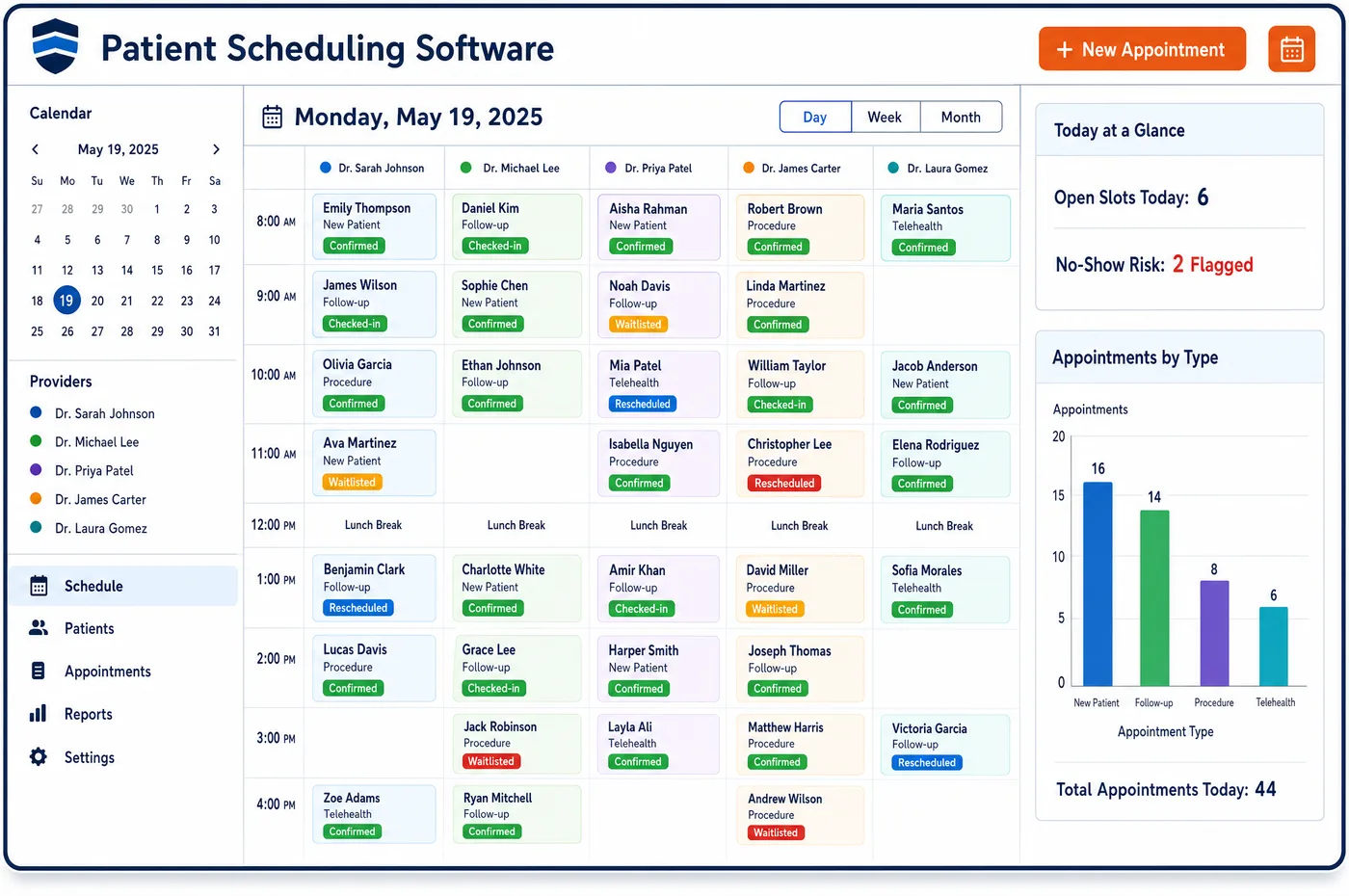
Patient Scheduling in a Addiction Medicine Practice
An addiction schedule repeats more than most. An OTP patient may come in for dosing every morning at first, then less often as take-home doses are earned. A patient on a monthly buprenorphine injection needs that visit booked on time, with counseling in the weeks between. Group sessions fill a room with one counselor and many patients. Intensive outpatient patients need enough sessions each week to meet the program's threshold, and Medicare won't pay OTP intensive outpatient services given by video. Drug tests are best done at random, so they can't sit on a fixed day. Addiction medicine patient scheduling software sets each of these up as a visit type or a series. It ties the series to the treatment plan, warns staff when a booking goes past an approval, and sends reminders by text or email. A missed dose or session triggers a same-day follow-up list.
Why Is Patient Scheduling Different in Addiction Medicine?
Missed visits carry more risk here. A missed dosing day can mean withdrawal or a return to use. A missed injection can leave a patient without medication. The schedule is a safety tool as much as a calendar, and gaps need to surface the same day, not at the end of the month.
The billing week shapes the calendar too. Medicare pays an OTP by the week, and the program can use one set start day for everyone or a cycle that differs by patient. A new patient who starts mid-week, or a holiday that closes the clinic, can put two bundles in one week. CMS allows that only with modifier 59 and a documented reason, so the scheduler needs to know the cycle.
Some visits also have hard limits. A monthly injection bundle isn't expected more than once every four weeks. OTP intensive outpatient care must be in person to be paid under Part B. Office-based treatment bundles count minutes across the calendar month. Patient scheduling in addiction medicine has to book within those rules, or the visits happen and the claims fail.
What Addiction Medicine Patient Scheduling Software Handles
- Weekly billing cycles at an OTP
- CMS lets an OTP bill weekly bundles on one standard cycle start day or on a cycle that varies by patient. The scheduler stores each patient's cycle, so dosing and counseling visits fall inside the right week. (CMS: Opioid Treatment Program (OTP) Billing & Payment)
- Two bundles in one week (modifier 59)
- When a new patient is synced to the program's cycle, or the OTP closes for part of a holiday week, a bundle may be billed twice in one week with modifier 59 and a documented reason. The scheduler flags those weeks for billing. (Medicare Claims Processing Manual, Chapter 39: Opioid Treatment Programs (Rev. 13572, 2026))
- Monthly injection and non-drug weeks (G2069, G2074)
- CMS expects G2069 for the week a monthly buprenorphine injection is given and G2074 for later weeks with at least one non-drug service. The scheduler books the injection on cycle and the counseling visits between. (Medicare Claims Processing Manual, Chapter 39: Opioid Treatment Programs (Rev. 13572, 2026))
- OTP intensive outpatient (G0137)
- G0137 requires at least nine services in a week, and Medicare does not pay OTP intensive outpatient services given by video or phone. The scheduler builds in-person IOP blocks that meet the threshold. (Medicare Claims Processing Manual, Chapter 39: Opioid Treatment Programs (Rev. 13572, 2026))
- Take-home supplies (G2078, G2079)
- Each take-home add-on covers up to a week of extra methadone or oral buprenorphine, and CMS allows up to three units in a month. Pickup visits are booked to match the take-home plan. (Medicare Claims Processing Manual, Chapter 39: Opioid Treatment Programs (Rev. 13572, 2026))
- Random drug testing
- Under Novitas LCD L35006, testing for patients with a diagnosed SUD should happen at random intervals. The scheduler can add test visits on varied days instead of a fixed weekly slot. (CMS Medicare Coverage Database, LCD L35006: Controlled Substance Monitoring and Drugs of Abuse Testing (Novitas))
How Does Addiction Medicine Patient Scheduling Software Work?
1. Build visit types from the treatment plan
Dosing, injection, counseling, group, IOP and testing visits each get a type with set length, staff and room. Series are created from the plan, not booked one at a time.
2. Set the billing week
Each patient's weekly cycle is stored, and visits are grouped by episode of care. Holiday closures and mid-week starts are flagged for billing.
3. Check approvals as visits are booked
Each booking is checked against eligibility and open approvals. Visits past an approved count are held for clearance staff to resolve.
4. Remind and confirm
Reminders go out by text or email through addiction medicine patient engagement. A patient can reply to confirm, or to ask for a new time.
5. Act on missed visits the same day
A missed dose, injection or group puts the patient on a follow-up list that day. Open slots go to waitlist patients, so new admissions move faster.
Addiction Medicine Patient Scheduling Software vs. Generic Software
| Area | Generic approach | Unlimited Systems |
|---|---|---|
| Repeat visits | Booked one at a time by hand. | Series built from the treatment plan. |
| Billing week | No link between calendar and bundle. | Visits grouped by each patient's weekly cycle. |
| Injections | Next dose date tracked on paper. | Injection visits booked on cycle with reminders. |
| Drug testing | Same weekday every time. | Random test days added to the schedule. |
| Missed visits | Found at the end of the week. | Follow-up list the same day. |
Who Uses It in a Addiction Medicine Practice
- Dosing nurse: A clear daily list of who is due for dosing or a take-home pickup, with missed patients flagged.
- Group counselor: Rosters for each group session, with attendance that flows straight to billing.
- Program director: One schedule that matches the billing week, so OTP bundles and charge lines for each visit line up.
Addiction Medicine Patient Scheduling Software FAQs
Patient scheduling sets up dosing as a repeating visit type tied to each patient's plan. Early in treatment that may be every day. As take-home doses are earned, pickup visits replace some dosing visits. The daily list shows who is due and flags anyone who misses a dose, so staff can follow up the same day.
Monthly injections can be booked as a series from the treatment plan, with a reminder before each one. CMS doesn't expect the monthly injection bundle more than once every four weeks, so the series keeps that spacing. Counseling visits are booked in the weeks between, which are billed under the non-drug bundle when services are given.
Random drug tests are added on varied days rather than on a fixed weekday. Novitas LCD L35006 says testing for patients with a diagnosed SUD should be random. The scheduler can place tests within a set range, and staff can add one on the spot when the clinician asks for it.
OTP intensive outpatient services billed to Medicare under G0137 must be given in person, since CMS does not pay them by video or phone. The scheduler builds in-person IOP blocks and counts services per week against the threshold. Other payers and programs may set different rules, so the visit type follows each plan.
A holiday closure can shift dosing and services so that a bundle is billed twice in one week. CMS allows that only with modifier 59 and a documented reason. The scheduler marks holiday weeks and early take-home pickups, so billing staff see which claims need the modifier and the note.
Group sessions have a set number of seats. When a patient drops out or misses, the open seat can be offered to a waitlist patient by text. Attendance is taken in the session, and each patient's attendance is billed under their own coverage.
Related Addiction Medicine Software
Front office
In the revenue cycle
Patient Scheduling for related specialties
Sources
- CMS: Opioid Treatment Program (OTP) Billing & Payment
- Medicare Claims Processing Manual, Chapter 39: Opioid Treatment Programs (Rev. 13572, 2026)
- CMS Medicare Coverage Database, LCD L35006: Controlled Substance Monitoring and Drugs of Abuse Testing (Novitas)
- CMS: Office-Based Substance Use Disorder (SUD) Treatment Billing
GET STARTED
See Unlimited Systems in Action
Whether you're actively evaluating new technology or simply preparing for your next vendor renewal, Unlimited Systems can help you understand where your current workflows may be creating avoidable revenue risk.