

Front office
Addiction Medicine Patient Intake Software
Screening, assessment, history and consent completed before the first dose or counseling session, and ready for the care plan.
Addiction Medicine Patient Intake Software gathers what a program needs before treatment starts: validated screening, a substance use and treatment history, a multidimensional assessment, medical and psychiatric history, and signed consents. Patients complete much of it on their own device. Staff review it at check-in, and the results flow into the assessment and the care plan.



 6,500+ specialty providers

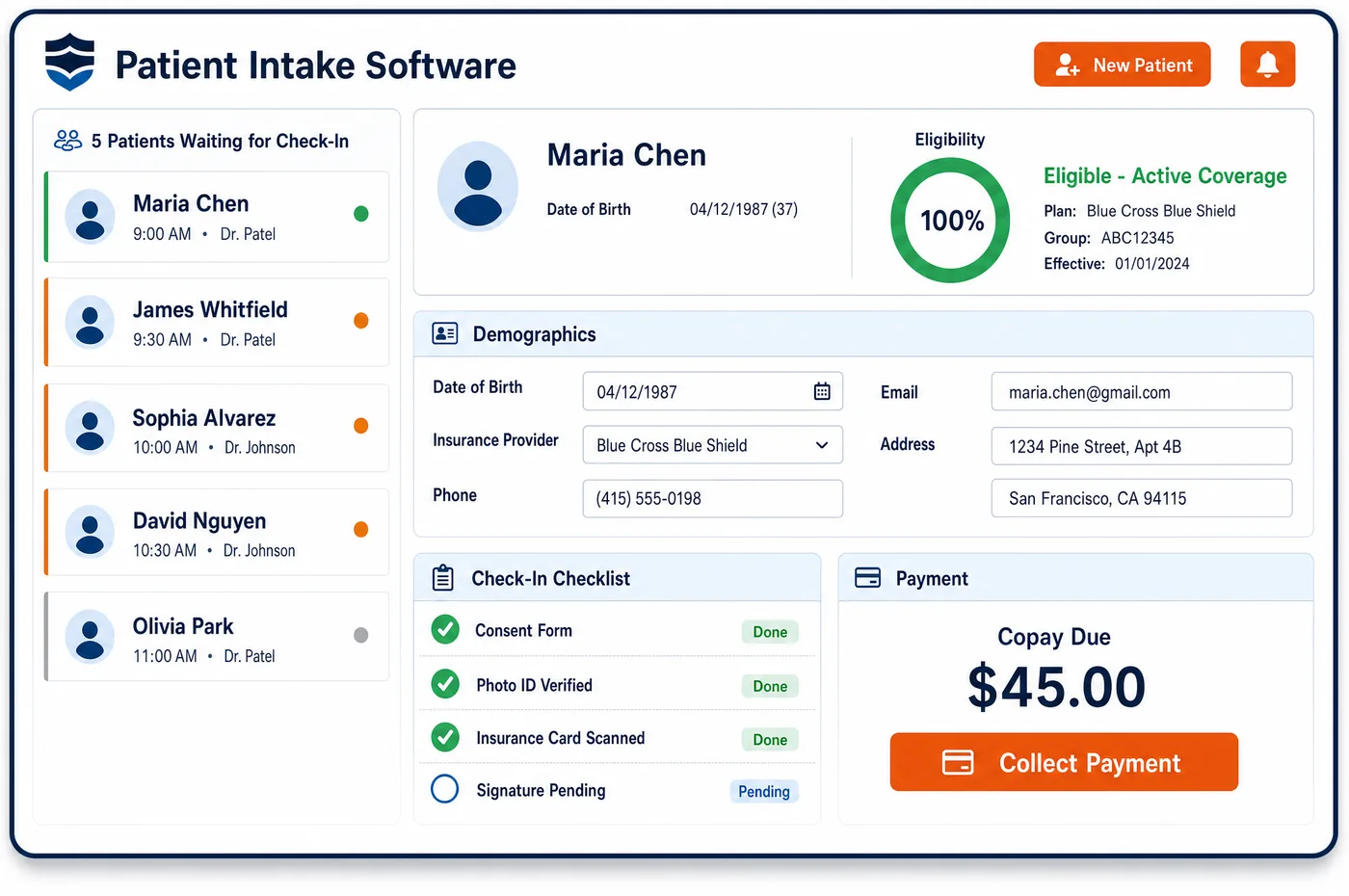
Patient Intake in a Addiction Medicine Practice
Intake in addiction care does more than fill in a chart. It feeds the clinical assessment that decides the level of care, and that assessment is often what a payer reviews before it approves treatment. A typical packet starts with a validated screen such as the AUDIT or DAST. It then asks about each substance used, how it is used, past treatment, overdoses and current medications. Medical, mental health, housing and legal questions follow, since The ASAM Criteria look at the whole person. The patient signs the Part 2 consent and any release to a referring court or clinic. At check-in, staff confirm identity, scan the insurance card and open the visit. Addiction medicine patient intake software saves each answer as a structured field, so the clinician starts the assessment with the history already in front of them.
Why Is Patient Intake Different in Addiction Medicine?
The intake visit is also a billable service, and the rules are tight. A Medicare-enrolled OTP bills intake activities as an add-on, and only for patients starting treatment at that OTP. Medicaid programs often pay a separate assessment code under state Medicaid rules, with limits on how often it can be billed. Intake has to record what was done and by whom, or the visit can't be billed at all.
The questions are sensitive. Patients are asked about drug use, arrests, overdoses and sometimes trauma. Many fear the answers will reach an employer, a court or a family member. Clear consent screens, plain language and the option to finish forms in private all help patients answer honestly, and honest answers lead to the right level of care.
Speed matters for safety. A person in withdrawal or just out of a hospital stay may not come back if intake drags. Collecting history and consent before the visit, then confirming at check-in, lets the clinician start the medical exam sooner. For buprenorphine, that can mean the first dose happens at the first visit, not the second.
What Addiction Medicine Patient Intake Software Handles
- OTP intake add-on (G2076)
- G2076 covers intake activities, including the initial medical exam, a care plan and an optional evidence-based assessment. CMS limits it to new patients starting treatment at the OTP, so intake records whether the patient is new to that program. (Medicare Claims Processing Manual, Chapter 39: Opioid Treatment Programs (Rev. 13572, 2026))
- Starting treatment by video at an OTP
- Since 2025, an OTP may bill G2076 for starting methadone by audio-video when DEA and SAMHSA rules allow it. Buprenorphine can also be started this way. Intake notes the modality, and modifier 95 or 93 follows the claim. (Medicare Claims Processing Manual, Chapter 39: Opioid Treatment Programs (Rev. 13572, 2026))
- Medicaid assessment code (H0001)
- Washington Apple Health covers H0001 once per day for each new and returning client and does not allow updates to be billed as new assessments. Intake marks whether an assessment is new or an update. Other states set their own limits. (Washington Apple Health (Medicaid) Substance Use Disorder Billing Guide, October 2025)
- Validated screens (AUDIT, DAST)
- Medicare SBIRT codes G0396 and G0397 describe a structured assessment using tools such as the AUDIT or DAST. Intake forms can include these screens, and scores are saved for the clinician. (CMS MLN Booklet: Screening, Brief Intervention & Referral to Treatment (SBIRT) Services (MLN904084))
- Multidimensional assessment (The ASAM Criteria)
- The ASAM Criteria assess the patient across six dimensions to choose a level of care. Intake questions are grouped so they feed that assessment directly. (American Society of Addiction Medicine: About The ASAM Criteria)
- Office-based first month (G2086)
- For Medicare, G2086 covers at least 70 minutes of office-based SUD treatment in the first calendar month, including building the treatment plan. Intake time spent on the plan is logged so it counts toward that total. (CMS: Office-Based Substance Use Disorder (SUD) Treatment Billing)
How Does Addiction Medicine Patient Intake Software Work?
1. Send forms before the visit
Once the patient is registered, a secure link goes out by text or email. The patient completes screens, history and consents on their own phone, in private.
2. Screen with validated tools
The packet includes the screens the program uses, such as the AUDIT or DAST. Scores are saved as numbers, so the clinician can compare them later.
3. Gather history by dimension
Questions are grouped by the dimensions of the assessment, from withdrawal and medical needs to mental health and living situation. The answers line up with the level of care decision.
4. Confirm at check-in
Staff confirm identity, scan the insurance card and review any blank answers with the patient. The visit is marked as new or returning for billing.
5. Hand results to the care team
Answers post as structured fields to the clinical record and the patient's treatment record. The clinician sees the history before the exam starts.
Addiction Medicine Patient Intake Software vs. Generic Software
| Area | Generic approach | Unlimited Systems |
|---|---|---|
| Forms | Clipboard forms completed at the front desk before the visit. | Mobile forms finished at home, in private. |
| Screening scores | Written on paper and retyped. | Saved as structured scores on the record. |
| Assessment | Free text with no link to level of care. | Questions grouped to feed the level of care assessment. |
| New or returning | Billing guesses from the chart. | Intake marks new patients and updates clearly. |
| Consent | Signed on paper after the visit starts. | Signed on screen before the patient arrives. |
Who Uses It in a Addiction Medicine Practice
- Intake counselor: A complete history and screen scores before the assessment, so the session can focus on the patient.
- Medical director: Exam-ready charts at the first visit, with medication and overdose history up front.
- Billing team: Clear records of which intake or assessment service was done, by whom and how, ready for booking the next visits and for the claim.
Addiction Medicine Patient Intake Software FAQs
Patient intake in addiction medicine includes validated screening, a substance use and treatment history, medical and mental health history, social needs such as housing, and signed Part 2 consents. It feeds the multidimensional assessment that sets the level of care. Patients can complete most of it on their phone before the visit, and staff confirm the rest at check-in.
A Medicare-enrolled OTP can bill intake activities with add-on code G2076 alongside the weekly bundle. It covers the initial medical exam and the care plan. CMS limits it to patients starting treatment at that OTP, so assessments after intake are billed as periodic assessments instead. Medicaid and commercial rules vary by plan and state.
Under Medicare, an OTP may start buprenorphine by video and, since 2025, methadone too, when DEA and SAMHSA rules allow it at the time. Audio-only is allowed only in narrow cases. The intake record notes how the visit happened, and the claim carries modifier 95 for video or 93 for audio-only.
Screening scores are saved as structured numbers on the patient record, not as scanned pages. The clinician can see the AUDIT or DAST score at the first visit and compare later scores with it. Structured scores also support payer reviews that ask for the basis of a level of care decision.
Patients can finish forms on their own phone, in private, before they arrive. The consent screens explain in plain words who can see the answers and why. Many patients are more open when they are not sitting at a front desk. Staff then review any skipped questions gently at check-in or leave them for the counselor.
Medicaid programs often limit how often an assessment code can be billed. Washington, for example, covers H0001 once per day per client and does not allow updates to be billed as new assessments. Intake marks whether each assessment is new or an update, so billing staff can apply the rule for the patient's state.
Related Addiction Medicine Software
Front office
In the revenue cycle
Patient Intake for related specialties
Sources
- Medicare Claims Processing Manual, Chapter 39: Opioid Treatment Programs (Rev. 13572, 2026)
- Washington Apple Health (Medicaid) Substance Use Disorder Billing Guide, October 2025
- CMS MLN Booklet: Screening, Brief Intervention & Referral to Treatment (SBIRT) Services (MLN904084)
- American Society of Addiction Medicine: About The ASAM Criteria
- CMS: Office-Based Substance Use Disorder (SUD) Treatment Billing
GET STARTED
See Unlimited Systems in Action
Whether you're actively evaluating new technology or simply preparing for your next vendor renewal, Unlimited Systems can help you understand where your current workflows may be creating avoidable revenue risk.