

Front office
Addiction Medicine Financial Clearance Software
Confirm who pays for counseling, medication and testing, secure approvals for injectables and higher levels of care, and give patients a cost they can plan for.
Addiction Medicine Financial Clearance Software confirms, before treatment, which payer covers each part of a patient's care and what the patient will owe. It checks eligibility and benefits and finds carve-outs. It tracks approvals for long-acting injections and intensive care, then builds an estimate. Staff resolve problems before the first dose, not after the first denial.



 6,500+ specialty providers

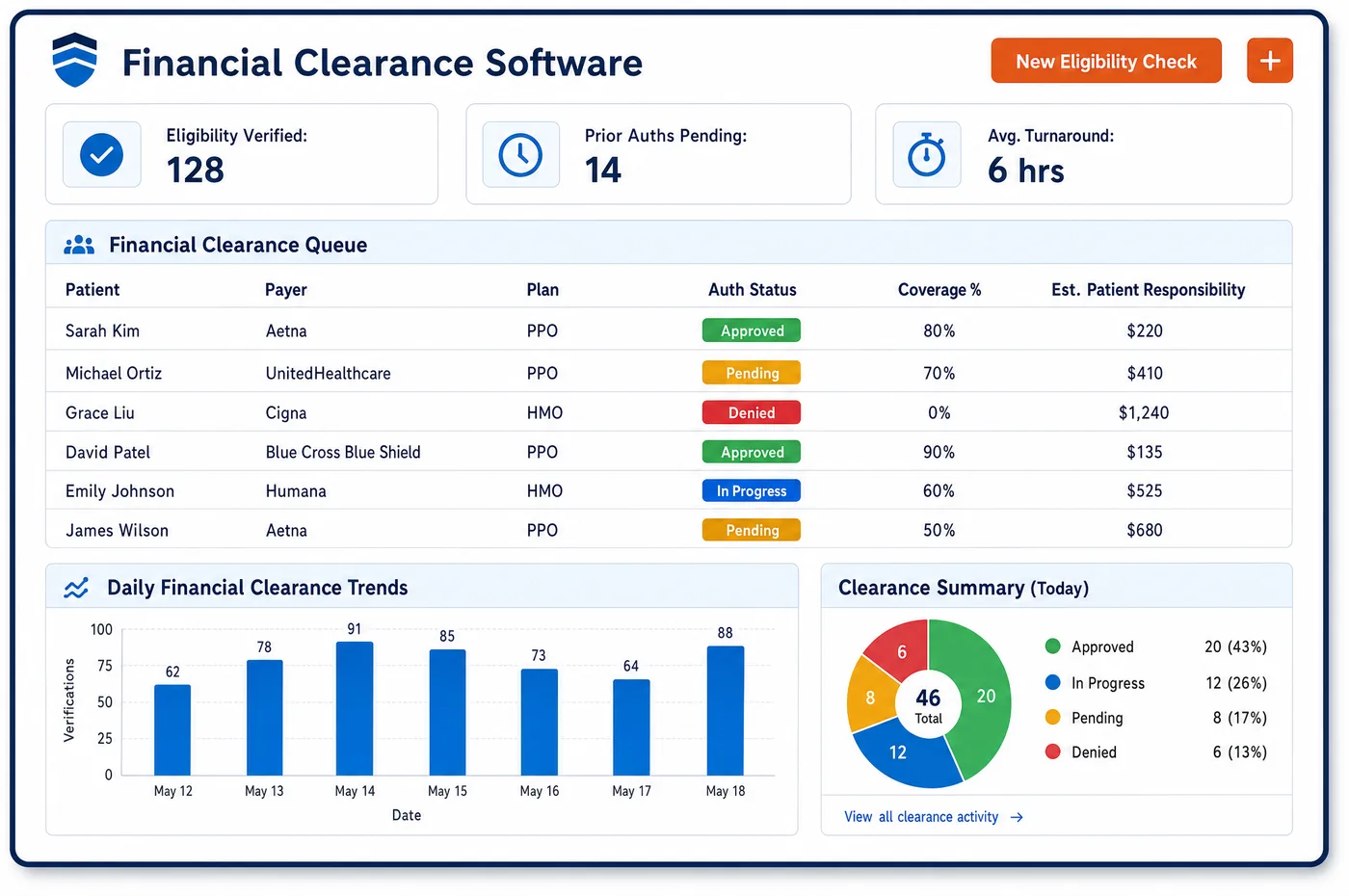
Financial Clearance in a Addiction Medicine Practice
Clearance in addiction care splits one patient into several payment questions. Counseling may be covered by a behavioral health vendor, the office visit by the medical plan, and the medication by a pharmacy benefit or a specialty pharmacy. A long-acting buprenorphine injection usually needs prior approval, and the plan may ask for proof that the patient tolerated buprenorphine first. An intensive outpatient program needs a level of care review, often against The ASAM Criteria. Medicare patients at an OTP owe no copay but still owe the Part B deductible. Uninsured patients are entitled to a good faith estimate. Addiction medicine financial clearance software checks eligibility when the visit is booked. It flags each approval the plan needs and tracks it by units and end date. Staff then share the estimate with the patient before treatment starts.
Why Is Financial Clearance Different in Addiction Medicine?
Medication is where clearance is hardest. A clinician gives long-acting buprenorphine. The plan may cover it as a medical drug, or a specialty pharmacy may ship it under the drug benefit. The answer changes who orders it, who bills it and what the patient pays. Because these products are under a REMS, they can't be handed to the patient to bring in.
Levels of care bring their own approvals. Many states and health plans use The ASAM Criteria to judge the need for intensive outpatient and higher levels of care. Approvals often cover a set number of days or sessions, and a concurrent review is due before they run out. A missed review means unpaid care for a patient who is still in treatment.
Cost is a real barrier to staying in care. Many patients pay a weekly fee, a deductible or a grant-based sliding fee, and a surprise bill can end treatment. A clear estimate at the start, and a fresh one when coverage changes, keeps the money conversation from getting in the way of recovery.
What Addiction Medicine Financial Clearance Software Handles
- Prior approval for long-acting buprenorphine (J0577, J0578, Q9991, Q9992)
- UnitedHealthcare's commercial policy, for example, covers Brixadi and Sublocade for moderate to severe OUD. A patient not on buprenorphine must first show a test dose was tolerated. Clearance attaches that history and the codes to the request. (UnitedHealthcare Commercial Medical Benefit Drug Policy: Buprenorphine (Brixadi and Sublocade), effective October 1, 2026)
- Continuation approvals
- Under the same policy, continued therapy needs documented positive clinical response and dosing that follows the FDA label. Clearance tracks each approval's end date and prompts staff to send the response notes before it lapses. (UnitedHealthcare Commercial Medical Benefit Drug Policy: Buprenorphine (Brixadi and Sublocade), effective October 1, 2026)
- REMS-restricted supply
- The BRIXADI REMS requires certified settings and pharmacies to provide the drug directly to a clinician for administration, never to the patient. Clearance records whether the practice buys the drug or a specialty pharmacy ships it to the setting. (FDA: BRIXADI (buprenorphine) extended-release injection prescribing information, revised 12/2025)
- OTP intensive outpatient certification (G0137)
- For Medicare, a physician or non-physician practitioner must certify that the patient needs at least nine hours of services per week before an OTP bills G0137. Clearance holds the IOP schedule until the certification and plan of care are on file. (Medicare Claims Processing Manual, Chapter 39: Opioid Treatment Programs (Rev. 13572, 2026))
- Office-based medication under Part D
- CMS notes that Medicare drug plans must cover buprenorphine and naltrexone prescribed for OUD in the office setting. Clearance checks the patient's Part D plan separately from Part B, since the visit and the drug are billed apart. (CMS MLN Booklet: Screening, Brief Intervention & Referral to Treatment (SBIRT) Services (MLN904084))
- Good faith estimates for self-pay patients
- Uninsured and self-pay patients have the right to a good faith estimate of expected charges. Clearance builds the estimate from the planned visits, testing and medication, and staff give it to the patient. (CMS No Surprises Act: Understanding Costs in Advance (Good Faith Estimates))
How Does Addiction Medicine Financial Clearance Software Work?
1. Check eligibility at booking
An electronic eligibility request runs when the visit is booked. The response shows the plan, any behavioral health vendor and the patient's deductible and copay.
2. Split the benefits
Staff record which benefit pays for counseling, visits, testing and medication. The medical or pharmacy benefit question for injectables is settled before anything is ordered.
3. Request and track approvals
Prior approval requests go out with the history the plan asks for. Each approval is tracked by units, dates and service, and the addiction medicine scheduler warns staff before a visit goes past it.
4. Build the estimate
Expected charges and the patient's share are added up from the plan's benefits. Self-pay patients get a good faith estimate before the first visit.
5. Recheck when anything changes
A new plan, a lapse or a step to a new level of care sends the patient back through clearance. Staff see the change before the next claim, not after a denial reaches addiction medicine denial management.
Addiction Medicine Financial Clearance Software vs. Generic Software
| Area | Generic approach | Unlimited Systems |
|---|---|---|
| Benefit split | One eligibility check for the whole visit. | Counseling, visits, testing and medication checked one by one. |
| Injectable approvals | Requested after the first claim denies. | Requested and tracked before the drug is ordered. |
| Level of care reviews | Due dates kept on a whiteboard. | Approval end dates tracked with alerts. |
| Supply route | Unclear who orders the injection. | Buy-and-bill or specialty pharmacy route recorded up front. |
| Patient cost | Quoted at the end of the visit, if at all. | Estimate shared before treatment starts. |
Who Uses It in a Addiction Medicine Practice
- Benefits coordinator: One screen that shows which benefit pays for each service and which approvals are open.
- Prescriber: Clear notice of what a plan needs before a long-acting injection, so the first dose isn't delayed by paperwork.
- Patient: A cost they can plan for, given before treatment begins and updated when coverage changes.
Addiction Medicine Financial Clearance Software FAQs
Financial clearance checks eligibility for each payer. It shows which benefit covers counseling, visits, testing and drugs, and whether a service needs prior approval. It also confirms level of care approvals and builds an estimate of what the patient will owe. In addiction care, this often means checking a medical plan, a behavioral health vendor and a pharmacy benefit for the same patient.
Many plans require prior approval for Brixadi and Sublocade. UnitedHealthcare's commercial policy, for example, covers them for moderate to severe OUD and asks for proof that a patient new to buprenorphine tolerated a test dose. Continued use needs a documented positive response. Rules differ by plan, so each request is checked against the patient's own plan policy.
Long-acting buprenorphine is under a REMS, so it can't be dispensed to the patient. The practice either buys the drug and bills it, or a specialty pharmacy ships it to the practice under the pharmacy benefit. The route decides who bills the drug and what the patient owes, so it is settled during clearance.
Medicare charges no copayment for the codes an OTP bills, but the Part B deductible applies. Early in the year, a Medicare patient at an OTP may owe part of the weekly bundle until the deductible is met. Clearance shows the remaining deductible, and staff explain it to the patient up front.
Each intensive outpatient approval is tracked by start date, end date and number of sessions or days allowed. Staff are alerted before a concurrent review is due, so clinical notes can go to the plan in time. When an approval ends, the scheduler stops booking past it until a new one is on file.
Uninsured and self-pay patients can receive a good faith estimate of expected charges before care. The estimate lists the planned visits, testing and any medication the practice will bill. Where the program offers a sliding fee or grant funding, the estimate reflects the patient's share under that policy.
Related Addiction Medicine Software
Front office
In the revenue cycle
Financial Clearance for related specialties
Sources
- UnitedHealthcare Commercial Medical Benefit Drug Policy: Buprenorphine (Brixadi and Sublocade), effective October 1, 2026
- FDA: BRIXADI (buprenorphine) extended-release injection prescribing information, revised 12/2025
- Medicare Claims Processing Manual, Chapter 39: Opioid Treatment Programs (Rev. 13572, 2026)
- CMS MLN Booklet: Screening, Brief Intervention & Referral to Treatment (SBIRT) Services (MLN904084)
- CMS No Surprises Act: Understanding Costs in Advance (Good Faith Estimates)
- American Society of Addiction Medicine: About The ASAM Criteria
GET STARTED
See Unlimited Systems in Action
Whether you're actively evaluating new technology or simply preparing for your next vendor renewal, Unlimited Systems can help you understand where your current workflows may be creating avoidable revenue risk.