

Front office
Psychiatry Financial Clearance Software
Check behavioral health benefits, visit limits and approvals for TMS, Spravato and other psychiatric care before it starts.
Psychiatry Financial Clearance Software confirms that a psychiatric visit or treatment course is covered before it happens. It checks eligibility with the right payer and tracks visit limits and approvals for TMS and Spravato. It also gives patients a cost estimate for each evaluation, medication visit or therapy session.



 6,500+ specialty providers

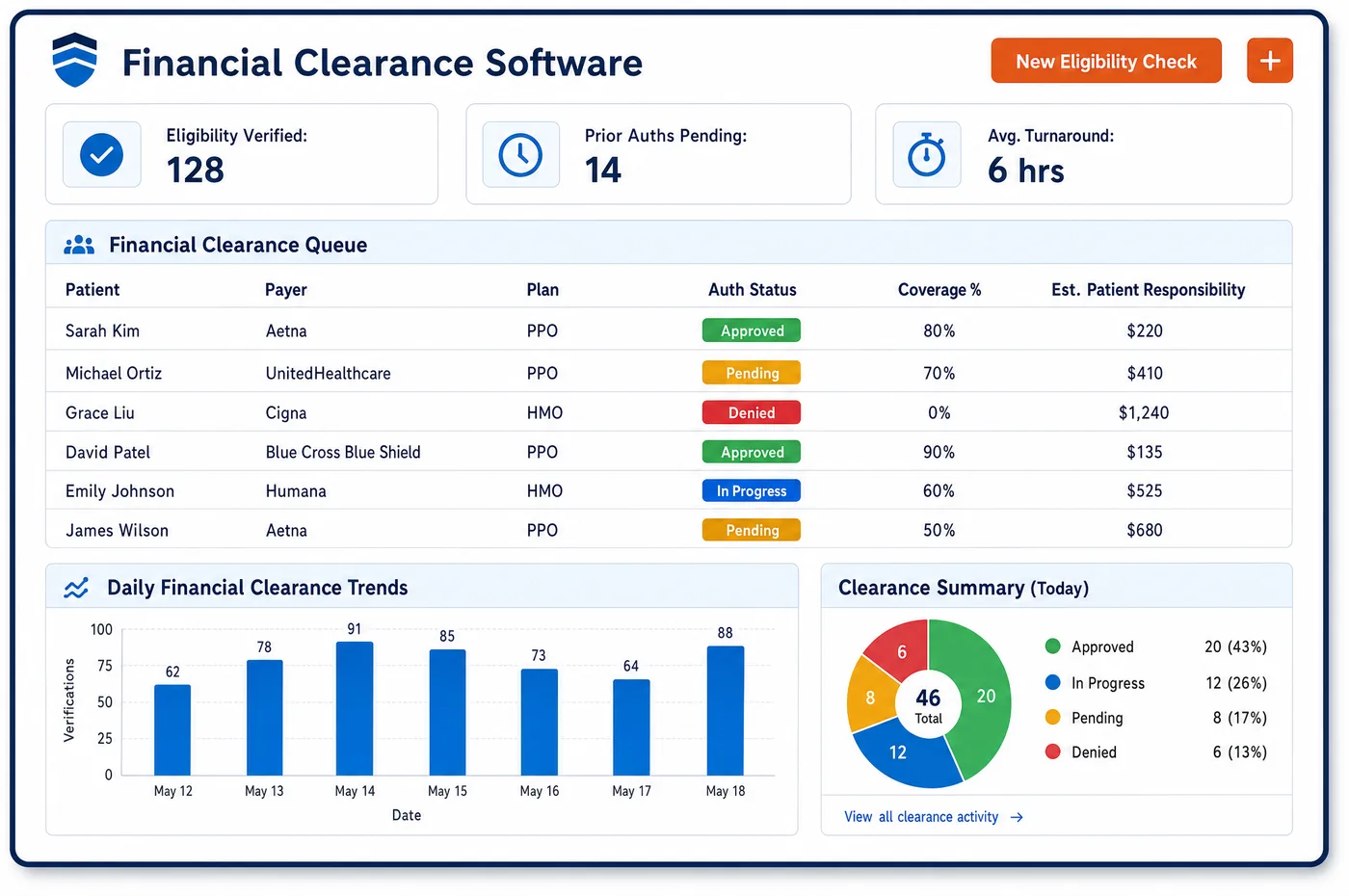
Financial Clearance in a Psychiatry Practice
Clearance in psychiatry starts with the right payer. An eligibility check at booking asks about mental health and psychotherapy benefits by service type code. If a separate behavioral health company manages those benefits, the check runs again with that company. The reply shows copays, deductibles and any visit limits. Next, staff see whether the service needs prior authorization. Routine medication visits often don't. A TMS course, Spravato treatment, an intensive outpatient program or psychological testing often does. Requests go out with the detail the payer asks for, and the approval number, approved sessions and end date are stored on the booking. Patients then get an estimate of what they will owe, and self-pay patients get a good faith estimate. When an authorization is pending or close to running out, psychiatry financial clearance software holds the next booking and alerts staff.
Why Is Financial Clearance Different in Psychiatry?
Mental health benefits often sit with a different company than the medical plan. That company runs its own eligibility, its own authorization rules and its own claims address. A check sent only to the medical plan can come back active while the psychiatric benefit is managed somewhere else. The visit then goes ahead on the wrong assumption, and the behavioral health payer never hears about it.
Treatment courses raise the stakes. A TMS course is a series of sessions approved as a block, and payers usually want proof of treatment-resistant depression first. Spravato adds a REMS-certified setting on top of payer approval. Long-acting injectables may fall under the medical or the pharmacy benefit, depending on the plan. Each needs prior authorization checked before the first session, and counted after it.
Patient cost is also less predictable. Behavioral health copays and deductibles can differ from medical ones, and some plans set visit limits. Federal parity law limits how much stricter mental health rules can be than medical rules, but payers still differ. Many psychiatric patients pay out of pocket or see clinicians outside their network. That is why financial clearance in psychiatry covers cost, not just coverage.
What Psychiatry Financial Clearance Software Handles
- Psychotherapy and mental health benefit checks (service types A6, MH)
- Clearance asks about psychotherapy and mental health benefits by service type, not just medical coverage. Copays, deductibles and visit limits are saved on the booking. (X12 Service Type Codes (used in 270/271 eligibility transactions))
- Prior authorization request (X12 278)
- Requests for TMS, Spravato or intensive outpatient care can go out as electronic 278 transactions. The approval number, approved units and end date are tied to the booking. (X12 Transaction Sets: 270/271 Eligibility, 278 Authorization, 837 Claims)
- TMS diagnosis criteria (90867, 90868)
- One Medicare contractor's billing article lists F32.2 and F33.2 as the diagnoses that support TMS codes. Clearance checks the diagnosis on the request before the mapping session (90867) and treatment sessions (90868) are booked. (CMS Medicare Coverage Database, Billing and Coding Article A57072: Transcranial Magnetic Stimulation)
- Spravato REMS-certified setting
- Spravato is available only through its REMS, and the treating setting must be certified. Clearance confirms setting certification and patient enrollment, along with any payer approval, before the first dose is booked. (SPRAVATO REMS (FDA-required Risk Evaluation and Mitigation Strategy))
- Benefit maximum reached (CARC 119)
- When a plan caps visits, a claim past the cap comes back with reason code 119. Clearance tracks visits used against the limit, so staff can ask for more visits or talk with the patient first. (X12 Claim Adjustment Reason Codes)
- Mental health parity (MHPAEA)
- Parity law limits how much stricter a plan's mental health limits can be than its medical ones. Authorization and denial patterns can be reported by payer, which helps the practice spot rules that differ from medical benefits. (CMS: The Mental Health Parity and Addiction Equity Act (MHPAEA))
- Good faith estimate for self-pay patients
- Uninsured and self-pay patients are owed a good faith estimate of expected charges when they schedule. Clearance builds it from the booked services, such as an evaluation and the follow-up visits planned after it. (CMS No Surprises Act: Understanding Costs in Advance (Good Faith Estimates))
How Does Psychiatry Financial Clearance Software Work?
1. Check eligibility at booking
Eligibility runs when the visit is booked, against both the medical plan and any behavioral health payer. Copays, deductibles and visit limits come back before the patient is seen.
2. Flag what needs approval
The booked service is checked against payer rules. TMS, Spravato, intensive outpatient care and psychological testing are flagged when the payer requires approval.
3. Request and record the approval
Requests go out with the clinical detail the payer asks for, such as prior medication trials. The approval number, approved sessions and end date are stored on the booking.
4. Estimate what the patient owes
Staff share a patient cost estimate for the visit or the whole course. Self-pay patients receive a good faith estimate, and out-of-network patients learn how superbills work.
5. Hold bookings when coverage lapses
If an authorization is pending or about to run out, psychiatric scheduling holds the next session and alerts staff. Patients aren't treated against coverage that no longer exists.
Psychiatry Financial Clearance Software vs. Generic Software
| Area | Generic approach | Unlimited Systems |
|---|---|---|
| Payer checked | Only the medical plan is checked. | The medical and behavioral health payers are both checked. |
| TMS and Spravato courses | Sessions continue after the approval runs out. | Approved sessions are counted and bookings held at the limit. |
| Visit limits | Limits are found when a claim denies. | Visits used are tracked against the plan limit. |
| Self-pay estimates | Prices are quoted verbally at the front desk. | Good faith estimates are built from the booked services. |
| Authorization requests | Faxed forms and phone calls. | Electronic 278 requests with approvals saved to the booking. |
Who Uses It in a Psychiatry Practice
- Authorization coordinator: One queue of psychiatric services that need approval, with approved sessions and end dates tracked for each course.
- Front desk: Copays and estimates ready before check-in, including the behavioral health copay when it differs from the medical one.
- Practice owner: Fewer write-offs on TMS and Spravato courses, and payer reports that feed psychiatric denial management with the rules that are hardest to meet.
Psychiatry Financial Clearance Software FAQs
Psychiatry financial clearance software checks eligibility with the payer that manages the mental health benefit. That may be a separate behavioral health company. It records copays, deductibles and visit limits, and flags services that need approval, such as TMS or Spravato. It also tracks approved sessions and gives patients a cost estimate before care begins.
Many payers require prior authorization for a TMS course and ask for proof of treatment-resistant major depression, such as failed medication trials. Clearance flags the request at booking, sends it with the needed detail, and stores the approval. It then counts each treatment session against the approved number so the course does not run past it.
Spravato clearance has two parts. The treating setting must be certified in the Spravato REMS, and outpatients must be enrolled in it. The payer must also approve the treatment where its policy requires that. Clearance confirms both before the first session is booked, then tracks each session against the approval on file.
When a plan caps visits, clearance tracks how many have been used against the limit. Staff see the count before each booking, so they can ask the payer for more visits or talk with the patient about cost. Without that tracking, the first sign is often a claim denied with reason code 119, benefit maximum reached.
Self-pay and uninsured patients are owed a good faith estimate under the No Surprises Act when they schedule care. Clearance builds the estimate from the booked services, for example a diagnostic evaluation followed by medication visits. Out-of-network patients can also learn how superbills work before their first visit.
Long-acting injectable antipsychotics may be covered under the medical benefit or the pharmacy benefit, depending on the plan. Financial clearance checks which benefit applies and whether prior authorization is needed before the injection visit is booked. The approval and drug details are stored with the booking, so the visit and the drug can both be billed.
Related Psychiatry Software
Front office
In the revenue cycle
Financial Clearance for related specialties
Sources
- X12 Service Type Codes (used in 270/271 eligibility transactions)
- X12 Transaction Sets: 270/271 Eligibility, 278 Authorization, 837 Claims
- CMS Medicare Coverage Database, Billing and Coding Article A57072: Transcranial Magnetic Stimulation
- SPRAVATO REMS (FDA-required Risk Evaluation and Mitigation Strategy)
- X12 Claim Adjustment Reason Codes
- CMS: The Mental Health Parity and Addiction Equity Act (MHPAEA)
- CMS No Surprises Act: Understanding Costs in Advance (Good Faith Estimates)
GET STARTED
See Unlimited Systems in Action
Whether you're actively evaluating new technology or simply preparing for your next vendor renewal, Unlimited Systems can help you understand where your current workflows may be creating avoidable revenue risk.