

Front office
Psychiatry Patient Management Software
One psychiatric record that follows each patient from the first evaluation through medication management, therapy and treatment courses.
Psychiatry Patient Management Software is the single record a psychiatric patient carries from the first evaluation onward, through every medication visit and therapy course. It holds the evaluation, medication and therapy history, rating scale scores and consents. It also stores the behavioral health payer and treatment courses such as TMS or Spravato, so every team sees the same patient.



 6,500+ specialty providers

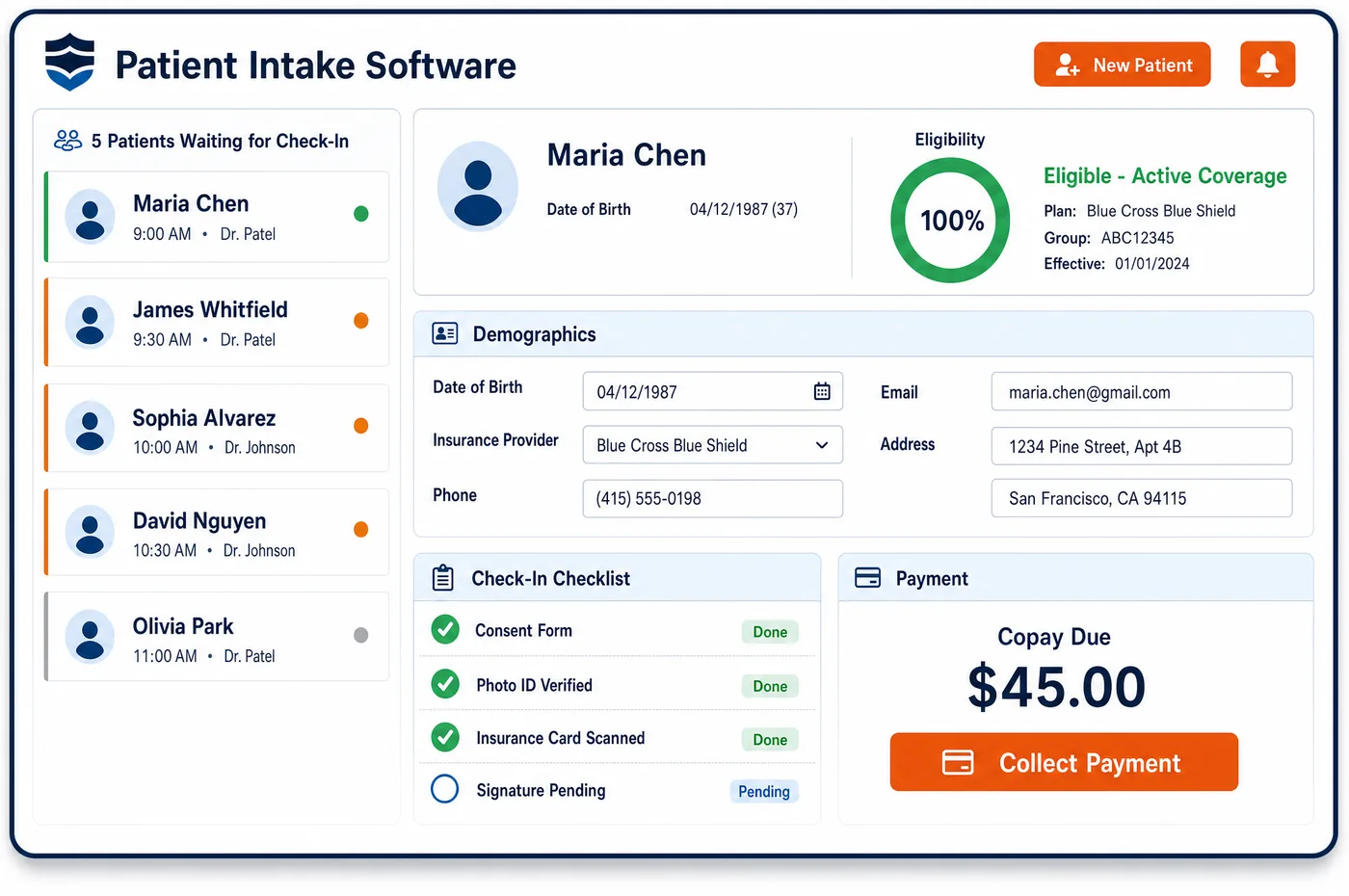
Patient Management in a Psychiatry Practice
A psychiatric patient often starts with a diagnostic evaluation (90791 or 90792). Then come medication visits billed as E/M, with or without psychotherapy add-on time. Some also see a therapist in the same group, start a course of TMS, or receive Spravato in a certified setting. Psychiatry patient management software ties all of that to one record. Each episode shows who is treating and which payer covers the behavioral health benefit. It also shows open authorizations and how scores have moved. Consents travel with the record too: a release to talk with the primary care doctor, telehealth consent, and any 42 CFR Part 2 consent for substance use disorder records. When the patient calls, the front desk, the clinician and the billing team open the same view. Nobody has to rebuild the story from a scanned chart or a side spreadsheet.
Why Is Patient Management Different in Psychiatry?
Psychiatric care is long-running and layered. One patient may see a psychiatrist for medication management, a therapist for weekly psychotherapy, and a care team for a TMS course, all in the same group. Each service has its own codes, its own clinician type and often its own authorization. A patient record built for one-off visits loses the thread between them.
Coverage is split more often than in other specialties. Many health plans hand mental health benefits to a separate company with its own member ID, claims address and authorization rules. The record has to hold both the medical plan and the behavioral health carve-out, and know which one pays for which service. That split is first captured at patient registration, but it has to stay right for as long as the patient is in care.
Privacy rules are also stricter. Records from a federally assisted substance use disorder program fall under 42 CFR Part 2, which adds its own consent and redisclosure rules on top of HIPAA. Psychotherapy notes, safety plans and crisis follow-up need careful access control. Patient management in psychiatry means showing each role what it needs, and logging who looked.
What Psychiatry Patient Management Software Handles
- Psychiatric diagnostic evaluation (90791, 90792)
- The evaluation opens the episode. The record notes whether it was 90791, without medical services, or 90792, with medical services, so later medication and therapy visits link back to it. (CMS MLN Booklet: Medicare & Mental Health Coverage (MLN1986542))
- 42 CFR Part 2 consent
- Substance use disorder records from a Part 2 program carry a consent flag on the patient record. Staff can see whether a single consent for treatment, payment and health care operations is on file before records are shared, and each access is logged in the audit trail. (eCFR: 42 CFR Part 2, Confidentiality of Substance Use Disorder Patient Records)
- Psychiatric collaborative care (99492, 99493, 99494)
- Some psychiatrists act as the consultant to a primary care team. The record shows that care episode, its registry status and the rating scales the care manager tracks. (CMS MLN Booklet: Behavioral Health Integration Services (MLN909432))
- TMS treatment course (90867, 90868, 90869)
- A TMS course shows as one episode: the initial mapping session (90867), each treatment session (90868) and any motor threshold re-check (90869). Session counts sit next to the authorization, so staff can see how many remain. (CMS Medicare Coverage Database, Billing and Coding Article A57072: Transcranial Magnetic Stimulation)
- Spravato REMS enrollment
- Spravato may only be given in a REMS-certified setting, and outpatients must be enrolled in the program. The record keeps the enrollment status beside each treatment session, so a gap is plain to see. (SPRAVATO REMS (FDA-required Risk Evaluation and Mitigation Strategy))
- Safety planning and follow-up contacts (G0560, G0544)
- Safety planning and post-discharge follow-up calls become part of the patient's history. The record notes the safety plan and the patient consent Medicare requires before or during the first follow-up call. (CMS MLN Booklet: Medicare & Mental Health Coverage (MLN1986542))
How Does Psychiatry Patient Management Software Work?
1. Open the episode at the first evaluation
The diagnostic evaluation starts a psychiatric episode on the record. The treating clinician, diagnosis and plan of care are attached, and the payer that manages the behavioral health benefit is confirmed.
2. Link every service to the episode
Medication visits, therapy, group sessions and treatment courses all post to the same episode. Staff see the full course of care without opening separate charts.
3. Keep consents and releases current
Releases of information, telehealth consent and Part 2 consent are stored on the record with their dates. Forms collected during psychiatry patient intake feed them in, and they are refreshed when a patient returns after a break in care.
4. Track scores and treatment response
Rating scale results such as the PHQ-9 and GAD-7 are stored with the visit they came from. Clinicians and care managers see the trend across the episode, not just the latest score.
5. Close or hand off the episode
When the patient finishes a course, moves to a therapist, or returns to primary care, the episode is closed with a reason. Open balances and authorizations stay visible, so nothing is lost at the hand-off.
Psychiatry Patient Management Software vs. Generic Software
| Area | Generic approach | Unlimited Systems |
|---|---|---|
| Care across services | Medication visits, therapy and TMS live in separate schedules and charts. | One record links every service to the psychiatric episode. |
| Behavioral health payer | Only the medical plan is stored, and carve-out details hide in free-text notes. | The medical plan and the behavioral health payer both sit on the record. |
| Part 2 records | Substance use records are shared like any other chart. | Part 2 consent is flagged and every access is logged. |
| Treatment courses | TMS and Spravato sessions are counted by hand. | Sessions are counted against the authorization on the record. |
| Outcome scores | PHQ-9 results are scanned in as images. | Scores are stored as data and trended across visits. |
Who Uses It in a Psychiatry Practice
- Front desk: One screen with the patient's current payers, consents and next visits, so calls get answered without digging through notes.
- Psychiatrist or nurse practitioner: The full course of care in one place: evaluation, medication changes, therapy, treatment courses and score trends.
- Practice administrator: Role-based access and an audit trail that show who opened sensitive records, which supports HIPAA and Part 2 reviews.
Psychiatry Patient Management Software FAQs
Psychiatry patient management software tracks the whole episode on one record. That includes the evaluation, medication visits, therapy, group sessions and courses such as TMS or Spravato. It also holds both payers, open authorizations, consents and score trends over time. A caller gets the same answer from the front desk, the clinician and the biller.
Records from a federally assisted substance use disorder program are covered by 42 CFR Part 2. On the patient record, Part 2 information carries a consent flag. It shows whether the patient has signed a consent, such as a single consent for treatment, payment and health care operations. Role-based permissions limit who can open it, and the audit trail logs each access.
A therapist and a psychiatrist in the same group can share one patient record. Psychotherapy sessions and medication management visits link to the same episode, while each clinician's notes stay under their own name. Medicare now enrolls marriage and family therapists and mental health counselors. Many groups now bill for several types of clinician on one shared record.
When a health plan hands mental health benefits to a separate company, the record stores both the medical plan and the behavioral health payer, each with its own member ID. Each service is tied to the payer that covers it. That keeps psychotherapy and medication visits from going to the wrong plan, and makes payer changes easy to spot across the episode.
Treatment courses appear as one episode on the record. For TMS, staff see the initial mapping session, each treatment session and the count left on the authorization. For Spravato, the record keeps the REMS enrollment status and each session. Alerts warn staff before a course runs past the number of sessions the payer authorized.
Telepsychiatry visits sit on the same record as in-person visits, with the place of service and the audio-video or audio-only mode noted. That history matters for Medicare. Under current law, its in-person visit rule for home mental health telehealth is set to apply to services after December 31, 2027. In-person visit dates need to be easy to find.
Related Psychiatry Software
Front office
Patient Management for related specialties
Sources
- CMS MLN Booklet: Medicare & Mental Health Coverage (MLN1986542)
- eCFR: 42 CFR Part 2, Confidentiality of Substance Use Disorder Patient Records
- CMS MLN Booklet: Behavioral Health Integration Services (MLN909432)
- CMS Medicare Coverage Database, Billing and Coding Article A57072: Transcranial Magnetic Stimulation
- SPRAVATO REMS (FDA-required Risk Evaluation and Mitigation Strategy)
- CMS Medicare Telehealth FAQ
GET STARTED
See Unlimited Systems in Action
Whether you're actively evaluating new technology or simply preparing for your next vendor renewal, Unlimited Systems can help you understand where your current workflows may be creating avoidable revenue risk.