

Front office
Psychiatry Patient Registration Software
Capture identity, guarantor, the medical plan and the behavioral health payer correctly before the first psychiatric evaluation.
Psychiatry Patient Registration Software captures who the patient is and who pays before the first evaluation. It records identity, guarantor, the medical plan and any separate behavioral health payer, and it checks for duplicate records. It also notes self-pay status and the patient's home address for telepsychiatry visits.



 6,500+ specialty providers

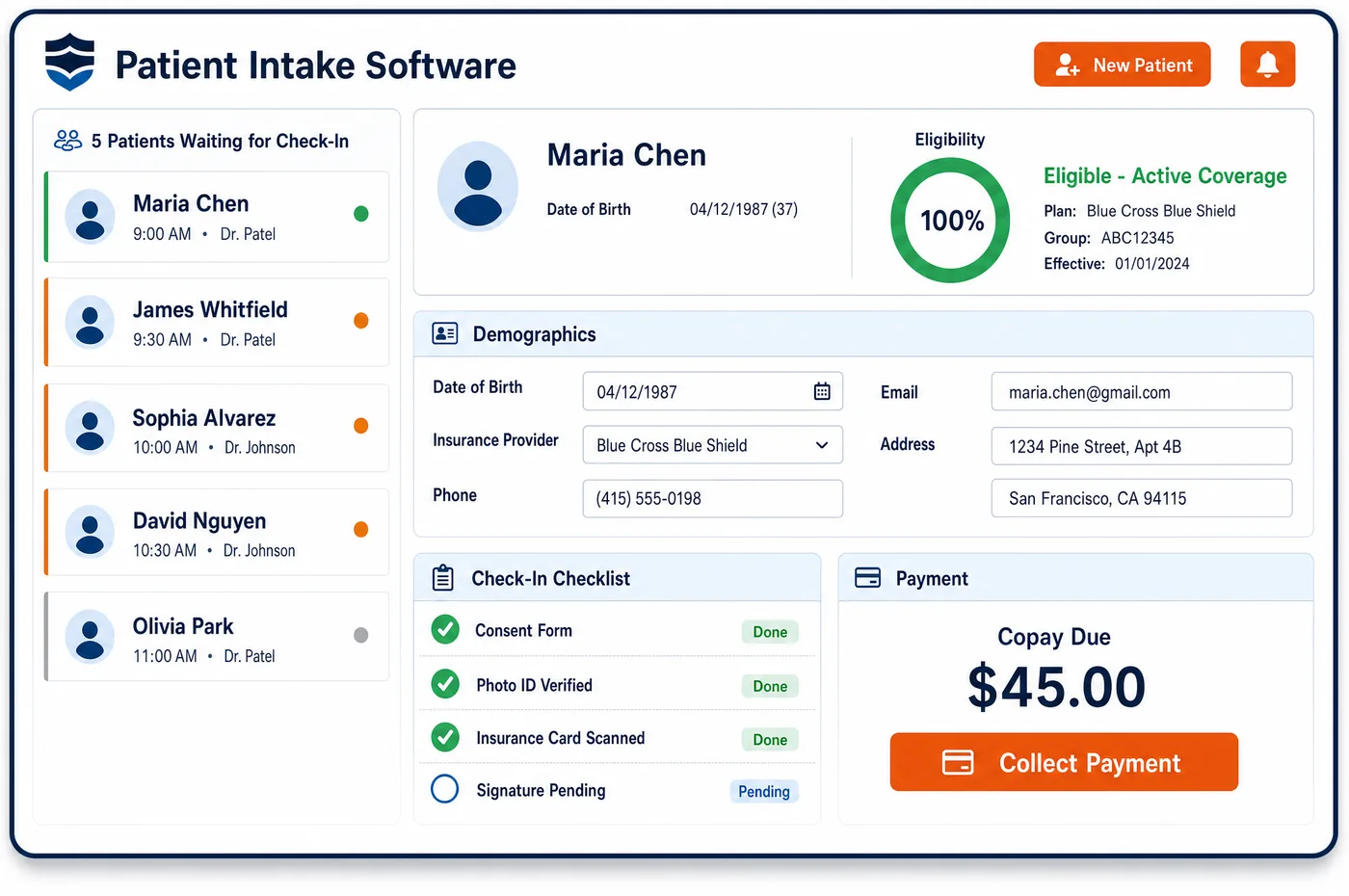
Patient Registration in a Psychiatry Practice
Registration in a psychiatric practice starts with a search. Duplicate detection flags a likely match before a second record is made. That matters for patients who return after years away or who use a chosen name. Staff then enter identity, address and guarantor. For a minor, the guarantor is usually a parent or legal guardian, and two households may mean two plans. Next comes coverage. The medical plan goes in first, then any behavioral health company that manages mental health benefits for that plan, each with its own member ID. An eligibility check runs as the coverage is saved, so typos show up right away. Last, staff record how the patient will pay: insurance, self-pay, or out-of-network with a superbill. Psychiatry patient registration software keeps all of this on one record that intake, scheduling and billing then share.
Why Is Patient Registration Different in Psychiatry?
Psychiatric patients often carry two insurance identities. The medical plan is on the front of the card, but a separate company may manage mental health benefits under its own member ID. If registration captures only the medical plan, every therapy and medication claim can go to the wrong payer. The fix starts at sign-up, not in billing.
Identity and guarantor details also need care. Child and adolescent care brings in parents, guardians and sometimes two households with two plans. Then coordination of benefits decides which plan pays first. Adults may use a chosen name that differs from the insurance card. A clean master patient index keeps these patients from being split into two records, which would scatter their history across psychiatric patient management views.
Self-pay and out-of-network care is common in psychiatry, and some practices do not contract with insurers at all. Patient registration has to record how each patient pays, whether a good faith estimate is due, and whether the patient will want a superbill. Telepsychiatry adds one more field that matters: where the patient will be during the visit.
What Psychiatry Patient Registration Software Handles
- Mental health service type codes (MH, A4, A6, A8)
- At registration, the eligibility check asks about each mental health benefit by its service type code. If the reply points to another company for those benefits, staff add that payer to the record. (X12 Service Type Codes (used in 270/271 eligibility transactions))
- Eligibility inquiry and response (X12 270/271)
- A 270 inquiry goes out as soon as coverage is entered. The 271 eligibility response confirms the member is active and fills in plan details, so a mistyped member ID is caught before the first visit. (X12 Transaction Sets: 270/271 Eligibility, 837 Claims, 835 Remittance)
- Medicare Advantage mental health benefits
- Medicare Advantage plans cover Part B mental health services and may add benefits such as wider telehealth. Registration records the plan as Medicare Advantage rather than Original Medicare, so claims go to the plan and not the MAC. (CMS MLN Booklet: Medicare & Mental Health Coverage (MLN1986542))
- 42 CFR Part 2 program status
- If the patient is treated in a Part 2 substance use disorder program, registration sets that flag on the record from the start. Part 2 consent and redisclosure rules then follow every record the program creates. (eCFR: 42 CFR Part 2, Confidentiality of Substance Use Disorder Patient Records)
- Telehealth place of service (POS 02, POS 10)
- Registration stores the patient's home address and whether video visits will happen there. That supports POS 10 for telehealth in the patient's home, and POS 02 when the patient joins from somewhere else. (CMS Place of Service Code Set)
- Self-pay status and the good faith estimate
- When a patient is marked uninsured or self-pay, staff know a good faith estimate is due under the No Surprises Act. The patient's payment method, such as a card on file, is recorded on the account at the same time. (CMS No Surprises Act: Understanding Costs in Advance (Good Faith Estimates))
How Does Psychiatry Patient Registration Software Work?
1. Search before creating a record
Staff search by name, date of birth and phone before adding anyone. Duplicate detection flags a likely match, so a returning patient keeps one record and one history.
2. Capture identity and guarantor
Legal name, chosen name, address and contact details are entered once. For minors, the parent or guardian is set as guarantor, with custody notes in custom fields where the practice needs them.
3. Enter both payers
The medical plan goes in as one coverage line and the behavioral health payer as another, each with its own member ID. Secondary coverage, such as Medicaid behind a commercial plan, is entered in order.
4. Check coverage as it is saved
An eligibility check runs on each coverage line. Inactive plans and mismatched member details come back to staff while the patient is still on the phone.
5. Set flags and hand off
Site, Part 2 status and payment method are set before the record is saved. The record then moves to psychiatry patient intake for forms, history and consents.
Psychiatry Patient Registration Software vs. Generic Software
| Area | Generic approach | Unlimited Systems |
|---|---|---|
| Duplicate records | A second chart is made when a returning patient's name has changed. | Duplicate detection flags a likely match before a new record is saved. |
| Carve-out coverage | Only the medical plan is entered at sign-up. | The behavioral health payer is entered as its own coverage line. |
| Guarantor for minors | The patient is listed as their own guarantor. | A parent or guardian is the guarantor, with each household's plan in order. |
| Self-pay patients | Self-pay status is noted in a comment. | Self-pay status and payment method are set on the account. |
| Multi-site search | Staff scroll through every location's patients. | Location-based security narrows search to the user's own sites. |
Who Uses It in a Psychiatry Practice
- Front desk and intake staff: A registration screen with room for both payers, the guarantor and the payment method, plus a warning when the patient may already exist.
- Billing manager: Fewer wrong-payer and eligibility denials, because the behavioral health payer and member ID were right before the first claim.
- Practice owner: One clean record per patient across every site and clinician, which keeps history, balances and reports accurate.
Psychiatry Patient Registration Software FAQs
Many health plans hand mental health benefits to a separate behavioral health company. That company has its own member ID, payer ID and claims address. Psychiatry patient registration records the medical plan and the behavioral health payer as two coverage lines, so psychotherapy, evaluation and medication claims go to the payer that actually covers them.
Duplicate patient detection compares a new registration against existing demographics and flags a likely match before a second record is created. Staff can open the existing record instead. This matters in psychiatry because patients may return after a long gap, change their name, or use a chosen name that differs from the one on their insurance card.
For a minor, the guarantor is usually a parent or legal guardian, not the patient. When parents live apart, each may carry a plan, and coordination of benefits rules decide which plan is primary. Registration stores each guardian, each plan and the order of coverage, so claims and statements reach the right adult.
Self-pay and out-of-network patients are set up at registration with their payment method on the account, such as a card on file. Marking a patient as uninsured or self-pay also tells staff that a good faith estimate is due under the No Surprises Act. Patients who plan to seek out-of-network payment can be set up for a superbill.
Medicare uses place of service 10 when the patient is at home for a telehealth visit and 02 when they join from somewhere else. Registration stores the home address so the right code can be set. The patient's location also matters for state licensure, since the clinician generally must be licensed where the patient is.
When a patient enters a federally assisted substance use disorder program, registration sets a 42 CFR Part 2 flag on the record. From then on, the Part 2 consent and redisclosure rules apply to those records. Role-based permissions limit who can open them, and the audit trail shows who did.
Related Psychiatry Software
Front office
In the revenue cycle
Patient Registration for related specialties
Sources
- X12 Service Type Codes (used in 270/271 eligibility transactions)
- X12 Transaction Sets: 270/271 Eligibility, 837 Claims, 835 Remittance
- CMS MLN Booklet: Medicare & Mental Health Coverage (MLN1986542)
- eCFR: 42 CFR Part 2, Confidentiality of Substance Use Disorder Patient Records
- CMS Place of Service Code Set
- CMS No Surprises Act: Understanding Costs in Advance (Good Faith Estimates)
GET STARTED
See Unlimited Systems in Action
Whether you're actively evaluating new technology or simply preparing for your next vendor renewal, Unlimited Systems can help you understand where your current workflows may be creating avoidable revenue risk.