

Front office
Psychiatry Patient Scheduling Software
Book evaluations, medication visits, timed therapy, TMS and Spravato at the length, room and modality each one needs.
Psychiatry Patient Scheduling Software books each psychiatric visit at the length and in the room it needs. Diagnostic evaluations, medication follow-ups, timed psychotherapy, group sessions, TMS courses and Spravato treatments each get their own visit type. Video visits are flagged as telepsychiatry, so the right place of service follows the visit to billing.



 6,500+ specialty providers
Patient Scheduling in a Psychiatry Practice
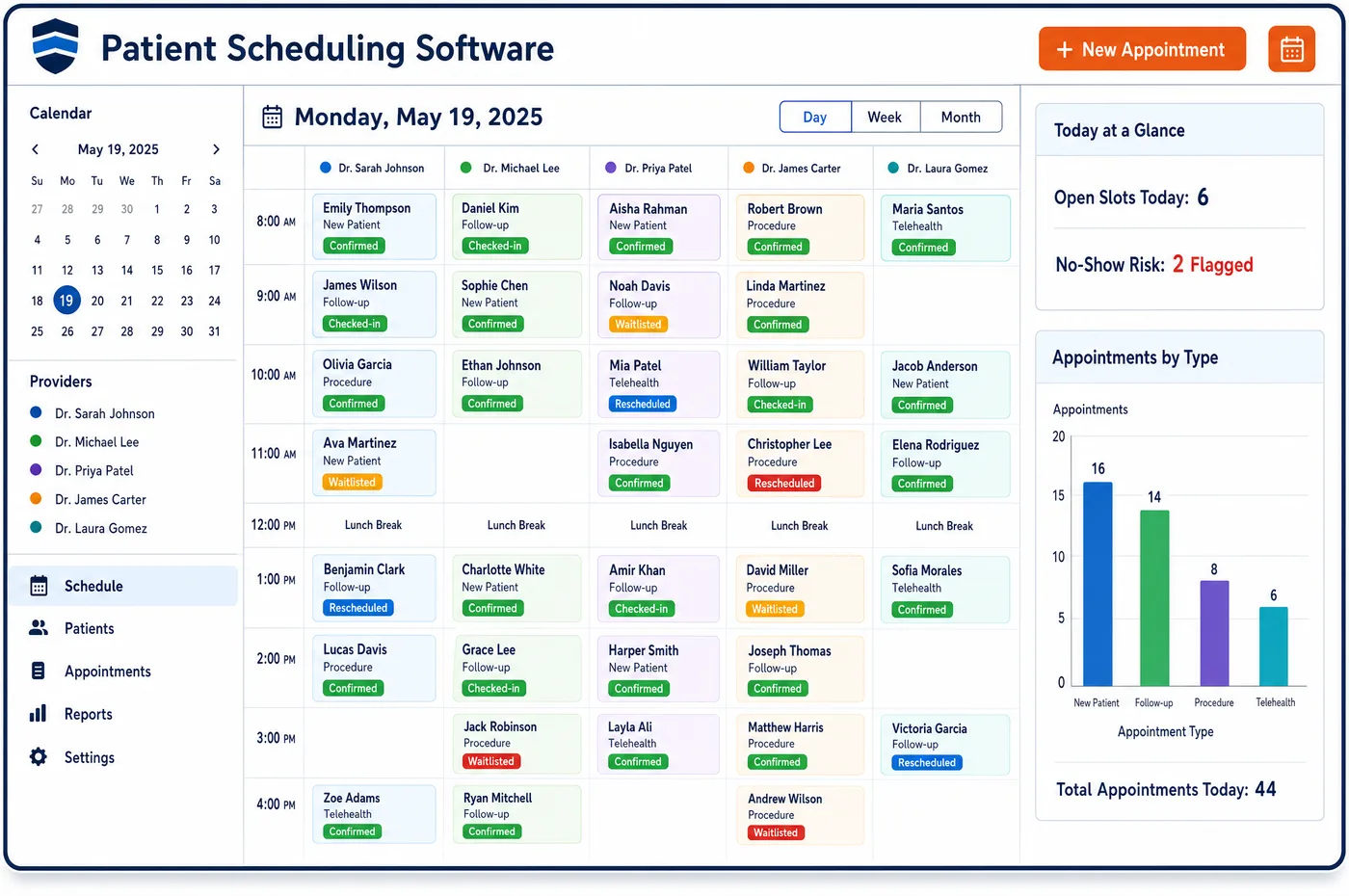
A psychiatric schedule mixes very different visits. A new evaluation (90791 or 90792) needs a long slot. A medication follow-up may be short, or longer when psychotherapy add-on time is planned. Timed therapy has to fit the code the clinician means to bill, since 90834 covers 38 to 52 minutes and 90837 starts at 53. A TMS course books a run of treatment sessions on one device. A Spravato visit holds a monitored room and staff for the observation period. Psychiatry patient scheduling software sets each of these up as a visit type with its own length, provider, room and equipment. Video visits get a secure link and a telehealth flag. Reminders go out by text or email, and a waitlist offers open slots when patients cancel. That matters because a missed psychiatric visit is also missed care.
Why Is Patient Scheduling Different in Psychiatry?
The length of a visit often decides the code in psychiatry. A therapy session that ends a few minutes short can drop to a lower code. A medication visit with planned therapy needs room for both the E/M work and separate therapy time. One slot length for every visit type either wastes time or forces rushed sessions that the note can't support.
Some psychiatric treatments also need rooms and equipment, not just a clinician. TMS uses a device and a trained operator for a course of sessions. Spravato needs a certified setting, a room where the patient can be watched, and staff to monitor them until they are cleared to leave. A scheduler that only knows provider names will double-book the device or the observation room.
Telepsychiatry adds its own rules. Video visits need a secure link and the right place of service for a video visit, based on where the patient will be. The clinician generally needs a license in the patient's state, so an open slot isn't open to every patient. Patient scheduling in psychiatry has to know who can see whom, where and how.
What Psychiatry Patient Scheduling Software Handles
- Timed psychotherapy (90832, 90834, 90837)
- Session lengths are set to the time bands, where 90832 covers 16 to 37 minutes, 90834 covers 38 to 52 and 90837 covers 53 or more. Booking therapy at the right length keeps the session long enough for the planned code. (CMS Medicare Coverage Database, Billing and Coding Article A57520: Psychiatric Diagnostic Evaluation and Psychotherapy Services)
- E/M with psychotherapy add-on (90833, 90836, 90838)
- A medication visit with planned therapy is its own visit type. The slot leaves room for the E/M work plus separate therapy time, since add-on time can't overlap the E/M. (CMS Medicare Coverage Database, Billing and Coding Article A57520: Psychiatric Diagnostic Evaluation and Psychotherapy Services)
- Crisis psychotherapy (90839, 90840)
- Crisis visits use 90839, with 90840 added when the visit runs longer. Templates can hold same-day crisis slots open, so an urgent patient has somewhere to go. (CMS Medicare Coverage Database, Billing and Coding Article A57520: Psychiatric Diagnostic Evaluation and Psychotherapy Services)
- Group and family psychotherapy (90853, 90846, 90847)
- Group sessions are booked as one session with many patients, since NCCI treats 90853 as one unit per session rather than a timed code. Family sessions are booked to the 50 minutes that the 90846 and 90847 descriptors describe. (CMS NCCI Policy Manual for Medicare Services, Chapter XI (Medicine, including Psychiatric Services))
- TMS treatment sessions (90867, 90868)
- A TMS course is booked as a series on one device, starting with the mapping session (90867) and then treatment sessions (90868). The device and operator are scheduled as resources, so the machine isn't double-booked. (CMS Medicare Coverage Database, Billing and Coding Article A57072: Transcranial Magnetic Stimulation)
- Spravato observation visits (G2082, G2083)
- Codes G2082 and G2083 include 2 hours of post-dose observation. The scheduler holds the monitored room and staff for that whole window, inside a REMS-certified setting. (Federal Register: CY 2020 Physician Fee Schedule final rule, esketamine codes G2082 and G2083 (84 FR 62568))
How Does Psychiatry Patient Scheduling Software Work?
1. Build visit types by service
Each psychiatric service gets a visit type with a set length, provider type and room. Evaluations, medication follow-ups, therapy, group sessions, TMS and Spravato are booked from those types, not from a blank slot.
2. Match the clinician to the visit
Templates show which clinicians offer which visits at which sites. For video visits, staff confirm the clinician is licensed in the state where the patient will be.
3. Check clearance before confirming
Booking checks eligibility and any approval tied to the visit. A TMS or Spravato session past the approved count is held until psychiatry financial clearance resolves it.
4. Send the link and the reminders
Video visits get a secure link. Reminders go out by text or email through patient engagement for psychiatry, and patients can confirm or ask to reschedule by reply.
5. Fill cancellations from the waitlist
When a patient cancels, waitlist patients are offered the open slot by text. New-patient evaluations booked far ahead can be pulled forward this way.
Psychiatry Patient Scheduling Software vs. Generic Software
| Area | Generic approach | Unlimited Systems |
|---|---|---|
| Visit lengths | One slot length for every visit type. | Lengths set by service and matched to each code's time band. |
| TMS and Spravato | Booked by provider only, so devices and rooms double-book. | Device, room and staff are booked as resources. |
| Telepsychiatry | Video links sent by hand from a separate tool. | Secure link and telehealth flag set at booking. |
| Licensure | Staff check state licenses from memory. | The visit shows the patient's state, so staff check the clinician's license against it before the video visit is booked. |
| Cancellations | Open slots go unfilled. | Waitlist patients are offered the slot by text. |
Who Uses It in a Psychiatry Practice
- Scheduler: Visit types that set length, room and device for each booking, so a TMS or Spravato visit is right the first time.
- Clinician: A day built around the visits they actually provide, with therapy sessions long enough for the code they plan to bill.
- Practice manager: One schedule across sites and modalities, with place of service and telehealth modifiers passed on to charge validation.
Psychiatry Patient Scheduling Software FAQs
Psychiatry patient scheduling software sets a length for each visit type. A new evaluation gets a long slot, a medication follow-up a shorter one, and timed therapy a slot that fits the planned code. Medication visits with planned therapy get room for both parts. Schedulers then book from those types instead of guessing at a length.
A TMS course can be booked as a series on a single device, starting with the mapping session and followed by treatment sessions. The device and the operator are booked as resources, so they are not double-booked. Each session is counted against the authorization, and staff are warned before the series passes the approved number.
Spravato visits are booked in a REMS-certified setting, with a monitored room and staff held for the observation period after the dose. Because the room and staff are booked as resources, two patients are not placed in one observation space. The visit type also reminds staff to confirm REMS enrollment and payer approval.
Telepsychiatry visits are booked with a secure video link and a telehealth flag. The booking notes whether the patient will be at home or somewhere else, which sets the place of service for billing. Staff can also check that the clinician is licensed in the patient's state before the visit is confirmed.
Reminders go out by text or email before each visit, and patients can confirm or reschedule by reply. When a slot opens, waitlist patients are offered it by text. Late cancellations and no-shows are tracked by provider and visit type, so the practice can see where reminders or policies need to change.
Group psychotherapy is booked as one session with several patients attached. Each patient is checked in and billed for that session, which matches the NCCI rule that group psychotherapy is reported per session, not by time. Family therapy sessions are booked as their own visit type, with or without the patient present.
Related Psychiatry Software
Front office
In the revenue cycle
Patient Scheduling for related specialties
Sources
- CMS Medicare Coverage Database, Billing and Coding Article A57520: Psychiatric Diagnostic Evaluation and Psychotherapy Services
- CMS NCCI Policy Manual for Medicare Services, Chapter XI (Medicine, including Psychiatric Services)
- CMS Medicare Coverage Database, Billing and Coding Article A57072: Transcranial Magnetic Stimulation
- Federal Register: CY 2020 Physician Fee Schedule final rule, esketamine codes G2082 and G2083 (84 FR 62568)
- SPRAVATO REMS (FDA-required Risk Evaluation and Mitigation Strategy)
GET STARTED
See Unlimited Systems in Action
Whether you're actively evaluating new technology or simply preparing for your next vendor renewal, Unlimited Systems can help you understand where your current workflows may be creating avoidable revenue risk.