

Billing & claims
Psychiatry Charge Validation Software
Check psychotherapy time, add-on pairs, interactive complexity, same-day edits and telehealth modifiers before a psychiatric claim goes out.
Psychiatry Charge Validation Software checks every psychiatric charge against the note, coding edits and payer rules before the claim goes out. It confirms that psychotherapy time fits the code, add-ons have their E/M, and interactive complexity is documented. It also checks same-day code pairs and the telehealth place of service and modifiers each payer expects.



 6,500+ specialty providers

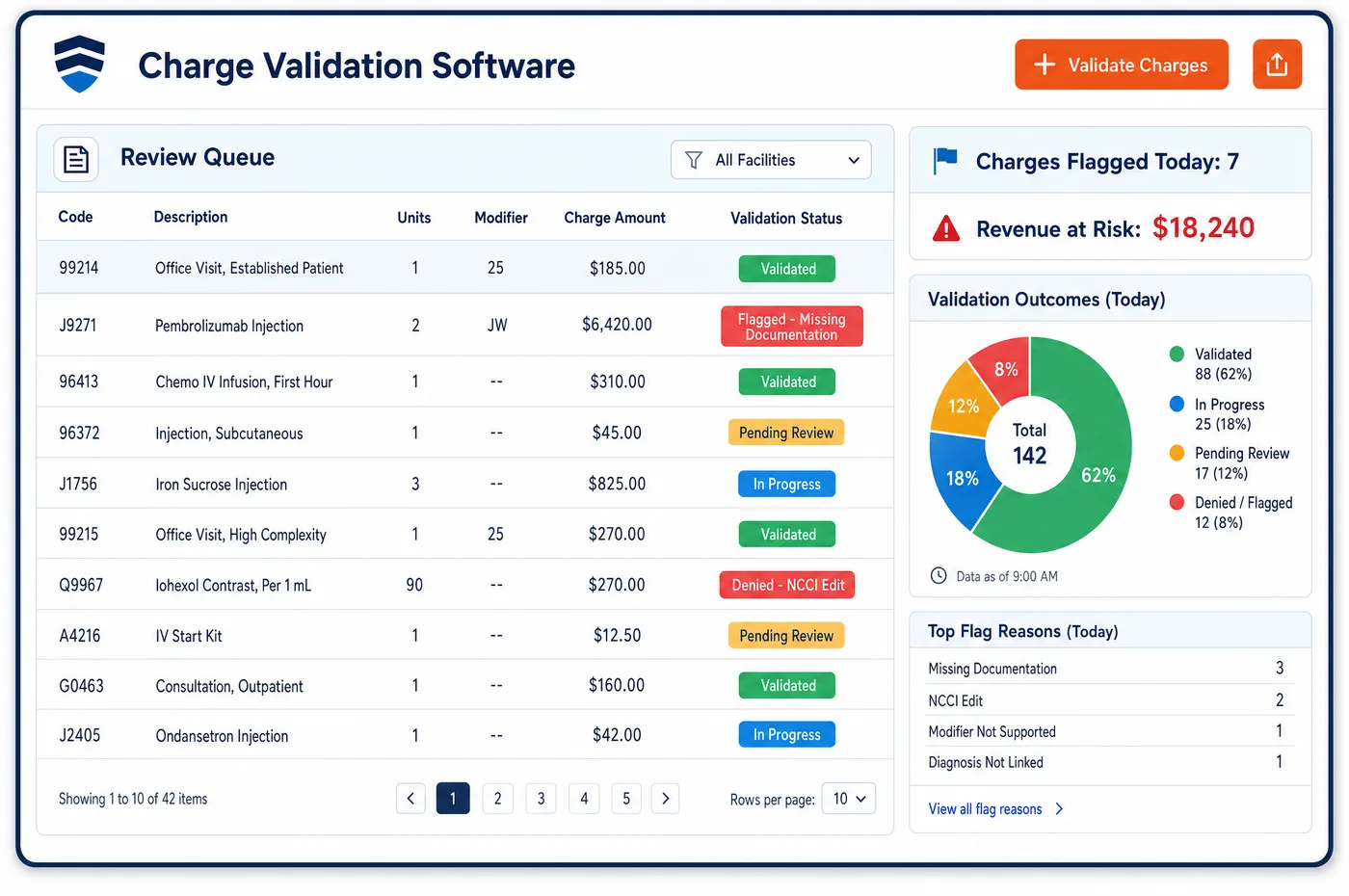
Charge Validation in a Psychiatry Practice
Validation sits between charge assembly and the claim. Each line is checked against the documentation first. A 90834 needs a note showing 38 to 52 minutes of therapy, and a session under 16 minutes can't be billed as psychotherapy at all. An add-on such as 90836 needs an E/M on the same claim and therapy time kept apart from the E/M work. Next come coding edits: no E/M with 90791 or 90792 on the same day, one unit of group therapy per session, and the TMS mapping code once per course. Payer rules follow, such as the diagnosis a TMS policy expects, or whether a payer wants modifier 95 or 93 on a video or phone visit. Psychiatry charge validation software holds any line that fails, with the reason attached. It then routes the line to the right person to fix before the claim is built.
Why Is Charge Validation Different in Psychiatry?
Psychiatric codes are time-based, and payers audit time. A therapy code is only as good as the time recorded in the note. When time is missing, rounded or mixed with E/M work, the charge may be downcoded on review or taken back later. Validation has to read the time and compare it to the code before the payer does.
The rules about which codes can go together are dense. Diagnostic evaluations can't be billed with E/M or psychotherapy on the same day. Add-ons need their primary code. Interactive complexity needs a documented reason and can't ride on crisis codes. Family therapy on the same day as individual therapy needs its own separate time. Generic scrubbers catch some of these, but not the psychiatric logic behind them.
Telehealth and treatment courses add payer-specific layers. Place of service depends on where the patient was. Modifiers depend on the payer and on whether the visit was video or audio-only, and audio-only applies only to certain codes. TMS and Spravato have their own coverage policies. Charge validation in psychiatry checks all of that in one pass and sends clean lines on to psychiatry medical billing.
What Psychiatry Charge Validation Software Handles
- Psychotherapy time bands (90832, 90834, 90837)
- Each timed code is checked against the documented time, so 90832 needs 16 to 37 minutes, 90834 needs 38 to 52 and 90837 needs 53 or more. Notes without start and stop times or a total time are held for the clinician. (CMS Medicare Coverage Database, Billing and Coding Article A57520: Psychiatric Diagnostic Evaluation and Psychotherapy Services)
- Add-on rules (90833, 90836, 90838)
- Each add-on must sit with an E/M on the same claim, and the note must show therapy time apart from the E/M. Prolonged service codes are blocked from pairing with these add-ons. (CMS Medicare Coverage Database, Billing and Coding Article A57520: Psychiatric Diagnostic Evaluation and Psychotherapy Services)
- Diagnostic evaluation pairs (90791, 90792)
- Validation blocks an E/M or a psychotherapy code on the same date as 90791 or 90792. It also checks that 90792 was used only when medical services were part of the evaluation. (CMS NCCI Policy Manual for Medicare Services, Chapter XI (Medicine, including Psychiatric Services))
- Interactive complexity (90785)
- Code 90785 passes only with a documented qualifying factor and a valid primary code. It is held when paired with crisis codes or with an E/M that has no psychotherapy. (CMS NCCI Policy Manual for Medicare Services, Chapter XI (Medicine, including Psychiatric Services))
- Audio-only codes (CPT Appendix T, modifier 93)
- Modifier 93 is allowed only on codes listed in CPT Appendix T. Validation checks the code against that list and the payer's own audio-only policy before the line goes out. (AMA: CPT Appendix T and Modifier 93 (audio-only services))
- TMS edits (90867, 90868, 90869)
- Validation allows 90867 once per course and holds it on the same claim as 90868 or 90869. It also checks that the diagnosis matches the payer's TMS policy, such as F32.2 or F33.2. (CMS Medicare Coverage Database, Billing and Coding Article A57072: Transcranial Magnetic Stimulation)
- Substance use screening pairs (G0396, G0397)
- NCCI bars G0396 and G0397 with E/M, psychiatric evaluation or psychotherapy codes for the same work. Validation flags the pair so the screening isn't billed twice. (CMS NCCI Policy Manual for Medicare Services, Chapter XI (Medicine, including Psychiatric Services))
How Does Psychiatry Charge Validation Software Work?
1. Match each line to the note
Codes, times and diagnoses are compared with the signed note. Lines without support, such as a timed code with no time recorded, are held.
2. Run coding edits
NCCI edits, add-on rules and unit limits run on every line. Same-day pairs that NCCI blocks are held before the claim is built.
3. Apply payer policy
Payer rules for telehealth, TMS, Spravato and psychological testing are applied. Place of service and the audio-only modifier are checked against the payer's current policy.
4. Find missed charges
Documented services with no matching charge are flagged, such as therapy time with no add-on or an injection with no drug line. Coders review them before the encounter closes.
5. Route exceptions with the reason
Each held line goes to a work queue with the rule that stopped it. Repeated holds point to the template or rule that needs fixing upstream in charge assembly.
Psychiatry Charge Validation Software vs. Generic Software
| Area | Generic approach | Unlimited Systems |
|---|---|---|
| Therapy time | The code is accepted as keyed, whatever the note says. | The code is checked against documented time bands. |
| Add-ons | Add-ons billed without separate therapy time. | Add-on time validated against the note. |
| Same-day pairs | Found when the payer denies the claim. | Held by NCCI and psychiatric pair rules before the claim. |
| Audio-only visits | Modifier 93 added to any code. | Checked against Appendix T and payer policy. |
| Exceptions | A single error list with no owner. | Held lines routed to queues with the reason attached. |
Who Uses It in a Psychiatry Practice
- Coder: A queue of held lines, each with the rule that failed and a link to the encounter.
- Psychiatrist or therapist: Fewer surprise audits, and clear feedback when a note lacks the time or detail that psychotherapy add-on codes need.
- Compliance officer: Proof that time-based and add-on codes were checked against documentation before every claim was sent.
Psychiatry Charge Validation Software FAQs
Psychiatry charge validation software checks each charge against the note, coding edits and payer rules before the claim goes out. It confirms psychotherapy time fits the code, add-ons have an E/M, interactive complexity is documented, same-day pairs are allowed, and telehealth place of service and modifiers match the payer. Lines that fail are held with the reason.
The documented therapy time is compared with the time band for the code. A 90834, for example, needs 38 to 52 minutes. If the note has no start and stop times or total time, or the time falls in another band, the line is held for the clinician to correct, or the code is changed to match.
Interactive complexity, code 90785, is an add-on that needs a documented qualifying factor, such as a caregiver whose behavior interferes with treatment. It can't be billed with crisis psychotherapy codes, or with an E/M visit that has no psychotherapy. Validation holds 90785 when the note shows no factor or the pairing is not allowed.
NCCI does not allow an E/M code on the same day as a psychiatric diagnostic evaluation, whether 90791 or 90792. The medical work is already part of 90792. Validation holds the pair so staff can drop the E/M or correct the date before the claim is sent, rather than after a denial.
Telehealth lines are checked for the right place of service, based on where the patient was, and for the modifier the payer expects. Modifier 93 for audio-only is allowed only on codes in CPT Appendix T, and payers set their own rules for modifier 95. Lines that don't match the payer's policy are held.
TMS lines are checked for the right code for each session and for diagnoses that match the payer's policy. One Medicare contractor expects 90867 once per course and not on the same claim as 90868 or 90869. Sessions past the authorized count are held, so the practice can request more before billing them.
Related Psychiatry Software
Billing & claims
In the revenue cycle
Charge Validation for related specialties
Sources
- CMS Medicare Coverage Database, Billing and Coding Article A57520: Psychiatric Diagnostic Evaluation and Psychotherapy Services
- CMS NCCI Policy Manual for Medicare Services, Chapter XI (Medicine, including Psychiatric Services)
- AMA: CPT Appendix T and Modifier 93 (audio-only services)
- CMS Medicare Coverage Database, Billing and Coding Article A57072: Transcranial Magnetic Stimulation
GET STARTED
See Unlimited Systems in Action
Whether you're actively evaluating new technology or simply preparing for your next vendor renewal, Unlimited Systems can help you understand where your current workflows may be creating avoidable revenue risk.