

Billing & claims
Behavioral Health Charge Validation Software
Check every therapy, program and Medicaid charge against time rules, code pairs, clinician type and payer modifiers before it becomes a claim.
Behavioral Health Charge Validation Software checks each charge before it becomes a claim. It confirms the psychotherapy code matches documented time, that add-ons have a valid primary, that code pairs pass NCCI, and that the clinician's license fits the code and payer. Place of service and payer modifiers are checked too.



 6,500+ specialty providers

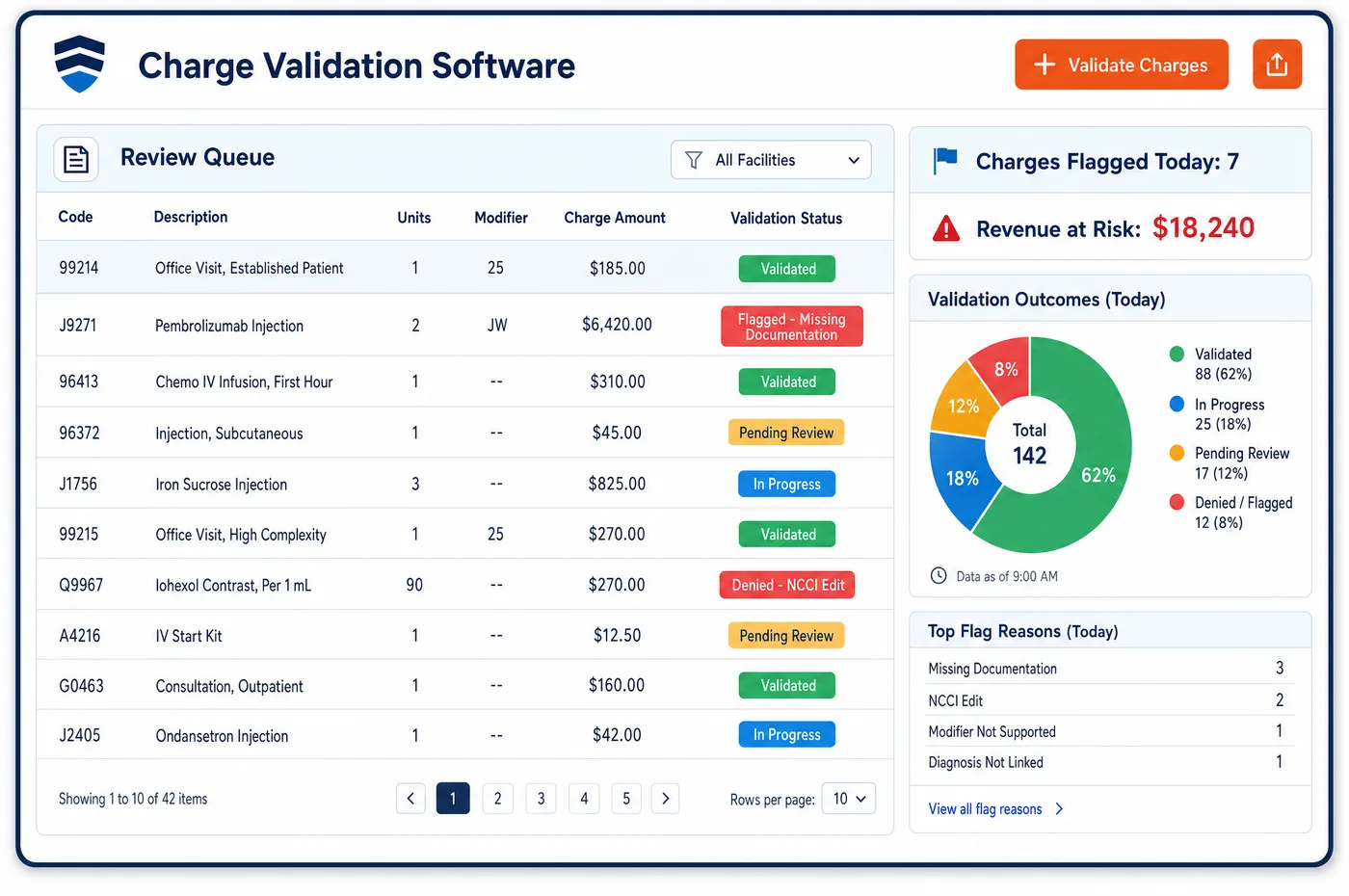
Charge Validation in a Behavioral Health Practice
Validation sits between the note and the claim. It takes the built charge lines and tests each one against payer rules. Time comes first: does the logged time support the code? Then code pairs: an evaluation and a therapy session on the same date, or an E/M code with an evaluation, fail NCCI edits for Medicare. Add-ons are checked against their primary code and the note. Next comes the person. A line coded for a service the clinician's license or the payer's contract does not allow is held. Medicaid lines are checked for the state's modifiers, such as education level or crisis. Telehealth lines are checked for the right place of service and the payer's modifier. Behavioral health charge validation software holds any line that fails and routes it to a coder with the reason, so the fix happens before a payer ever sees the claim.
Why Is Charge Validation Different in Behavioral Health?
Behavioral health claims are small and many, which makes repeat errors costly. A wrong rule applied to one clinician's sessions can deny every one of them for weeks before anyone notices. Catching the pattern on the first charge protects the rest. That is why checks run on every line, not on a sample at month end.
Code pairs are a common trap. Intake visits pair badly with therapy on the same date. Prescribers who add therapy to a medication visit need an E/M code plus the right add-on, with separate time, which are the therapy add-on rules payers audit. Testing codes can't overlap a diagnostic evaluation. A clinician who works across services can trip any of these in one day.
Licensure adds a layer most specialties lack. Payers decide which license types may bill which codes, and the answer differs by payer and state. A licensed counselor may bill psychotherapy but not an E/M visit. A peer specialist may bill a Medicaid peer code and nothing else. Validation has to know the person as well as the code.
What Behavioral Health Charge Validation Software Handles
- E/M with a diagnostic evaluation
- NCCI says E/M codes such as 99202 to 99215 shall not be reported with 90791 or 90792. A line pairing the two is held for review before the claim is built. (CMS NCCI Policy Manual for Medicare Services, Chapter XI (Medicine, including Psychiatric Services), revised 1/1/2026)
- Therapy add-ons need their own time (90833, 90836, 90838)
- When a prescriber bills an E/M visit with a psychotherapy add-on, the note must show the two services are separately identifiable, and therapy time can't include E/M time. Validation checks for an E/M line and a separate therapy time. (CMS Medicare Coverage Database, Billing and Coding Article A57520: Psychiatric Diagnostic Evaluation and Psychotherapy Services)
- Neurobehavioral status exam with an evaluation (96116, 96121)
- NCCI bars 96116 and 96121 from being reported with 90791 or 90792. When a testing practice codes both on one date, validation flags the pair. (CMS NCCI Policy Manual for Medicare Services, Chapter XI (Medicine, including Psychiatric Services), revised 1/1/2026)
- Provider type edits (CARC 170, CARC 185)
- CARC 170 denies payment when the service is billed by this type of provider, and CARC 185 says the rendering provider is not eligible to perform it. Validation compares each line's code with the clinician's license type and the payer's rules before submission. (X12 Claim Adjustment Reason Codes)
- Crisis modifier in Ohio Medicaid (KX)
- Ohio Medicaid uses the KX modifier for crisis services on T1002, H2017, H2019, H0004 and 90832. Lines from a crisis contact are checked for KX, and routine sessions are checked for its absence. (Ohio Department of Medicaid: Behavioral Health State Plan Services Provider Requirements and Reimbursement Manual, version 1.28.1 (March 2026))
- Family and individual therapy on one date (90846, 90847)
- Family psychotherapy may be billed with individual psychotherapy on the same date only as a separate, distinct service in a separate time interval. Validation checks that the two sessions show separate times in the record. (CMS NCCI Policy Manual for Medicare Services, Chapter XI (Medicine, including Psychiatric Services), revised 1/1/2026)
- Telehealth place of service (POS 02, POS 10)
- A video session in the client's home should carry POS 10, and one at another location POS 02. Validation compares the place of service with where the client was recorded at booking. (CMS: Place of Service Code Set)
How Does Behavioral Health Charge Validation Software Work?
1. Test time against the code
Logged session time is compared with the code on the line. A line whose time falls outside that code's range is held, with the correct code suggested.
2. Run code-pair edits
Each date's lines are checked against NCCI pairs and payer edits. Evaluation plus therapy, E/M plus evaluation, and testing plus evaluation pairs are flagged.
3. Match code to clinician
The rendering clinician's license type is compared with what the payer allows for the code. Lines a counselor or associate can't bill under that payer are held.
4. Check modifiers and place of service
Telehealth, crisis, group and education-level modifiers are checked against each payer's rules. Place of service is compared with where the client was recorded.
5. Hold, fix and learn
Failed lines go to a coder with the reason attached. Repeat failures feed denial management for behavioral health, so the upstream cause gets fixed.
Behavioral Health Charge Validation Software vs. Generic Software
| Area | Generic approach | Unlimited Systems |
|---|---|---|
| Time and code | Code accepted as entered. | Code checked against the documented time. |
| Code pairs | Found on the remittance. | NCCI and payer edits run before submission. |
| Clinician license | Not checked at all. | License type matched to code and payer. |
| Medicaid modifiers | Added from a cheat sheet. | State modifier rules checked on each line. |
| Telehealth | Place of service copied from the last visit. | Place of service checked against the client's location. |
Who Uses It in a Behavioral Health Practice
- Coder: A short queue of held lines, each with the reason and the likely fix, instead of a stack of denials.
- Compliance officer: Proof that every line was checked for time, code pairs and clinician type before it left, which supports payer audits.
- Billing manager: Fewer denials for provider type and modifiers, with telehealth modifiers applied the way each plan wants.
Behavioral Health Charge Validation Software FAQs
Behavioral health charge validation checks that the psychotherapy code matches documented time, that add-ons have a valid primary code, and that code pairs pass NCCI and payer edits. It also checks that the clinician's license type can bill the code under that payer, and that place of service and modifiers are right.
For Medicare, NCCI says 90791 and 90792 are not separately reportable with psychotherapy codes on the same date, because psychotherapy includes ongoing evaluation. E/M codes also can't be reported with either evaluation code. Validation flags those pairs, so the right service is billed and the other is dropped or moved.
Add-on codes 90833, 90836 and 90838 are billed only with an E/M visit by a prescriber. The note must show the therapy and the E/M were separately identifiable, and therapy time cannot include E/M time. Validation checks for the E/M line and a separate therapy time before the add-on is allowed.
The line is held before submission. Payers deny such lines with codes like CARC 170, for services billed by a provider type they don't pay, or CARC 185, when the rendering provider can't perform the service. Validation compares license type and payer rules first, so the line is fixed or reassigned instead of denied.
Medicaid modifier rules vary by state and are checked line by line. In Ohio Medicaid, for example, crisis services on codes such as H2019 and H0004 carry the KX modifier, telehealth services carry GT, and some non-licensed staff need an education-level modifier. Lines missing a required modifier are held.
Validation compares each telehealth line's place of service with where the client was recorded. POS 10 means telehealth in the client's home, and POS 02 means telehealth somewhere else. The payer's telehealth modifier is also checked, since rules differ by plan and by state.
Related Behavioral Health Software
Billing & claims
In the revenue cycle
Charge Validation for related specialties
Sources
- CMS NCCI Policy Manual for Medicare Services, Chapter XI (Medicine, including Psychiatric Services), revised 1/1/2026
- CMS Medicare Coverage Database, Billing and Coding Article A57520: Psychiatric Diagnostic Evaluation and Psychotherapy Services
- X12 Claim Adjustment Reason Codes
- Ohio Department of Medicaid: Behavioral Health State Plan Services Provider Requirements and Reimbursement Manual, version 1.28.1 (March 2026)
- CMS: Place of Service Code Set
GET STARTED
See Unlimited Systems in Action
Whether you're actively evaluating new technology or simply preparing for your next vendor renewal, Unlimited Systems can help you understand where your current workflows may be creating avoidable revenue risk.