

Billing & claims
Behavioral Health RCM Software
Run the full revenue cycle for therapy, programs and community services across commercial, carve-out, Medicaid, Medicare and self-pay payers.
Behavioral Health RCM Software runs the revenue cycle from first call to final payment for therapy practices, group practices and community clinics. It covers registration, eligibility, approvals, charges, claims, posting, denials and client balances. RCM in behavioral health also tracks who delivered each session, since the clinician's license often decides what a payer will pay.



 6,500+ specialty providers

RCM in a Behavioral Health Practice
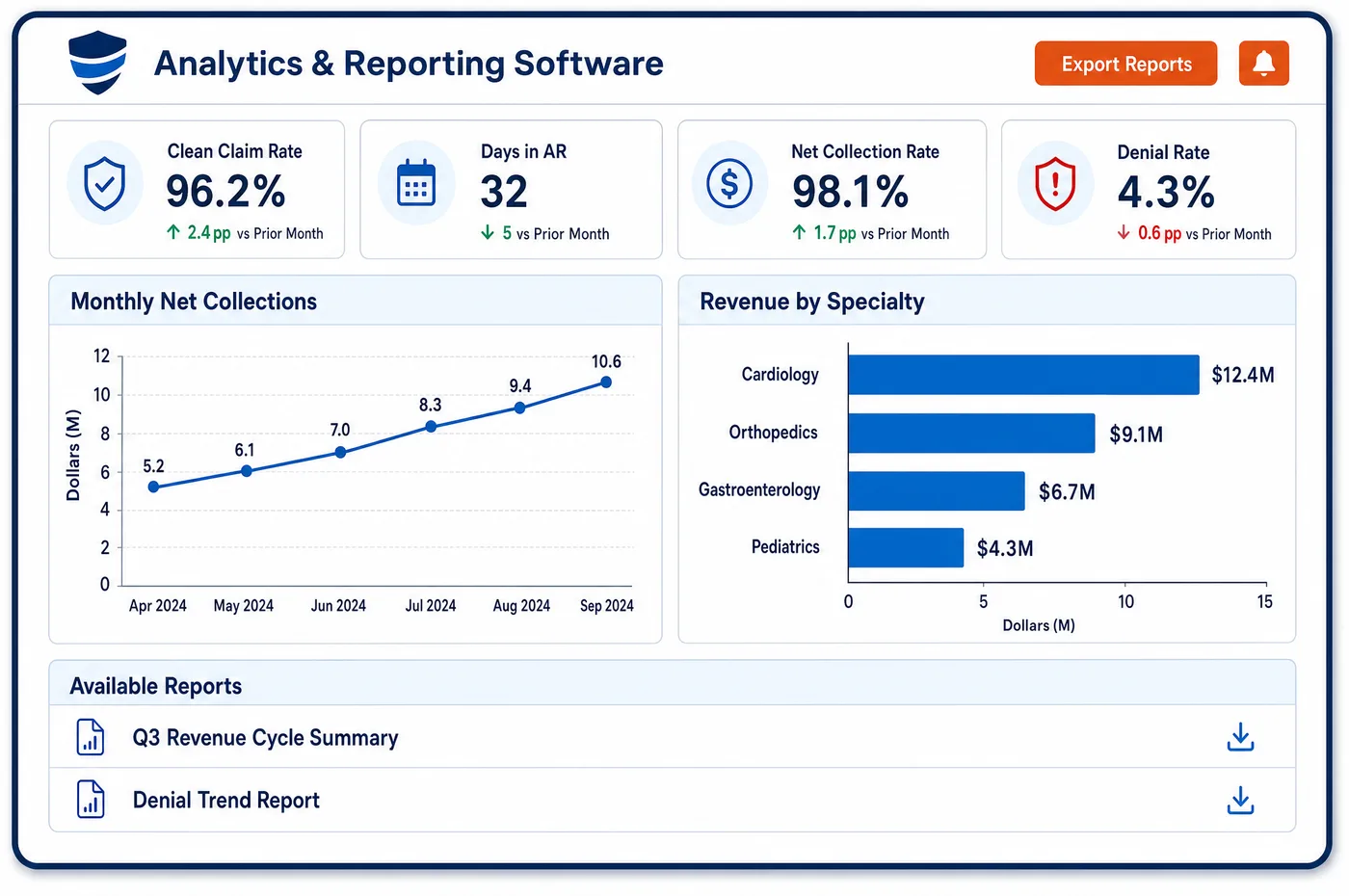
A behavioral health revenue cycle has more payment paths than most. One group can bill commercial plans, separate behavioral health companies, Medicaid managed care, a state behavioral health plan, Medicare and self-pay clients in the same week. A community clinic may add grants, county contracts and, if certified, a CCBHC rate. Behavioral health RCM software keeps each path's rules in one place. Eligibility and approvals are checked before care. Sessions become charges with the right code, units and modifiers for the clinician and payer. Claims are scrubbed, sent and tracked, and remittances post on their own. Denials route to a work queue by reason. The claim side of that chain is covered in depth under behavioral health medical billing. Leaders watch the numbers that matter here: approved sessions used, no-shows, denials by payer and clinician type, and sessions waiting on credentialing.
Why Is RCM Different in Behavioral Health?
The clinician's license shapes revenue more than in most fields. A psychologist, an LCSW, a licensed counselor and a supervised associate may each get a different rate for the same code, or no payment at all from some payers. Medicare pays several therapist types at a share of the psychologist rate. RCM here has to price, route and report by clinician type.
Volume is high and claim values are low. A busy group can file hundreds of therapy claims a week, each worth far less than a procedure claim. One recurring error, such as a missing approval for one plan, repeats on every session until someone finds it. Small leaks add up fast, so the cycle needs rules that catch patterns, not just single claims.
The payer mix is unusually wide. Community clinics blend Medicaid, grants and sliding fees. CCBHCs may be paid a daily or monthly rate instead of per service, yet still report each service. Group practices may contract with several behavioral health companies, each with its own rules. Whether billing is done in-house or outsourced, every one of those paths needs an owner.
What Behavioral Health RCM Software Handles
- Medicare payment for MFTs and MHCs
- Since January 1, 2024, Medicare pays marriage and family therapists and mental health counselors under the physician fee schedule at a share of the clinical psychologist amount, and they must accept assignment. The RCM setup sets expected payment by clinician type, not one rate per code. (CMS MLN Booklet: Medicare & Mental Health Coverage (MLN1986542, March 2026))
- CCBHC prospective payment options
- Under the CCBHC demonstration, states choose among four PPS methods: daily rates (PPS-1, PPS-3) and monthly rates (PPS-2, PPS-4), with PPS-3 and PPS-4 adding special crisis services rates. Quality bonus payments are optional for the daily options and required for the monthly ones. (Medicaid.gov: CCBHC Prospective Payment System (PPS) & Quality Bonus Payments)
- CCBHC encounter codes (T1040, T1041)
- T1040 is the per diem CCBHC code and T1041 the per month code, effective for dates of service from January 1, 2017. CMS expects CCBHC claims to include detailed line items for the services provided, so the cycle tracks the encounter and the services behind it. (Medicaid.gov: CCBHC Billing Codes (T1040, T1041))
- Medicaid carve-outs and PIHPs
- Behavioral health is the Medicaid benefit carved out most often, and PIHPs most often focus on mental health or combined mental health and substance use benefits. Each plan's rules are kept apart, from approvals to claim address. (MACPAC: Types of managed care arrangements (behavioral health carve-outs and PIHPs))
- Same-day evaluation and therapy edit
- For Medicare, NCCI does not let 90791 or 90792 be reported separately with psychotherapy on the same date. Commercial payers may apply similar edits, so intake visits are planned as evaluations alone. (CMS NCCI Policy Manual for Medicare Services, Chapter XI (Medicine, including Psychiatric Services), revised 1/1/2026)
- Education-level modifiers in Ohio Medicaid
- Ohio Medicaid requires HM, HN, HO or UK modifiers to show the education level of some non-licensed staff, such as qualified mental health specialists and peer supporters. Each staff member's level is set once, so the right modifier reaches each claim. (Ohio Department of Medicaid: Behavioral Health State Plan Services Provider Requirements and Reimbursement Manual, version 1.28.1 (March 2026))
How Does Behavioral Health RCM Software Work?
1. Clear the client before care
Eligibility, the mental health payer and any approvals are confirmed during financial clearance for therapy and programs. Clients paying on their own receive an estimate for the planned course.
2. Turn sessions into charges
Each session becomes a charge with the code that fits its time, the rendering clinician and the modifiers that payer wants. Charges are checked before they reach a claim.
3. Send and track claims
Claims are scrubbed against payer rules, sent electronically and tracked through acknowledgment and status. Rejections are fixed the same day.
4. Post and reconcile payments
Electronic remittances post to the ledger automatically. Underpayments are flagged against the expected rate for that payer and clinician type.
5. Work denials by cause
Denials route to behavioral health denial management by reason code, sorted by value and filing deadline. Repeat causes are traced back to the step that created them.
Behavioral Health RCM Software vs. Generic Software
| Area | Generic approach | Unlimited Systems |
|---|---|---|
| Clinician type | One fee schedule for everyone. | Expected payment set by payer and clinician type. |
| Payment paths | Grants and contracts tracked in spreadsheets. | Claims, programs and self-pay tracked in one cycle. |
| Approvals | Found missing when the denial arrives. | Checked before the session is held. |
| Repeat errors | Fixed claim by claim. | Grouped by cause so the rule gets fixed once. |
| Reporting | Month-end totals with no detail. | Denials, no-shows and approvals by payer and clinician. |
Who Uses It in a Behavioral Health Practice
- Billing director: One view of every payer path, with denials grouped by cause and underpayments flagged by clinician type.
- Practice owner: Revenue by clinician, program and payer, plus a clear list of sessions held up by credentialing or approvals.
- CCBHC finance lead: Encounter rates and the services behind them tracked together, with days in AR watched across Medicaid, grants and other payers.
Behavioral Health RCM Software FAQs
Behavioral health RCM software covers the full cycle: registration, eligibility, approvals, charges, claims, posting, denials and client balances. For a group practice it also tracks the rendering clinician on every session, since license type changes what many payers pay. Leaders see denials, no-shows and approved sessions used by payer and clinician.
Under the CCBHC demonstration, states pay clinics through one of four prospective payment methods. Two pay a daily rate and two pay a monthly rate, and two of them add special rates for crisis services. Claims use T1040 for a day or T1041 for a month, and CMS expects detailed line items for the services provided.
Medicare does not pay every therapist the same. Physicians and clinical psychologists are paid the full fee schedule amount. Clinical social workers, marriage and family therapists and mental health counselors are paid a share of the clinical psychologist amount and must accept assignment. Expected payment in the cycle is set by clinician type for that reason.
Either model can work. In-house teams know the clinicians and programs well, while outsourced teams bring payer experience and steady coverage. The deciding factors are volume, payer mix and how many separate behavioral health companies the practice bills. Both models can run on the same RCM platform, with the same queues and reports.
Useful measures include approved sessions used against each approval, no-show and late-cancel rates, first-pass claim acceptance, denials by payer and clinician type, and days in accounts receivable. Sessions waiting on a clinician's payer enrollment are worth tracking too, since they cannot be billed until enrollment is done.
Medicaid behavioral health rules vary widely by state. Some states carve the benefit out to a separate plan, and codes, units and modifiers differ. Ohio Medicaid, for example, requires education-level modifiers for some non-licensed staff and the GT modifier for telehealth. The cycle holds each state's and plan's rules separately.
Related Behavioral Health Software
Billing & claims
RCM for related specialties
Sources
- CMS MLN Booklet: Medicare & Mental Health Coverage (MLN1986542, March 2026)
- Medicaid.gov: CCBHC Prospective Payment System (PPS) & Quality Bonus Payments
- Medicaid.gov: CCBHC Billing Codes (T1040, T1041)
- MACPAC: Types of managed care arrangements (behavioral health carve-outs and PIHPs)
- CMS NCCI Policy Manual for Medicare Services, Chapter XI (Medicine, including Psychiatric Services), revised 1/1/2026
- Ohio Department of Medicaid: Behavioral Health State Plan Services Provider Requirements and Reimbursement Manual, version 1.28.1 (March 2026)
GET STARTED
See Unlimited Systems in Action
Whether you're actively evaluating new technology or simply preparing for your next vendor renewal, Unlimited Systems can help you understand where your current workflows may be creating avoidable revenue risk.