

Front office
Behavioral Health Financial Clearance Software
Confirm the right payer, the session benefit, approvals and the client's cost before therapy or a program starts.
Behavioral Health Financial Clearance Software confirms a client is cleared to start care. It checks which payer holds the mental health benefit, what each session will cost, and whether therapy, testing or an intensive program needs approval. Self-pay clients get a good faith estimate. Staff see the answers before the first session, not after a denial.



 6,500+ specialty providers

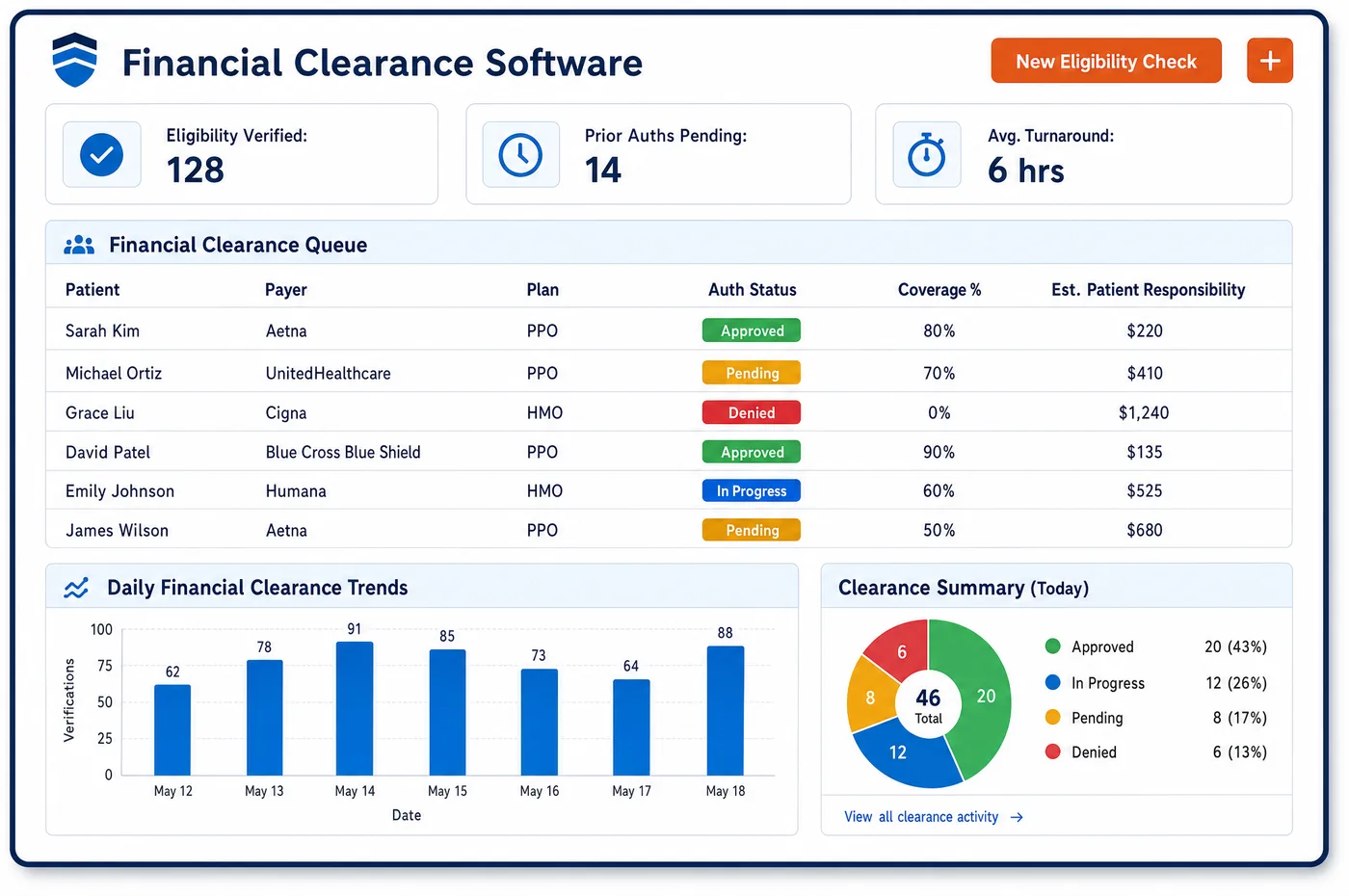
Financial Clearance in a Behavioral Health Practice
Clearance for behavioral health starts with finding the right payer. The medical plan may cover the visit, or it may route mental health to a separate company. Eligibility checks confirm which one holds the benefit and what the client owes per session. A weekly copay adds up fast, and a deductible can make the first sessions full price. Then come approvals. Many plans pay a set of outpatient visits before asking for prior authorization, while intensive outpatient, partial hospitalization and psychological testing usually need approval before they begin. Each approval has a session count, a date range and sometimes a named clinician. Behavioral health financial clearance software keeps those counts on the record and shows staff when a limit is close. Clients who are uninsured or choose not to use coverage get a good faith estimate for the planned course. The result is a client who knows the cost and a session the payer has agreed to pay.
Why Is Financial Clearance Different in Behavioral Health?
Mental health benefits are often run by a company the client has never heard of. The card names one plan, but a separate firm decides on approvals and pays the claims. A check that stops at the medical plan misses that. The session is then delivered, billed to the wrong payer and denied.
Approvals come in small pieces. A plan may approve a block of therapy sessions, then ask for an updated treatment plan before it approves more. Intensive programs are often approved a few days at a time and reviewed often. Psychological testing may be approved by the hour. Each piece needs tracking, or sessions slip past the approved count without anyone noticing.
Cost matters more because care repeats. A client who pays a copay every week feels each one. A high deductible can turn early sessions into full-price visits. Clear, early numbers keep clients in care, and for self-pay clients the good faith estimate rules make them a legal duty.
What Behavioral Health Financial Clearance Software Handles
- Eligibility for the mental health benefit (X12 270/271)
- Eligibility runs as an X12 270 inquiry with a 271 response. Staff check whether the response points mental health benefits to another company, then check eligibility with that company as well. (X12 Transaction Sets (270/271 eligibility, 278 authorization, 837 claims, 835 remittance))
- Specific reasons for prior authorization denials (CMS-0057-F)
- Starting in 2026, impacted payers such as Medicare Advantage plans, Medicaid and CHIP programs and their managed care plans must give a specific reason when they deny a prior authorization. Staff log that reason on the request. (CMS Fact Sheet: CMS Interoperability and Prior Authorization Final Rule (CMS-0057-F))
- Medicare program certification
- For Medicare, an intensive outpatient program needs a physician's determination that the client needs at least nine hours of services a week, and partial hospitalization needs certification of at least twenty. Staff hold the program start until that paperwork is on file. (CMS MLN Booklet: Medicare & Mental Health Coverage (MLN1986542, March 2026))
- Psychological testing hours (96130, 96136)
- In Ohio Medicaid, psychological testing codes such as 96130 and 96136 are covered up to 12 hours per patient per calendar year, with prior authorization for more. Staff check the hours already used before booking a testing battery. (Ohio Department of Medicaid: Behavioral Health State Plan Services Provider Requirements and Reimbursement Manual, version 1.28.1 (March 2026))
- Session limits and benefit maximums (CARC 119)
- A plan that caps sessions denies the extra ones with CARC 119, benefit maximum for this time period or occurrence reached. Clearance tracks sessions used against the limit, so the client and clinician know before the cap hits. (X12 Claim Adjustment Reason Codes)
- Good faith estimate for a planned course
- For uninsured or self-pay clients, one good faith estimate can cover recurring sessions, as long as its scope runs no longer than a year. The estimate lists the expected sessions and charges before care begins. (eCFR: 45 CFR 149.610, Good faith estimates for uninsured (or self-pay) individuals)
How Does Behavioral Health Financial Clearance Software Work?
1. Find the payer that holds the benefit
Eligibility runs at booking. If the medical plan points mental health to another company, staff check that company too and store it as the payer for therapy.
2. Read the session benefit
Copay or coinsurance per visit, deductible left and any visit limit come back in the response. The client sees the expected cost before the first session.
3. Request and track approvals
Requests for programs, testing or more sessions go out with the treatment plan. Approved counts, dates and the authorization number sit on the record, and bookings past them are held.
4. Warn before the limit
Staff see when a client nears the end of approved sessions. The clinician updates the plan, and the next request goes out before care stops.
5. Estimate and hand off
Uninsured and self-pay clients get a good faith estimate for the planned course. Denials that still come back route to behavioral health denial management with the payer's reason attached.
Behavioral Health Financial Clearance Software vs. Generic Software
| Area | Generic approach | Unlimited Systems |
|---|---|---|
| Payer for therapy | Only the medical plan is checked. | The company holding the mental health benefit is found and checked. |
| Session counts | Counted by hand on a whiteboard. | Approved and used sessions shown on the record. |
| Program approvals | Program staff track approvals in a binder. | Approvals tracked by client, dates and level of care. |
| Client cost | Copay explained after the first statement. | Per-session cost shown before care begins. |
| Self-pay clients | No estimate until the client asks. | Good faith estimate prepared for the planned course. |
Who Uses It in a Behavioral Health Practice
- Authorization coordinator: One list of approvals near their limit or end date, across every payer and program, so renewals go out on time.
- Therapist: Notice before the last approved session, so the treatment plan update is sent in time and therapy isn't interrupted. The same counts show on the therapy schedule.
- Front desk: Real per-session costs to share with new clients, and an estimate ready for anyone paying on their own.
Behavioral Health Financial Clearance Software FAQs
Behavioral health financial clearance checks which payer holds the mental health benefit, what the client owes per session, and whether the planned care needs approval. It also tracks approved session counts and dates. For uninsured or self-pay clients it prepares a good faith estimate. The goal is a first session the payer has agreed to cover.
Rules vary by payer and state. Intensive outpatient programs, partial hospitalization and psychological testing commonly need approval before they start. Many commercial and Medicaid plans also review ongoing therapy after an initial set of visits. Each payer's approval is stored with its session count and dates, so staff can see what is covered.
When the medical plan routes mental health benefits to another company, eligibility is checked with that company as well. It is stored as the payer for therapy, with its own member ID. Approvals are requested from it and claims go to it, which avoids the common denial for billing the wrong payer.
For Medicare, intensive outpatient services need a physician certification and a plan of care. The physician determines that the client needs at least nine hours of services a week. Partial hospitalization requires certification of at least twenty hours a week, with recertification on a set schedule. Staff keep those documents with the program stay.
Under the CMS Interoperability and Prior Authorization rule, impacted payers must give a specific reason for a denied prior authorization starting in 2026. Those payers include Medicare Advantage plans, Medicaid and CHIP programs and their managed care plans, and marketplace plans on the federal exchanges. Staff record that reason to guide the next request or appeal.
A good faith estimate is required for uninsured clients and for insured clients who choose not to use coverage. For recurring care such as weekly therapy, one estimate can cover the series. It must describe the expected scope, such as the number of sessions, and that scope cannot run longer than a year.
Related Behavioral Health Software
Front office
In the revenue cycle
Financial Clearance for related specialties
Sources
- X12 Transaction Sets (270/271 eligibility, 278 authorization, 837 claims, 835 remittance)
- CMS Fact Sheet: CMS Interoperability and Prior Authorization Final Rule (CMS-0057-F)
- CMS MLN Booklet: Medicare & Mental Health Coverage (MLN1986542, March 2026)
- Ohio Department of Medicaid: Behavioral Health State Plan Services Provider Requirements and Reimbursement Manual, version 1.28.1 (March 2026)
- X12 Claim Adjustment Reason Codes
- eCFR: 45 CFR 149.610, Good faith estimates for uninsured (or self-pay) individuals
GET STARTED
See Unlimited Systems in Action
Whether you're actively evaluating new technology or simply preparing for your next vendor renewal, Unlimited Systems can help you understand where your current workflows may be creating avoidable revenue risk.