

Front office
Behavioral Health Patient Intake Software
Screening tools, consents and history collected before the first session, with the intake assessment booked and coded the way payers expect.
Behavioral Health Patient Intake Software collects what a clinician needs before the first session. Clients complete history forms, screening tools such as the PHQ-9 and GAD-7, and consents for treatment, telehealth and releases on their phones. Scores and signed forms reach the record before the intake assessment, so the first session starts with the facts.



 6,500+ specialty providers

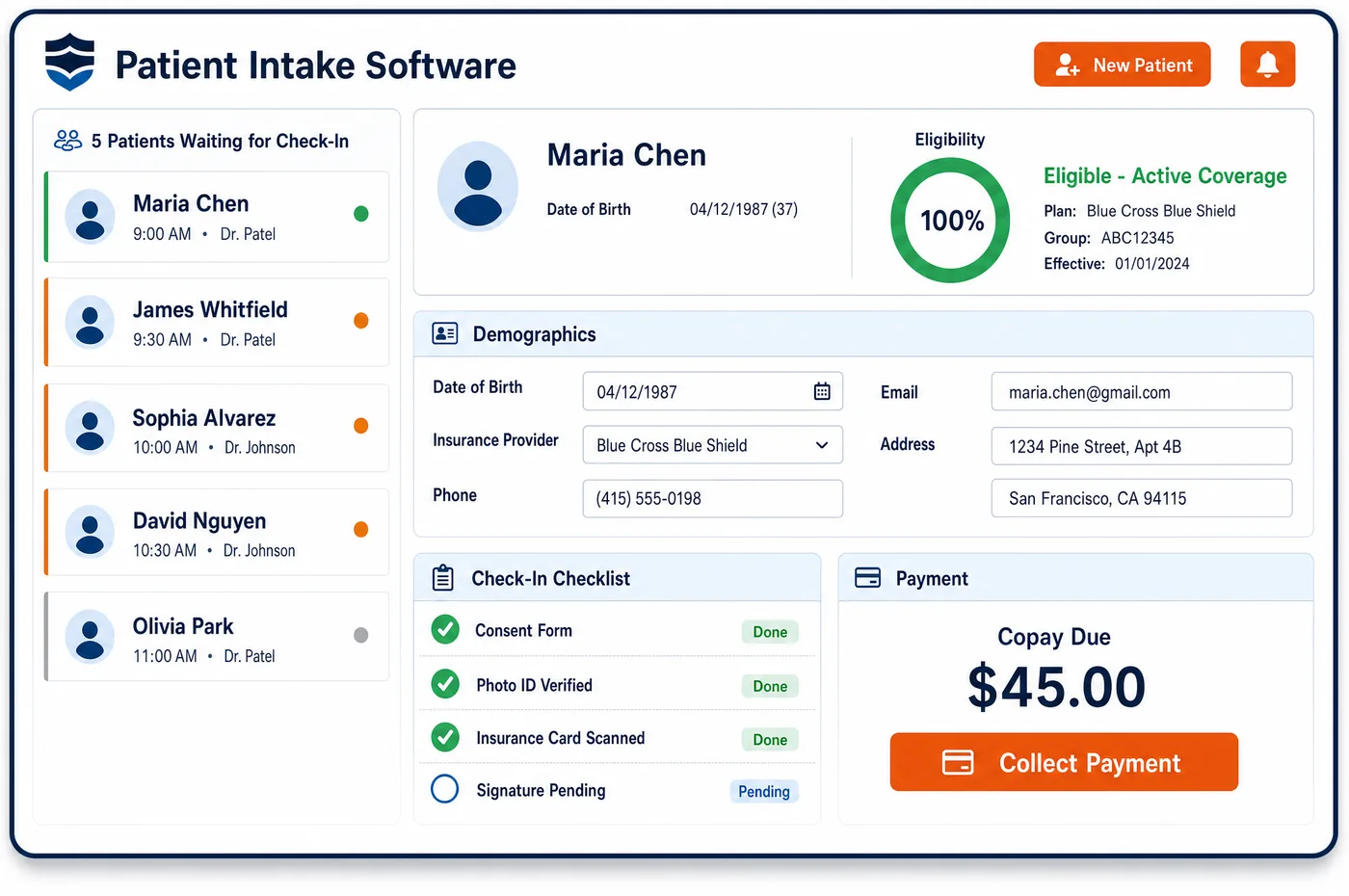
Patient Intake in a Behavioral Health Practice
Intake in behavioral health is a clinical step and a billing step at once. The client fills out history, current concerns and standard screening tools from home. Scored results reach the clinician before the visit. Consents come next: treatment, telehealth, release of information and, where substance use services are offered, a Part 2 consent. Behavioral health patient intake software sends the right packet for the program. An adult outpatient client gets one set of forms, a teen another, and an intensive outpatient referral a third. The intake visit itself is booked as an assessment, often a diagnostic evaluation, because Medicare's NCCI edits don't allow an evaluation and a therapy session on the same date. Insurance cards and guardian details flow in from client registration. Everything lands on the behavioral health patient management record, where it stays with the client.
Why Is Patient Intake Different in Behavioral Health?
The first session here is usually an assessment, not therapy. A counselor or social worker gathers history, rates symptoms and builds a treatment plan. Payers often limit how many evaluations they pay per client, and some bundle the evaluation with any therapy on the same date. Intake has to know which assessment fits the client and the payer before the slot is booked.
Screening tools do real work. A PHQ-9 or GAD-7 score shapes the plan, and repeat scores show whether care is helping. Substance use screens can point a client to a different level of care. Paper forms scored by hand slow that down and leave the scores trapped in a scanned image.
Consent is heavier than in most specialties. Telehealth consent, releases to schools or courts, family contacts and Part 2 consent all need dates and scope. Self-pay clients are owed a good faith estimate before care starts. Missing any of these can block a claim, a referral or a records request later.
What Behavioral Health Patient Intake Software Handles
- Diagnostic evaluation at intake (90791)
- A non-prescribing clinician's intake assessment is reported with 90791, the evaluation without medical services. NCCI treats 90791 and 90792 as not separately reportable with psychotherapy on the same date, so the intake visit is booked as an evaluation, not a therapy session. (CMS NCCI Policy Manual for Medicare Services, Chapter XI (Medicine, including Psychiatric Services), revised 1/1/2026)
- Ohio Medicaid evaluation limit
- In Ohio Medicaid, for example, 90791 and 90792 are limited to one encounter per person per calendar year per code per billing agency, with prior authorization for more. Intake staff check for an earlier evaluation before booking a second one. (Ohio Department of Medicaid: Behavioral Health State Plan Services Provider Requirements and Reimbursement Manual, version 1.28.1 (March 2026))
- Alcohol or drug assessment (H0001)
- Ohio Medicaid allows two H0001 assessments per patient per calendar year per billing agency before prior authorization is needed. Programs that offer substance use services record which intake assessment was used, so the next one is not denied. (Ohio Department of Medicaid: Behavioral Health State Plan Services Provider Requirements and Reimbursement Manual, version 1.28.1 (March 2026))
- Substance use screening (G0396, G0397)
- Medicare's structured alcohol and substance use assessment and brief intervention codes name tools such as AUDIT and DAST. Intake packets can carry those tools, and the score is stored with the visit. (CMS MLN Booklet: Medicare & Mental Health Coverage (MLN1986542, March 2026))
- Telehealth consent and modality
- Medicare covers mental health telehealth to a patient's home on a permanent basis and allows audio-only care based on the patient's limits or preference. Intake records the client's telehealth consent and whether they can use video. (CMS MLN Booklet: Medicare & Mental Health Coverage (MLN1986542, March 2026))
- Part 2 consent before records are shared
- For programs under 42 CFR Part 2, intake collects the client's written consent before records are shared for treatment, payment or operations. The signed consent is stored with its date and scope. (eCFR: 42 CFR 2.33, Uses and disclosures permitted with written consent)
How Does Behavioral Health Patient Intake Software Work?
1. Send the right packet
The intake packet follows the program and the client's age. Adults, teens with a guardian and intensive outpatient referrals each get forms built for them.
2. Score screening tools on arrival
PHQ-9, GAD-7 and substance use screens are scored when the client submits them. The clinician sees the results before the assessment begins.
3. Collect consents with scope
Treatment, telehealth, release and Part 2 consents are signed digitally. Each one is stored with the date and the people or groups it covers.
4. Confirm coverage before the assessment
Card details from sign-up go through eligibility verification. Staff confirm which payer covers the evaluation and whether that payer limits it.
5. Book the assessment, then the series
The intake visit is booked as an evaluation. Once the plan is set, weekly sessions are booked through behavioral health patient scheduling.
Behavioral Health Patient Intake Software vs. Generic Software
| Area | Generic approach | Unlimited Systems |
|---|---|---|
| Screening tools | Paper forms scored by hand and scanned. | Scores calculated on submission and stored as data. |
| Program packets | One packet for every client. | Packets built for adults, teens and intensive programs. |
| Consents | Signed on paper with no record of scope. | Signed digitally and stored with date and scope. |
| Intake visit coding | Evaluation and therapy billed on the same day. | Intake booked as an evaluation, therapy booked after. |
| Self-pay clients | Estimate given after the first bill. | Flagged for a good faith estimate before care starts. |
Who Uses It in a Behavioral Health Practice
- Intake coordinator: Complete packets before the visit, with missing consents shown on the record, so the first session doesn't start with paperwork.
- Therapist or counselor: Screening scores and history in hand before the assessment, which leaves more of the hour for the client.
- Billing manager: Assessments coded as evaluations and payer limits checked first, so fewer intake claims come back denied.
Behavioral Health Patient Intake Software FAQs
Behavioral health patient intake collects history, screening tools and consents before the first session. Clients complete forms on their phones, and scores such as the PHQ-9 reach the clinician before the visit. Treatment, telehealth and release consents are signed digitally. The intake visit is then booked as an assessment, which is usually how payers expect it billed.
Under NCCI, the diagnostic evaluations 90791 and 90792 are not separately reportable with psychotherapy on the same date of service. For that reason the first visit is normally billed as the evaluation alone. Weekly psychotherapy sessions start at the next visit, once the treatment plan is in place.
Practices commonly send the PHQ-9 for depression and the GAD-7 for anxiety, plus substance use screens such as AUDIT or DAST where those services are offered. Administrators choose the tools for each program. Clients complete them on their phones, scores are calculated on submission, and the results are saved to the client record as data.
Limits vary by state. In Ohio Medicaid, for example, 90791 and 90792 are limited to one encounter per person per calendar year per code per billing agency, with prior authorization required for more. Intake staff check for an earlier evaluation in the same year before booking another one for a returning client.
Telehealth consent is part of the digital intake packet and is stored with its date. Intake also asks whether the client can use video. Medicare covers mental health telehealth to the home on a permanent basis and allows audio-only care when the client can't or won't use video, so that answer matters.
Programs covered by 42 CFR Part 2 collect the client's written consent before sharing records. Part 2 allows a single consent for future treatment, payment and health care operations uses until the client revokes it in writing. Intake stores that consent with the treatment, telehealth and release consents, each with its date and scope.
Related Behavioral Health Software
Front office
In the revenue cycle
Patient Intake for related specialties
Sources
- CMS NCCI Policy Manual for Medicare Services, Chapter XI (Medicine, including Psychiatric Services), revised 1/1/2026
- Ohio Department of Medicaid: Behavioral Health State Plan Services Provider Requirements and Reimbursement Manual, version 1.28.1 (March 2026)
- CMS MLN Booklet: Medicare & Mental Health Coverage (MLN1986542, March 2026)
- eCFR: 42 CFR 2.33, Uses and disclosures permitted with written consent
GET STARTED
See Unlimited Systems in Action
Whether you're actively evaluating new technology or simply preparing for your next vendor renewal, Unlimited Systems can help you understand where your current workflows may be creating avoidable revenue risk.