

Billing & claims
Addiction Medicine RCM Software
Run the whole revenue cycle for OTP bundles, office-based treatment, Medicaid services, screening and drug testing on one set of rules.
Addiction Medicine RCM Software runs the revenue cycle of an addiction treatment practice from first contact to final payment. It covers eligibility, consent, approvals, charge capture, claims, remittance, denials and patient balances. It applies the rules of each payment model the specialty uses, from Medicare OTP bundles to office-based bundles and state Medicaid codes.



 6,500+ specialty providers

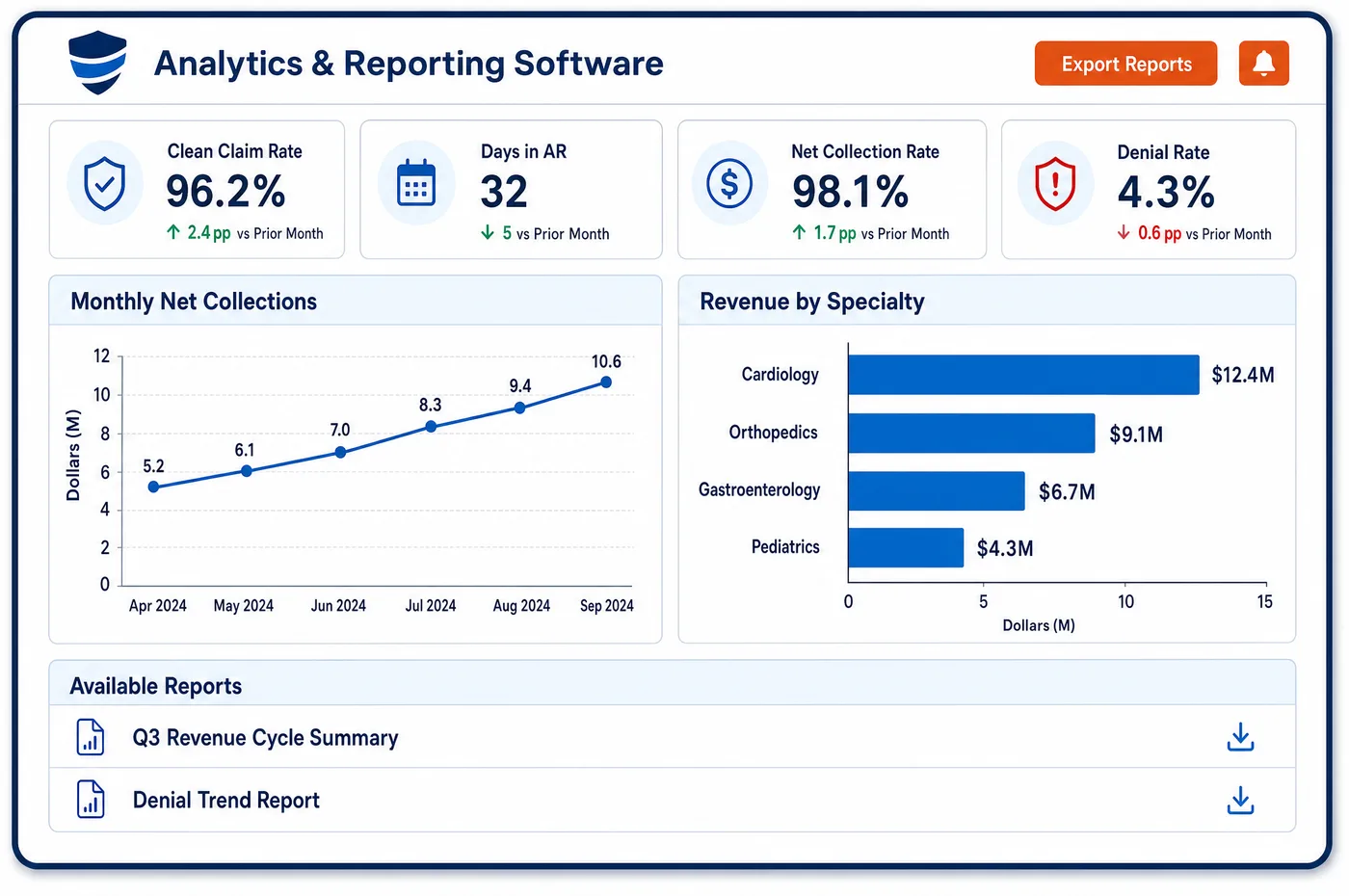
RCM in a Addiction Medicine Practice
Few specialties bill under so many models at once. A Medicare-enrolled OTP is paid weekly bundles that change with the drug given, plus add-ons for intake, assessments, take-home doses and extra counseling. An office-based practice bills monthly bundles under Medicare, or visits and counseling codes under other plans. Medicaid pays for assessment, counseling and methadone services under codes and modifiers that differ by state. Screening, brief intervention and drug testing each have their own code sets and limits. Grant and state funds pay for some of what's left. Addiction medicine RCM software keeps the rules for each model in one place. It checks coverage and consent up front, builds charges from the documented service, scrubs claims at checkout, and posts each remittance automatically. Denials go to work queues sorted by value and deadline, and every number ties back to a payer, a program and a patient.
Why Is RCM Different in Addiction Medicine?
The payment model changes with the setting, not just the payer. CMS says clinicians can't bill OTP codes for office-based treatment, and OTP services follow their own weekly rules. A practice that runs both an OTP and an office-based clinic needs two sets of rules in one revenue cycle, with each patient's episode pointing to the right one.
Funding is mixed. Medicare, Medicaid managed care, behavioral health vendors, job-based plans, block grants and self-pay can all appear in one program, and often for one patient. Block grant rules expect other payers to be billed first. Revenue cycle work in this specialty is as much about sending each service to the right source as about coding it.
Rules also move every year. CMS updates the OTP non-drug payment each year and adjusts it by locality. New add-on codes for peer support, navigation and nalmefene have been added in recent rules, and older implant codes were deleted. RCM in addiction medicine needs payer rules that are kept current, not a code list set up once and left alone.
What Addiction Medicine RCM Software Handles
- OTP claims on the CMS-1500 (POS 58)
- For Medicare, a professional OTP claim uses place of service 58, with the organization's NPI as billing provider and the prescriber's NPI also reported. RCM rules check both NPIs and the POS before the claim leaves. (CMS: Opioid Treatment Program (OTP) Billing & Payment)
- Institutional OTP claims (TOB 087x)
- OTPs enrolled as institutional providers bill on the CMS-1450, using type of bill 087x for a freestanding non-residential OTP. RCM settings follow the way each program is enrolled with Medicare. (CMS: Opioid Treatment Program (OTP) Billing & Payment)
- Office-based monthly bundles (G2086, G2087, G2088)
- Physicians and NPPs bill G2086 for the first month of office-based SUD treatment and G2087 for later months, with G2088 as an add-on. CMS says not to bill them more than once per month per patient, and RCM edits enforce that. (CMS MLN Booklet: Screening, Brief Intervention & Referral to Treatment (SBIRT) Services (MLN904084))
- SBIRT codes by payer (G2011, G0396, G0397, 99408, 99409)
- Medicare pays SBIRT under G2011, G0396 and G0397 and does not cover 99408 or 99409. Where a state Medicaid program covers 99408 and 99409, the same NCCI limits apply to them. RCM rules pick the code set by payer. (CMS NCCI Policy Manual for Medicare Services, Chapter XI (revised 1/1/2026))
- Definitive drug testing (G0480 to G0483)
- Definitive tests are coded by the number of drug classes, from G0480 for one to seven classes up to G0483 for 22 or more. These codes are subject to CLIA edits, so the lab's certificate type is checked as part of the cycle. (CMS Transmittal R3439CP (CR 9502): HCPCS codes subject to CLIA edits, including G0480 to G0483)
- Medicare filing limit for OTPs
- CMS asks OTPs to file as soon as possible and no later than one calendar year after the date of service. RCM work queues show each unbilled OTP week against that limit. (CMS: Opioid Treatment Program (OTP) Billing & Payment)
How Does Addiction Medicine RCM Software Work?
1. Clear the patient
Eligibility, any carve-out, Part 2 consent and open approvals are confirmed before care starts. Gaps go to staff before the first claim, not after.
2. Capture the service
Dosing, counseling, testing and visits are recorded against the patient's episode. Charges are built from the documented service with the right codes, units and modifiers.
3. Scrub and submit
Claims are checked against payer rules at checkout, then handed off through addiction medicine medical billing for electronic submission. Secondary claims follow the primary remittance.
4. Post and reconcile
Electronic remittances post automatically to each claim line. Grant and state program payments are tracked against their own funding source.
5. Work denials and measure
Denials route to queues sorted by value and filing deadline, with denial root causes grouped by payer and reason. Leaders see denial rate, days in AR and collections by program.
Addiction Medicine RCM Software vs. Generic Software
| Area | Generic approach | Unlimited Systems |
|---|---|---|
| Payment models | One generic fee schedule for every service. | Rules per model: OTP weekly, office-based monthly, Medicaid by state. |
| Setting | OTP and clinic claims mixed together. | Each episode points to the right billing rules. |
| Funding sources | Grants tracked in a separate spreadsheet. | Grant and state funds tracked as payers in the same cycle. |
| Rule updates | Code list set up once at go-live. | Payer rules and code sets kept current each year. |
| Performance | Month-end totals with no detail. | Denial rate, AR and collections by payer and program. |
Who Uses It in a Addiction Medicine Practice
- Revenue cycle director: One cycle across OTP, office-based and Medicaid billing, with each rule set kept in one place and work routed to the right team.
- Chief financial officer: Collections, denials and AR by funding source, so leaders can see which programs pay their way and where money is stuck, with deposits flowing to accounting.
- Program owner: A choice to keep billing in-house or pair the software with an outsourced billing team, with the same rules and queues either way.
Addiction Medicine RCM Software FAQs
RCM for addiction medicine has to handle several payment models at once. Medicare pays OTPs weekly bundles and office-based practices monthly bundles. Medicaid uses state codes and modifiers. Screening and drug testing have their own codes and limits, and grant funds pay for some care. The revenue cycle must send each service to the right source under the right rules.
One RCM system can handle both, as long as each patient episode points to the right rules. OTP care uses weekly bundles and add-ons, while office-based care uses monthly bundles or visit codes. CMS says clinicians can't use OTP codes for office-based treatment, so the setting decides which code set is used.
Grant and state program funds are set up as their own payers, so each service is billed to the right source. Block grant rules expect other payers to be billed first and patients to pay by ability, so the cycle checks coverage before grant funds are used. Payments are tracked against each grant for reporting.
Useful measures include denial rate by payer and reason, days in accounts receivable, clean claim rate, unbilled OTP weeks and collections by funding source. Tracking them by program helps leaders see whether a problem is in one payer, one clinic or one step of the cycle, such as approvals or charge capture.
Some programs keep billing in-house, while others pair the software with an outsourced billing team. The choice depends on staff, volume and how many payment models the program bills. Either way, the same payer rules, work queues and reports apply, so the program keeps a clear view of its own revenue cycle.
Medicare updates the non-drug part of OTP payments each year and adjusts it by locality. Recent rules added OTP add-ons for peer recovery support, patient navigation, coordinated care and nalmefene, and deleted the old implant codes. Medicaid programs also revise their manuals. Payer rules in the software are updated so claims follow the current version.
Related Addiction Medicine Software
Billing & claims
RCM for related specialties
Sources
- CMS: Opioid Treatment Program (OTP) Billing & Payment
- CMS MLN Booklet: Screening, Brief Intervention & Referral to Treatment (SBIRT) Services (MLN904084)
- CMS NCCI Policy Manual for Medicare Services, Chapter XI (revised 1/1/2026)
- CMS Transmittal R3439CP (CR 9502): HCPCS codes subject to CLIA edits, including G0480 to G0483
- Medicare Claims Processing Manual, Chapter 39: Opioid Treatment Programs (Rev. 13572, 2026)
- eCFR 45 CFR 96.137: Payment schedule (block grant as payment of last resort)
GET STARTED
See Unlimited Systems in Action
Whether you're actively evaluating new technology or simply preparing for your next vendor renewal, Unlimited Systems can help you understand where your current workflows may be creating avoidable revenue risk.