

Billing & claims
Psychiatry Invoicing Software
Bill payers, facilities, collaborative care partners and out-of-network patients, and track every psychiatric claim and invoice to payment.
Psychiatry Invoicing Software produces and tracks the bills a psychiatric practice sends to payers and to other parties. It formats claims to each payer's rules, including behavioral health payers. It also builds invoices for facility contracts, team care consulting, report requests and out-of-network superbills. Psychiatry invoicing then follows each one to payment.



 6,500+ specialty providers

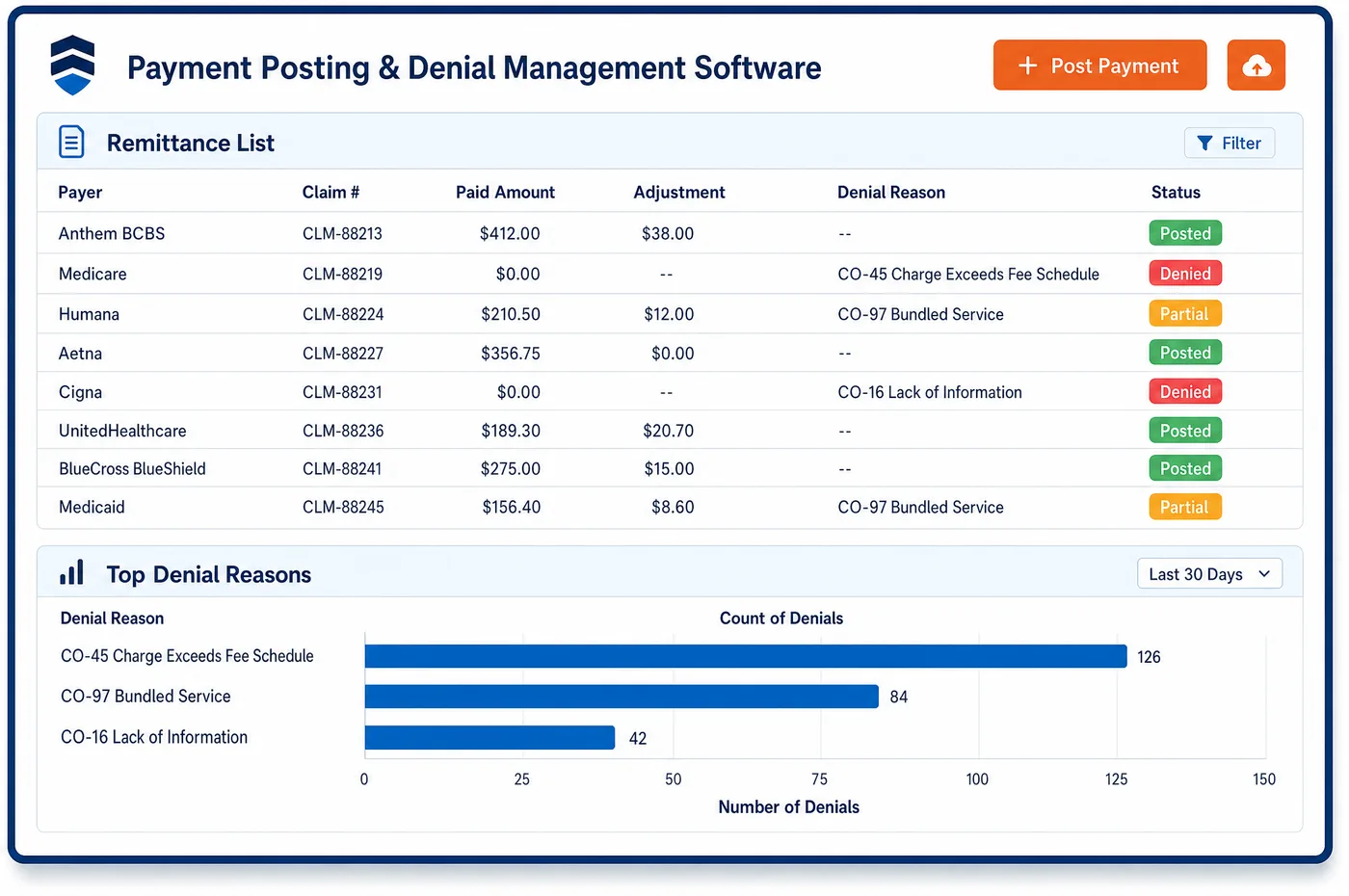
Invoicing in a Psychiatry Practice
Most psychiatric revenue still arrives through claims, and invoicing starts there. Each claim is formatted to the payer's rules and filed over a real-time clearinghouse connection, whether it goes to a medical plan or a behavioral health company. But psychiatry also bills outside the claim. A psychiatrist who covers a hospital unit or a community program bills the facility under a service contract. A psychiatric consultant in a collaborative care program may bill the primary care practice, which bills Medicare. An agency or insurer that asks for a written report pays for it directly. An out-of-network patient needs a superbill to file their own claim. Psychiatry invoicing software builds each of these from the same account record. It sends invoices by email or text where that fits, and keeps payer claims and other invoices in one view until they are paid.
Why Is Invoicing Different in Psychiatry?
Psychiatric practices often earn revenue from more than one kind of customer. Patients and their plans come first, but hospitals, residential programs, schools and primary care groups may also pay for psychiatric time under contract. Each has its own terms and rates, and none of them takes an 837 claim.
Team care with primary care is a good example. In Medicare's model, the primary care doctor bills the monthly collaborative care billing codes. The psychiatric consultant may be a contractor, not a billing provider. The primary care practice pays the consultant, so the psychiatric group needs a clean way to invoice its partners each month for caseload reviews and consults.
Out-of-network care adds a patient-facing layer. Many psychiatrists don't contract with insurers, so patients file their own claims using a superbill. Invoicing has to produce that document with correct codes and amounts, and keep it tied to what the patient actually paid. Every one of these bills needs to be tracked to payment, just like a claim.
What Psychiatry Invoicing Software Handles
- Psychiatric consultant contracts in collaborative care
- Care team members in BHI work as employees or under contract with the practitioner Medicare pays. Invoicing turns the consultant's logged caseload work into a monthly invoice to each primary care partner. (CMS MLN Booklet: Behavioral Health Integration Services (MLN909432))
- Report preparation (90889)
- Medicare does not cover preparing reports, and 90889 describes a report on a patient's psychiatric status prepared for an agency or insurer. Invoicing bills the requesting party directly and links the invoice to the request. (CMS MLN Booklet: Medicare & Mental Health Coverage (MLN1986542))
- Payer-specific claim formats (X12 837P)
- Behavioral health payers publish their own claim rules. Invoicing applies each payer's format to the 837P, so claims to a carve-out and to the medical plan each go out the way that payer expects. (X12 Transaction Sets: 837P Professional Claims and 835 Remittance)
- Community mental health center and facility contracts
- Some psychiatrists cover clinics, hospital units and residential programs under contract. Invoicing bills each facility for the coverage it bought and tracks each invoice to payment. (CMS MLN Booklet: Medicare & Mental Health Coverage (MLN1986542))
- Good faith estimate beside the final bill
- Self-pay patients can dispute a bill that is far higher than their good faith estimate. Invoicing keeps the estimate beside the final invoice, so staff can see any gap before the bill goes out. (CMS No Surprises Act: Understanding Costs in Advance (Good Faith Estimates))
How Does Psychiatry Invoicing Software Work?
1. Format and file payer claims
Clean charges become claims formatted to each payer's rules. They are filed over a real-time clearinghouse connection, with no manual formatting by staff.
2. Build contract and partner invoices
Facility coverage and consulting work are billed from what was recorded in the period. Each invoice carries the contract or partner it belongs to.
3. Produce superbills and third-party invoices
Out-of-network patients get a superbill with codes and amounts paid. Agencies or insurers that request reports get an invoice tied to the request.
4. Send by the right channel
Digital invoices go out by email or text, and partner invoices go to the contact on file. Patient balances follow psychiatric patient billing rules.
5. Track every bill to payment
Claims are tracked through remittance, and other invoices through the deposit. Open items of both kinds age together and flow into psychiatry AR management.
Psychiatry Invoicing Software vs. Generic Software
| Area | Generic approach | Unlimited Systems |
|---|---|---|
| Facility contracts | Invoices built in a spreadsheet from a calendar. | Invoices built from the recorded coverage work. |
| Collaborative care partners | Consultant time tallied by hand. | Logged caseload work feeds the partner invoice. |
| Payer claim formats | Staff adjust formats claim by claim. | Formatting set per payer, including carve-outs. |
| Superbills | Typed by hand for each patient. | Built from the visit's codes and payments. |
| Tracking to payment | Contract invoices sit outside AR. | Claims and invoices aged in one view. |
Who Uses It in a Psychiatry Practice
- Billing manager: Payer claims and contract invoices in one place, with every open item followed to payment.
- Practice owner: Facility and partner revenue billed on time, and visible beside claim revenue in practice accounting.
- Out-of-network patient: A clear superbill and digital invoices by email or text, so they can pay and seek reimbursement without calling the office.
Psychiatry Invoicing Software FAQs
Psychiatry invoicing software handles the bills a practice sends to payers and to other parties. It formats claims for medical plans and behavioral health payers, and builds invoices for facility contracts, collaborative care partners, report requests and out-of-network superbills. Each claim and invoice is tracked to payment in one view, so nothing sits outside accounts receivable.
In psychiatric collaborative care, the primary care practitioner bills Medicare for the monthly codes. The psychiatric consultant can work under contract with that practice and is paid by it, not by Medicare. Invoicing lets the psychiatric group bill each partner practice for the consulting work logged during the month, and follow that invoice to payment.
Invoicing produces superbills for patients who see out-of-network psychiatrists and file their own claims. The superbill lists the visit date, CPT and ICD-10-CM codes, the rendering clinician, the charge and the amount paid. It is built from the same account record as the visit, so the codes and payments match the practice's books.
When a psychiatrist covers a hospital unit, residential program or community clinic under contract, the practice bills the facility instead of a payer. Invoicing builds each invoice from the services provided under that contract, sends it, and tracks it to payment beside the practice's claims, so contract revenue is not managed in a separate spreadsheet.
Medicare does not cover preparing reports, and code 90889 describes this kind of report. When an agency or insurer asks for a written report on a patient's psychiatric status, the practice can bill that party directly. Invoicing creates the invoice, links it to the request on the patient record, and tracks it until it is paid.
Payer claims are formatted to each payer's rules and filed over a real-time clearinghouse connection, with no manual formatting by staff. Behavioral health payers and medical plans each get the format they expect. Unlimited Clearinghouse is available as part of the platform, and practices can ask about connecting to the clearinghouse they already use.
Related Psychiatry Software
Billing & claims
Invoicing for related specialties
Sources
GET STARTED
See Unlimited Systems in Action
Whether you're actively evaluating new technology or simply preparing for your next vendor renewal, Unlimited Systems can help you understand where your current workflows may be creating avoidable revenue risk.