

Front office
Addiction Medicine Patient Registration Software
Register identity, coverage, funding source and Part 2 consent correctly the first time a patient asks for treatment.
Addiction Medicine Patient Registration Software captures who the patient is, how their treatment will be paid for and what they allow the program to share. It records identity and contact details, Medicaid, Medicare or commercial coverage, any carve-out or grant funding, and a Part 2 consent that meets federal content rules, all on one record.



 6,500+ specialty providers

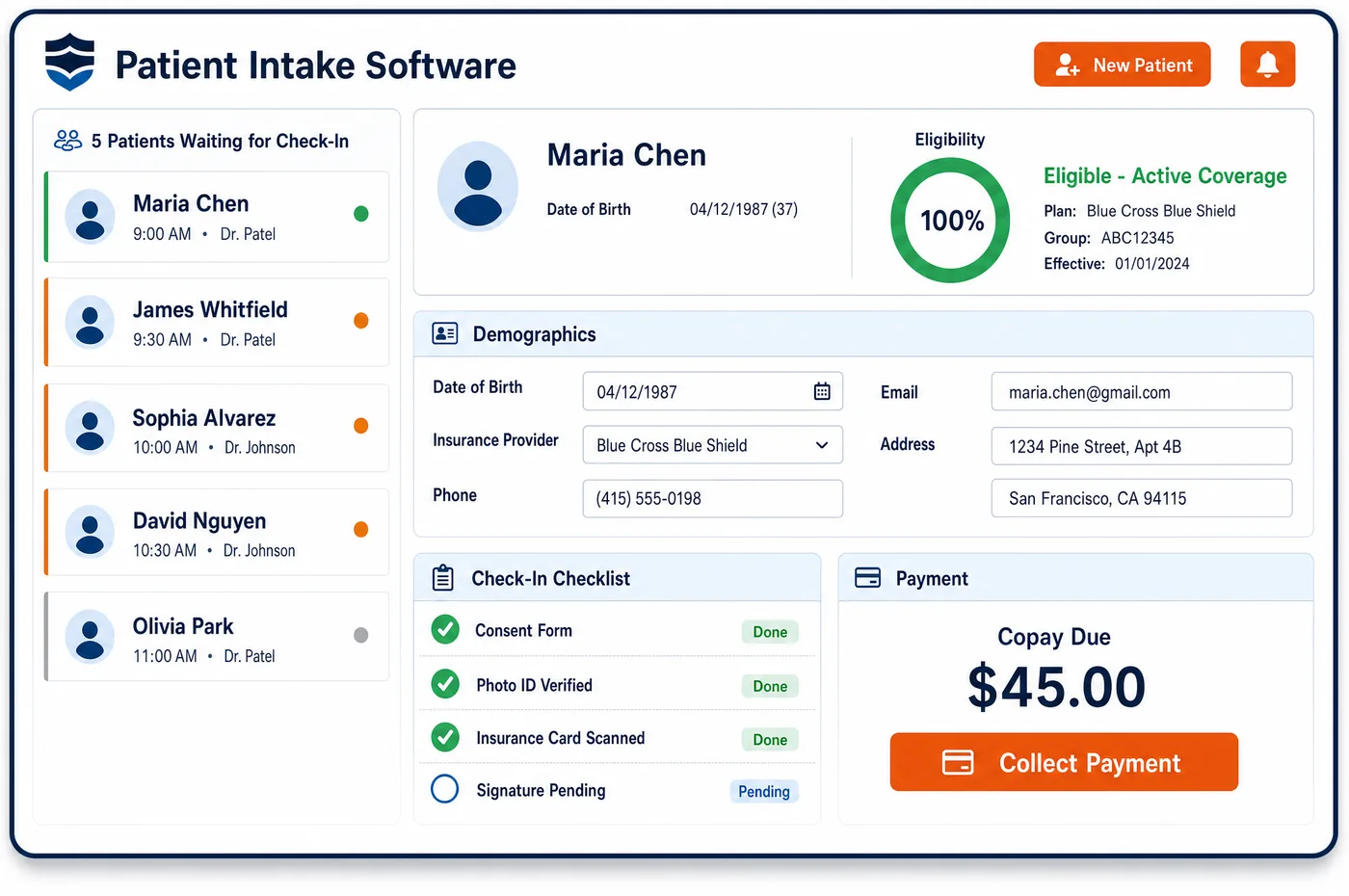
Patient Registration in a Addiction Medicine Practice
Registration often starts while the patient is still deciding to come in, so it has to be quick and calm. Staff search for an existing record first, since many patients have been seen before. They enter name, date of birth, address and a safe way to reach the person, noting whether texts or voicemail are allowed. Coverage comes next: the medical plan, any behavioral health carve-out, Medicare Part B for an OTP patient, or a state program. If no coverage is found, staff note the funding source the program will bill instead. Then comes consent. A Part 2 program needs written consent with set elements before it can bill or share records, and a minor may need to sign alone. Addiction medicine patient registration software checks each element, so a form missing a purpose or a signature is caught at the desk, not by an auditor.
Why Is Patient Registration Different in Addiction Medicine?
Patients often arrive at a hard moment, sometimes straight from an emergency room or a court referral. Some have no ID card with them, use a different name with the program, or share a phone. Registration has to collect enough to bill and to reach the patient safely, without turning the first contact into a barrier.
Coverage is rarely one card. A single patient can have a Medicaid managed care plan that sends SUD services to a behavioral health vendor, Medicare that pays an OTP under Part B, and a state program that pays for what neither covers. Federal block grant rules expect programs to bill other payers first and to charge patients by their ability to pay. Registration is where all of that is sorted out.
Consent carries more weight here than in most specialties. In a Part 2 program, a claim is itself a disclosure for payment, so the program needs a valid written consent before it bills. That consent must hold set elements, from the purpose to the expiration. Getting it right at patient registration protects both the patient's privacy and the claim.
What Addiction Medicine Patient Registration Software Handles
- Required consent elements (42 CFR 2.31)
- A Part 2 consent must name the patient, who may disclose, what information, the recipients, the purpose, the right to revoke, an expiration, a signature and a date. Registration checks each field before the form is saved as complete. (eCFR 42 CFR 2.31: Consent requirements)
- TPO purpose and expiration wording
- For a single consent covering treatment, payment and health care operations, the phrase "for treatment, payment, and health care operations" is a sufficient purpose. An expiration of "end of the treatment" or "none" is also allowed, so staff use that standard wording. (eCFR 42 CFR 2.31: Consent requirements)
- Minors where state law requires a parent
- If state law requires a parent's consent for a minor's treatment, both the minor and the parent must sign any consent to disclose. Registration records which rule the state follows before a parent is listed as guarantor. (eCFR 42 CFR 2.14: Minor patients)
- Medicare OTP cost sharing
- Medicare charges no copayment for codes billed by OTPs, but the Part B deductible still applies. Registration flags Medicare OTP patients so the front desk quotes the deductible, not a copay. (Medicare Claims Processing Manual, Chapter 39: Opioid Treatment Programs (Rev. 13572, 2026))
- Program modifiers tied to enrollment (Washington Medicaid)
- Washington Apple Health uses modifiers such as HF for a substance abuse program and HD for a pregnant and parenting women program. Registration records the program a patient is enrolled in, so later claims carry the right modifier. Other states set their own rules. (Washington Apple Health (Medicaid) Substance Use Disorder Billing Guide, October 2025)
- Block grant as payment of last resort (45 CFR 96.137)
- For the services it governs, block grant funding is the payment of last resort, and programs must try to bill other payers first. Registration records every coverage found and the patient's ability to pay before grant funds are used. (eCFR 45 CFR 96.137: Payment schedule (block grant as payment of last resort))
How Does Addiction Medicine Patient Registration Software Work?
1. Search before creating
Staff search by name, date of birth and phone before making a new record. A likely match is shown first, so a returning patient keeps their history and consents.
2. Record identity and safe contact
Legal name, any name the patient prefers and date of birth are entered with a contact method the patient says is safe. Text and voicemail permissions are saved for later reminders.
3. Capture every source of payment
The medical plan, any carve-out, Medicare and state programs are entered with member IDs. An electronic eligibility check confirms each one, and gaps go to addiction medicine financial clearance.
4. Complete the Part 2 consent
The consent is built from a template that holds every required element. Patients can sign on their own phone or a tablet, and a counseling notes consent stays separate.
5. Hand off to intake
Once the record is complete, the patient gets a link to forms for addiction medicine patient intake. Everything registered here then feeds the shared patient record.
Addiction Medicine Patient Registration Software vs. Generic Software
| Area | Generic approach | Unlimited Systems |
|---|---|---|
| Duplicate records | A new chart each time a patient comes back. | Search and match before a record is created. |
| Consent forms | Paper forms with missing elements found later. | Each required element is checked at the desk. |
| Funding source | Grant or state funding noted in a comment. | Funding source recorded as its own payer line. |
| Medicare OTP patients | Quoted a copay that doesn't apply. | Flagged for the Part B deductible instead. |
| Contact safety | One phone number with no permissions. | Safe contact method and text or voicemail consent saved. |
Who Uses It in a Addiction Medicine Practice
- Intake coordinator: A short, guided registration that catches a missing signature or member ID before the patient leaves.
- Compliance officer: Part 2 consents with every required element, stored with dates and any revocation, ready for review.
- Billing staff: Clean coverage and funding data from day one, so claims go to the right Medicaid managed care plan, vendor or program.
Addiction Medicine Patient Registration Software FAQs
Patient registration in addiction treatment captures identity, safe contact details, every source of payment and a Part 2 consent. Coverage can include Medicaid managed care, a behavioral health carve-out, Medicare for OTP care, a commercial plan, or state and grant funding. The consent must hold each required element. With all of this on one record, intake, scheduling and billing start from the same facts.
A claim shares patient information with a payer, so for a Part 2 program it is a disclosure for payment. That disclosure needs written consent unless an exception applies. Since the 2024 rule, one consent can cover all future uses for treatment, payment and health care operations. Collecting that consent at registration means the first claim can go out without a hold.
Staff first run an eligibility search, since some patients have Medicaid or other coverage they don't know about. If none is found, the record names the program that will pay, such as a state or grant-funded program, and the patient's ability to pay is recorded. Block grant rules expect other payers to be billed first, so this order matters.
Medicare charges no copayment for the codes an OTP bills, though the Part B deductible still applies. Registration flags these patients so front desk staff don't quote a copay. Patients with both Medicare and Medicaid are registered with both plans, so the deductible can be sent to Medicaid where the state covers it.
Patients can complete registration from their own phone before the first visit. They enter contact details, photograph their insurance card and sign consents on screen. Staff review the entries, confirm coverage and finish anything missing. This helps patients who are anxious about the waiting room and gets the record ready before they arrive.
A returning patient is matched to their existing record by name, date of birth and phone. Staff update the address and coverage, run a new eligibility check and confirm whether the old consent is still valid or was revoked. The past treatment history stays in place, so clinicians and billing staff see the full picture from the first day back.
Related Addiction Medicine Software
Front office
In the revenue cycle
Patient Registration for related specialties
Sources
- eCFR 42 CFR 2.31: Consent requirements
- eCFR 42 CFR 2.14: Minor patients
- Medicare Claims Processing Manual, Chapter 39: Opioid Treatment Programs (Rev. 13572, 2026)
- Washington Apple Health (Medicaid) Substance Use Disorder Billing Guide, October 2025
- eCFR 45 CFR 96.137: Payment schedule (block grant as payment of last resort)
- Federal Register: Confidentiality of Substance Use Disorder (SUD) Patient Records final rule (2024)
GET STARTED
See Unlimited Systems in Action
Whether you're actively evaluating new technology or simply preparing for your next vendor renewal, Unlimited Systems can help you understand where your current workflows may be creating avoidable revenue risk.