

Payments & AR
Addiction Medicine Payment Posting Software
Post OTP weekly bundles, carve-out remits, drug-test denials and grant payments to the right line and the right funding source.
Addiction Medicine Payment Posting Software applies remittances, grant payments and patient money to each addiction treatment claim line. It posts OTP weekly bundles apart from their add-on lines, sorts drug-test frequency denials from wrong-payer denials, and keeps Medicare, Medicaid, carve-out and grant dollars apart so every balance stays true.



 6,500+ specialty providers

Payment Posting in a Addiction Medicine Practice
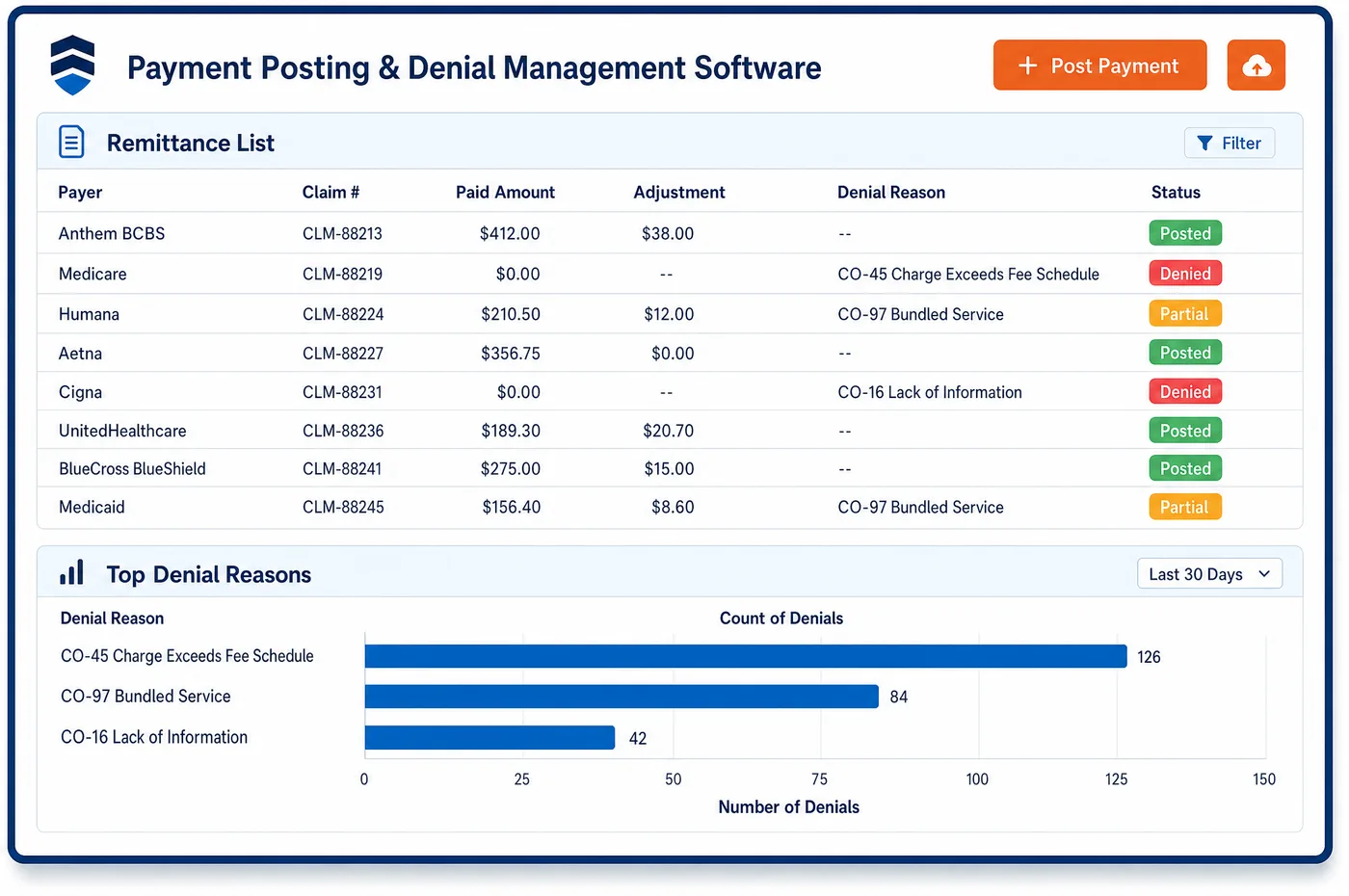
A week of opioid treatment program care can produce one claim with several lines. The weekly bundle, such as G2067 for methadone or G2068 for oral buprenorphine, sits beside add-ons for intake, a periodic assessment, a take-home supply or extra counseling. A payer can pay the bundle and deny an add-on, so each line has to post on its own. Office-based practices see a different mix of monthly treatment codes, E/M visits, long-acting injections and urine drug tests. Unlimited Systems imports each 835, matches it to the claim, and posts paid amounts, contractual adjustments and patient share line by line. Zero-pay lines go to a queue with their reason code attached. Money that arrives without an 835, such as a state contract payment or a grant draw, posts against the funding source it came from. Staff can then see what each payer, and each grant, paid for each week of care.
Why Is Payment Posting Different in Addiction Medicine?
Addiction treatment is paid by more kinds of payers than most outpatient care. One patient's counseling may be paid by a behavioral health carve-out, the lab test by the medical plan, and uncovered weeks by a state contract or block grant. Medicaid adds a layer, because each state decides whether SUD services sit inside the managed care plan or outside it. Each source pays in its own way, and only some of them send an 835.
OTP claims also post differently from visit claims. Medicare pays an OTP one weekly bundle for each run of seven days in a row, with add-on codes for take-home doses, extra counseling and naloxone. Medicare charges no copayment for OTP services, but the Part B deductible still applies. Early in the year, a remit can show patient responsibility on a service that has no copay. A poster who expects a copay, or a single visit line, will misread it.
Drug testing is the third pressure point. Presumptive tests (80305 to 80307) and Medicare's definitive codes (G0480 to G0483) are watched closely for frequency and need. A payer may deny a test as too frequent, as not needed, or as part of an OTP bundle that already pays for toxicology. Each of those outcomes needs a different fix. When payment posting reads the reason code on each line, the right person gets the right denial on the day the remit lands.
What Addiction Medicine Payment Posting Software Handles
- OTP weekly drug bundles (G2067, G2068, G0533)
- Each bundle posts as its own line under the week it covers. Medicare bills these bundles no more than once per patient in a run of seven days, so a second paid bundle in the same week is flagged for review unless modifier 59 and a documented reason are on the claim. (CMS: Opioid Treatment Program (OTP) Billing and Payment)
- OTP add-on lines (G2076 to G2080)
- Intake, periodic assessment, take-home supply and extra counseling add-ons post apart from the bundle. A denied G2080 counseling add-on stays visible instead of hiding inside a partly paid claim. (CMS: Opioid Treatment Program (OTP) Billing and Payment)
- Part B deductible on OTP claims
- CMS states there is no copayment for OTP services but the Part B deductible applies. Deductible amounts post as patient responsibility and move to the patient account, not to a copay field. (CMS: Opioid Treatment Program (OTP) Billing and Payment)
- Toxicology inside the OTP bundle
- The weekly bundle descriptors include toxicology testing if performed. A separate drug-test line from the same OTP that comes back denied as included in another service (CARC 97) posts at zero and goes to coding review. (Federal Register: CY 2020 Physician Fee Schedule final rule, OTP bundle codes G2067 to G2080 (84 FR 62568))
- CARC 151 and CARC 50 on drug tests
- A frequency denial (151) and a medical necessity denial (50) post at zero with the reason attached. They route to different queues, since one needs a frequency check and the other needs the clinician's documented reason. (X12 Claim Adjustment Reason Codes)
- CARC 109 from carve-out plans
- A wrong-payer denial posts at zero and routes to rebilling with the payer named on the remit. That is common when the medical plan receives a claim that belongs to a behavioral health vendor. (X12 Claim Adjustment Reason Codes)
- Block grant and state program payments
- Block grant money is meant to be the payment of last resort under 45 CFR 96.137. Grant and contract payments post to their funding source after insurance has paid or denied, so the grant is not charged for care a payer covers. (eCFR: 45 CFR 96.137, Payment schedule (block grant as payment of last resort))
How Does Addiction Medicine Payment Posting Software Work?
1. Import every remittance
ERA files from Medicare, Medicaid plans, carve-out vendors and commercial payers are imported as they arrive. Each one is matched to its claim by claim number and line, with 835 posting rules applied to clean lines.
2. Post bundles and add-ons line by line
The OTP bundle, each add-on, each E/M visit and each drug test post on their own. Paid amounts, contractual adjustments and patient share go to the line they belong to.
3. Sort denials by reason
Payment posting groups zero-pay lines by CARC and RARC. Frequency and necessity denials on drug tests go to coding, and wrong-payer and authorization denials go to the team that works aging addiction treatment claims.
4. Post non-835 money to its source
State contract payments, grant draws and county vouchers are posted against the funding source and the service period they cover. Each one is applied only after the insurance result is known.
5. Apply patient payments and reconcile
Deductibles, sliding fee amounts and self-pay fees post to the same account, and what is left moves to patient statements. Posted totals are then matched to bank deposits and grant receipts.
Addiction Medicine Payment Posting Software vs. Generic Software
| Area | Generic approach | Unlimited Systems |
|---|---|---|
| OTP claims | Bundle and add-ons posted as one blended payment. | Each bundle and add-on line posted with its own adjustment. |
| Drug-test denials | Every denial dropped into one general queue. | Frequency, necessity and bundling denials routed by reason code. |
| Carve-out remits | Wrong-payer denials found at month end. | CARC 109 lines sent to rebilling as soon as they post. |
| Grant payments | Grant money posted as a lump sum with no service detail. | Grant and contract payments tied to a funding source and service period. |
| Medicare OTP deductible | Deductible read as a copay error. | Deductible posted as patient share on the OTP line. |
Who Uses It in a Addiction Medicine Practice
- Payment poster: Remits that post line by line, with only the exceptions left to work. Each zero-pay line already shows its reason code and its next step.
- Billing manager: Denials by payer and reason, split between drug tests, OTP add-ons and wrong-payer claims, so setup problems are fixed at the source.
- Program director: Payments by funding source, including each grant and state contract, posted after insurance. That supports the funding source accounting the program reports on.
Addiction Medicine Payment Posting Software FAQs
Payment posting treats the OTP bundle and each add-on as separate lines. The weekly bundle, such as G2067, posts with its own paid amount and adjustment. Intake, assessment, take-home and counseling add-ons post on their own lines. If one add-on is denied, it stays visible at zero with its reason code, so staff can see what was paid for that week.
Medicare charges no copayment for OTP services, but the Part B deductible applies. Until the patient meets the deductible, part of the OTP payment can show as patient responsibility on the remit. That amount posts as a deductible and moves to the patient account. It should not be treated as a copay error or written off without a policy reason.
A frequency denial, usually CARC 151, posts at zero and goes to a coding queue. Staff check the test against the payer's frequency rules and the treatment phase in the record. If the clinician documented why the extra test was needed, the claim can be appealed. If not, it may be adjusted under practice policy.
Grant draws, state contract payments and county vouchers often arrive without an 835. They are posted against their funding source and the service period they cover. Because block grant money is meant to be the payment of last resort, staff apply it only after insurance has paid or denied the claim for that service.
A wrong-payer denial, CARC 109, posts at zero with the denying payer recorded. The claim then goes to rebilling, where staff send it to the behavioral health vendor or Medicaid plan that holds the benefit. Because the denial is caught when it posts, the claim can be resent before the right payer's filing limit runs out.
Posted insurance payments, patient payments and grant receipts are matched to bank deposits and lockbox files. Electronic funds transfers are paired with their 835. Cash, adjustments and recoveries post as double-entry lines for the general ledger, so month-end close starts from numbers that agree with the bank.
Related Addiction Medicine Software
Payments & AR
In the revenue cycle
Payment Posting for related specialties
Sources
GET STARTED
See Unlimited Systems in Action
Whether you're actively evaluating new technology or simply preparing for your next vendor renewal, Unlimited Systems can help you understand where your current workflows may be creating avoidable revenue risk.