

Payments & AR
Psychiatry Payment Posting Software
Post carve-out, medical plan and patient payments for psychiatric visits to one ledger, line by line.
Psychiatry Payment Posting Software applies 835 remittances and patient payments to each psychiatric claim line. It reads CARC and RARC codes from medical plans and behavioral health carve-out payers. It posts the E/M and psychotherapy add-on lines on their own, and ties every payment back to the bank deposit it came in.



 6,500+ specialty providers

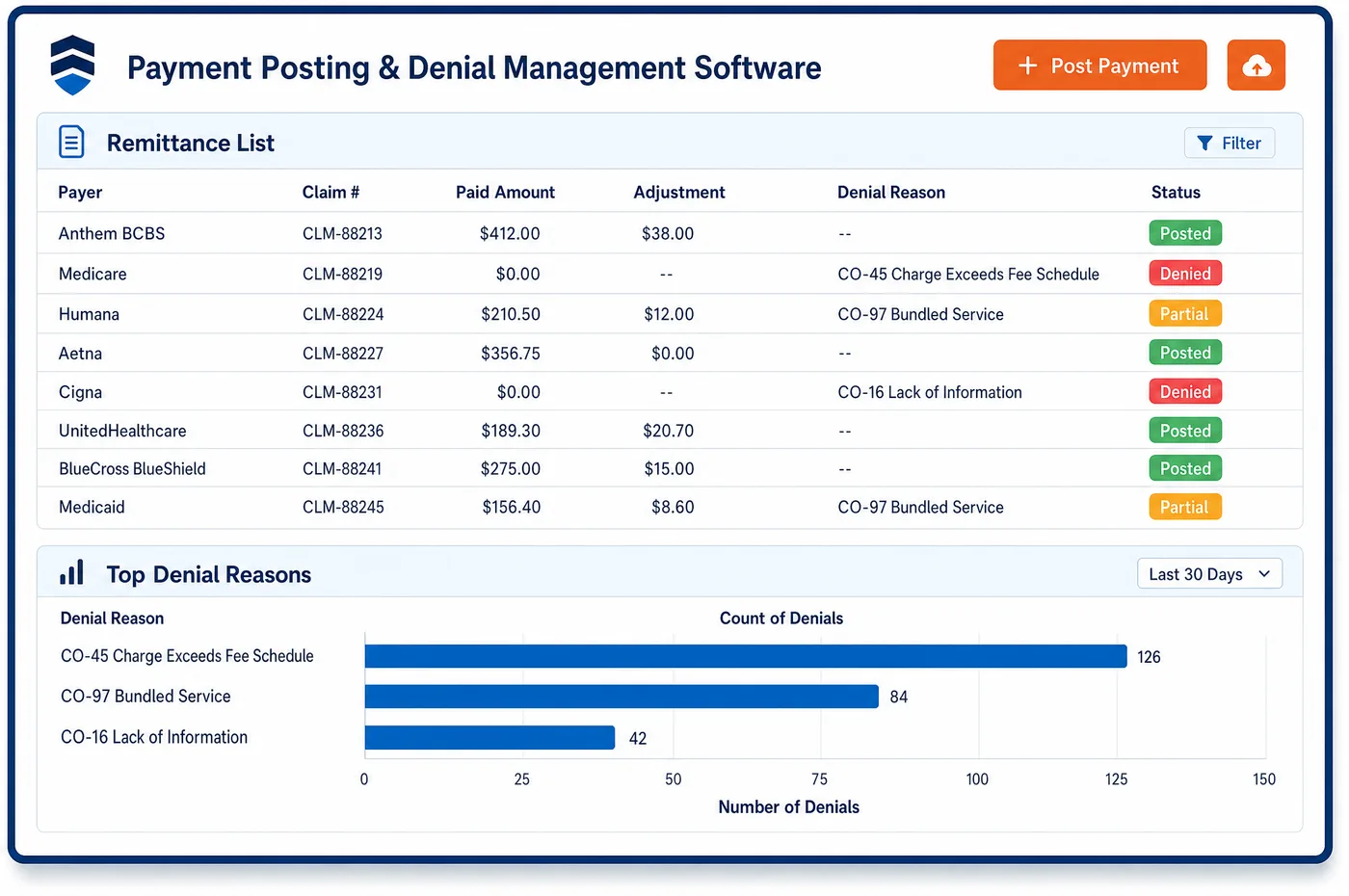
Payment Posting in a Psychiatry Practice
One psychiatric patient can create payments from two or three sources. The medical plan may pay for a lab or an E/M visit, while a behavioral health organization pays for therapy. Each payer sends its own electronic remittance under its own payer ID. Unlimited Systems imports each 835, matches it to the original claim, and posts paid amounts, contractual adjustments and patient responsibility at the line level. That matters because a visit billed as 99214 with 90833 can come back with the E/M paid and the add-on denied. The poster sees both lines, not a blended total. Telehealth lines that return with a modifier or place-of-service remark go to a correction queue. Patient payments, such as card-on-file charges for copays and late cancellations, post to the same ledger. At the end of the day, posted totals are matched to deposits so the books close on real cash.
Why Is Payment Posting Different in Psychiatry?
Psychiatry has more payers per patient than most specialties. Many health plans hand mental health benefits to a separate behavioral health carve-out with its own claims address, fee schedule and remittance. A practice can post an ERA from the medical plan in the morning and one from the carve-out that afternoon for the same person. If staff treat them as one payer, adjustments land on the wrong claim and balances stop making sense.
Psychiatric claims also split in ways that confuse simple posting rules. An E/M service and a psychotherapy add-on are separate lines with separate time rules, and a payer can pay one and deny the other. Timed codes such as 90834 and 90837 pay at different rates. A payment that matches the lower code may be an underpayment or a quiet recode. Each line needs its own reason code read and its own next step.
Then there is patient money. Self-pay and out-of-network therapy patients pay for every session, often with a card on file. Many practices also charge late cancellation and no-show fees. Those payments arrive outside the 835, yet they still have to reach the right visit. When payment posting keeps payer and patient money on one ledger, the front desk and the billing office see the same balance.
What Psychiatry Payment Posting Software Handles
- 835 remittances from carve-out payers
- Each behavioral health organization's 835 posts under its own payer ID. Carve-out payments never mix with the medical plan's remittance for the same patient. (X12 transaction sets: 835, 837, 276/277 and 270/271)
- CARC 45 contractual adjustments
- The amount over the allowed fee on therapy and E/M lines posts as a contractual adjustment. The allowed amount is then checked against the contracted rate for that code. (X12 Claim Adjustment Reason Codes)
- CARC 197 and CARC 109 denials
- Missing authorization (197) and wrong-payer (109) denials post at zero and route to follow-up with the reason attached. Both are common when benefits are carved out. (X12 Claim Adjustment Reason Codes)
- RARC M77 on telehealth lines
- A place-of-service remark on a video or audio-only visit sends the line to a correction queue. The billed POS 02 or 10 and the 95 or 93 modifier are shown beside it. (X12 Remittance Advice Remark Codes)
- Add-on codes 90833, 90836 and 90838
- Psychotherapy add-on lines post apart from the E/M line they ride with. A denied add-on stays visible instead of hiding inside a partial payment. (CMS Billing and Coding Article A57520: Psychiatric Diagnostic Evaluation and Psychotherapy Services)
- POS 02 and POS 10 payment rates
- Medicare pays POS 02 at the facility rate and POS 10 at the non-facility rate. The expected amount follows the POS on the line, so short pays are judged against the right rate. (CMS Medicare Claims Processing Manual, Chapter 26 (POS 02 and 10, modifiers 93 and 95))
How Does Psychiatry Payment Posting Software Work?
1. Import the 835
ERA files from medical plans and carve-out payers are imported as they arrive. Each one is matched to its original claim by claim number and line.
2. Post line by line
Paid amounts, contractual adjustments and patient responsibility post to each CPT line. An E/M line and its psychotherapy add-on are posted on their own.
3. Check against contract
Each payment is compared with the expected contracted amount for that code and payer. Short payments on timed therapy codes go to an underpayment queue.
4. Route denials and takebacks
Zero-pay lines and recoupments are routed by reason code. Wrong-payer and authorization denials go to the team that works open insurance balances.
5. Apply patient payments
Copays, self-pay session fees and card-on-file charges post to the same account. What is left moves on to patient statements.
6. Reconcile to deposits
Posted totals are matched to bank deposits and lockbox files. Cash, adjustments and recoveries post as double-entry lines for the general ledger.
Psychiatry Payment Posting Software vs. Generic Software
| Area | Generic approach | Unlimited Systems |
|---|---|---|
| Carve-out remittances | Keyed by hand from paper EOBs or a separate portal. | Each carve-out 835 posts on its own under its payer ID. |
| Add-on lines | E/M and add-on payments blended into one visit total. | Each line posted with its own adjustment and reason code. |
| Contract checks | Short payments found only when someone audits a fee schedule. | Every payment compared with the expected amount for the code. |
| Telehealth remarks | Modifier and POS remarks read only when the claim is reworked. | Telehealth remarks sent to a correction queue at posting. |
| Patient payments | Card and cash payments kept in a separate system. | Patient payments post to the same ledger as insurance. |
| Deposits | Bank deposits matched in a spreadsheet at month end. | Posted totals matched to deposits every day. |
Who Uses It in a Psychiatry Practice
- Payment poster: A queue of only the remittance lines that did not post cleanly, with each CARC and RARC already turned into a next step.
- Billing manager: Short payments and denials by payer, including each behavioral health carve-out, so contract and setup problems get fixed at the source.
- Practice owner: Cash that ties to the bank, and a ledger that shows what each payer really pays for 90834, 90837 and E/M with add-ons.
Psychiatry Payment Posting Software FAQs
Payment posting treats each carve-out as its own payer. The 835 from the behavioral health organization posts under that payer's ID, even when the medical plan pays other services for the same patient. Adjustments and patient responsibility land on the claim lines the carve-out paid, so balances stay correct for both payers and for the patient.
When a payer pays the E/M line and denies the add-on, the two lines post separately. The E/M payment is applied, and the add-on posts at zero with its reason code. The add-on then goes to a follow-up queue, where staff check whether therapy time was documented apart from the E/M work.
Underpayment checks run on every timed psychotherapy line. Codes 90832, 90834 and 90837 carry different contracted rates, so each payment is compared with the expected amount for the code billed. A payment that matches a lower code is flagged for review. That can point to a payer error or to a claim the payer recoded.
Telehealth remarks are read as each 835 posts. A remark for an invalid place of service, or a reason code for a modifier that does not fit the procedure, sends the line to a correction queue. Staff see the POS 02 or 10 and the 95 or 93 modifier that was billed, so the fix and resubmission are quick.
Card-on-file charges post to the same patient ledger as insurance payments. With the patient's written authorization, copays, session fees and late cancellation fees can be charged under practice policy. Each charge is applied to the right visit or fee, so the balance the front desk sees matches the one the billing office sees.
Posted payments are matched to bank deposits and lockbox files. Electronic funds transfers are paired with their 835, and cash, adjustments and recoveries post as double-entry lines. Month-end close then starts from a ledger that already agrees with the bank, instead of a spreadsheet rebuilt after the fact.
Related Psychiatry Software
Payments & AR
In the revenue cycle
Payment Posting for related specialties
Sources
- X12 transaction sets: 835, 837, 276/277 and 270/271
- X12 Claim Adjustment Reason Codes
- X12 Remittance Advice Remark Codes
- CMS Billing and Coding Article A57520: Psychiatric Diagnostic Evaluation and Psychotherapy Services
- CMS Medicare Claims Processing Manual, Chapter 26 (POS 02 and 10, modifiers 93 and 95)
GET STARTED
See Unlimited Systems in Action
Whether you're actively evaluating new technology or simply preparing for your next vendor renewal, Unlimited Systems can help you understand where your current workflows may be creating avoidable revenue risk.