

Payments & AR
Behavioral Health Payment Posting Software
Post Medicaid plan, carve-out, Medicare, CCBHC and sliding-fee payments for every session and unit to one ledger that ties to the bank.
Behavioral Health Payment Posting Software applies 835 remittances, patient payments and CCBHC wraparound payments to each session line. It reads unit-based service lines, denials for exceeded authorizations and wrong-payer claims, and posts every adjustment as a ledger entry. Posted totals are then matched to the day's deposits, so month-end starts from cash that ties to the bank.



 6,500+ specialty providers

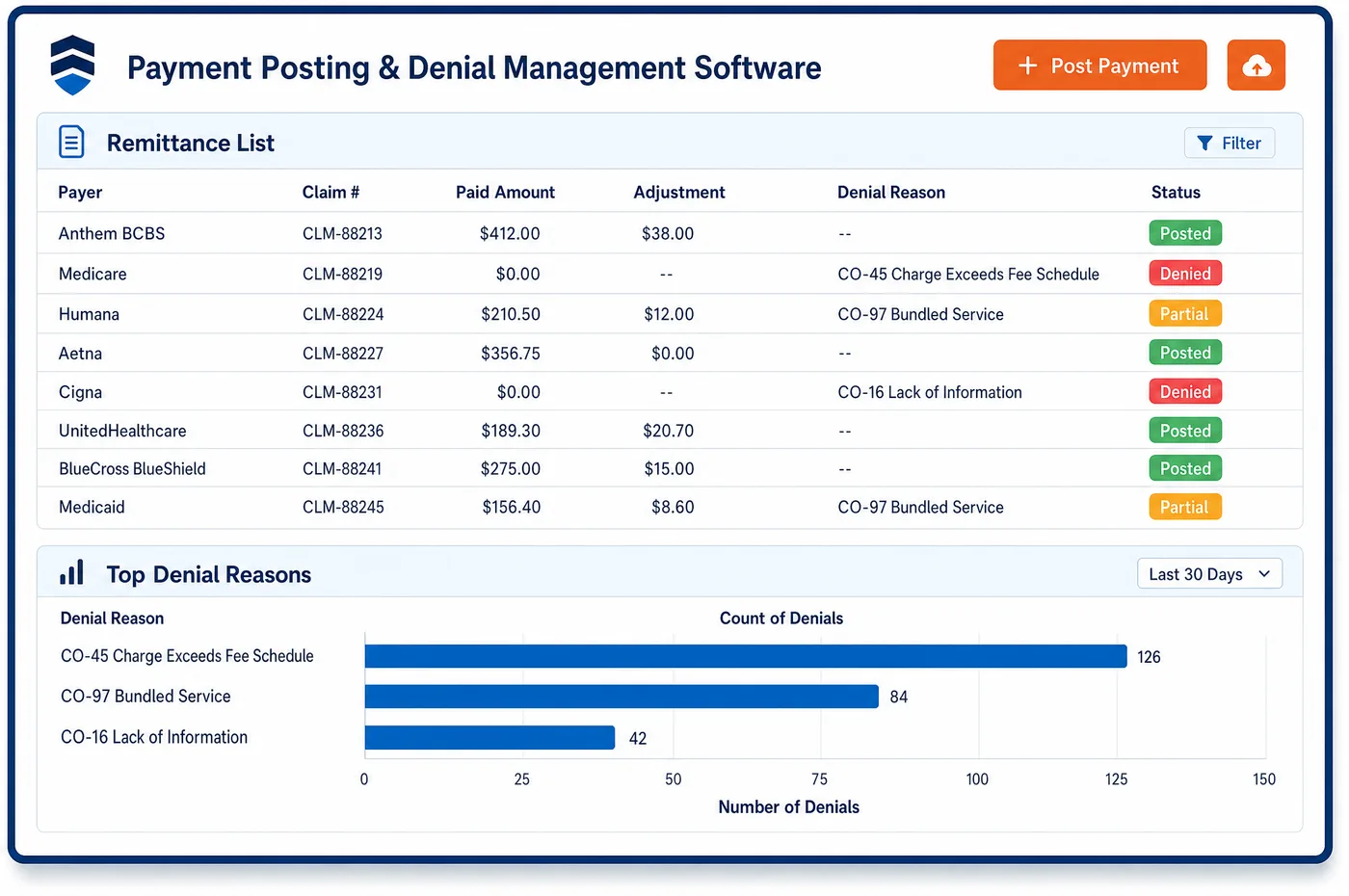
Payment Posting in a Behavioral Health Practice
A community behavioral health organization may post money from many sources in one week. Medicaid health plans pay for therapy, case management and peer support. A carve-out pays for some members, Medicare pays for others, and a grant covers people with no coverage at all. Unlimited Systems imports each 835 remittance file, matches it to the original claim, and posts paid amounts, contractual adjustments and patient share line by line. That matters because many Medicaid services are billed in units, and a plan may pay only part of a six-unit H2019 line. The short pay shows as units, not a blended total. Lines denied for an exceeded authorization or for the wrong payer go to a queue with the reason attached. Sliding-fee payments and card payments post to the same account. For a CCBHC, the daily or monthly encounter line posts next to the service lines it covers.
Why Is Payment Posting Different in Behavioral Health?
Few kinds of care are paid by as many payers as behavioral health. A single organization may bill Medicaid managed care plans, a behavioral health carve-out, Medicare, commercial plans, employee assistance programs and county contracts, all in the same week. Each payer sends its own remittance with its own payer ID and its own way of reporting units. Some grant and contract funders send no remittance at all. Posting has to keep each source apart while still showing one balance per client.
Units make the lines harder to read. Community support, skills training, peer support and case management are often billed per 15 minutes under HCPCS codes such as H2017, H0038 and T1016. A plan can pay some units and deny the rest when an authorization runs out. If posting rolls those lines into a visit total, nobody sees that four units were lost to an expired approval.
CCBHCs add a payment model of their own. A clinic paid under the CCBHC prospective payment system receives a clinic-specific daily or monthly rate, billed on an encounter line. The service lines under it may pay at zero by design. Where the state pays health plans and then makes a wraparound payment for the gap, that money arrives outside the 835 and still has to land on the right encounters. Payment posting in behavioral health has to understand all three patterns.
What Behavioral Health Payment Posting Software Handles
- T1040 and T1041 encounter lines
- CCBHCs bill demonstration encounters with T1040 (per diem) or T1041 (per month), and modifier Q2 can carry service-level detail. The encounter payment and its detail lines post together, so a zero-pay detail line is not mistaken for a denial. (Medicaid.gov: CCBHC Billing Codes (T1040, T1041 and modifier Q2))
- CCBHC wraparound supplemental payments
- Under one CMS option, the state pays the difference between the health plan payment and the clinic's PPS rate directly to the CCBHC. That payment posts against the encounters it covers, and the expected rate shows which encounters are still short. (CMS: Section 223 CCBHC Demonstration Prospective Payment System Guidance (updated February 2024), Section 6: Managed Care Considerations)
- CARC 198 and CARC 119 on unit lines
- Exceeded authorization (198) and benefit maximum (119) denials post at zero for the units refused. The line goes to follow-up with the units denied and the authorization number beside it. (X12 Claim Adjustment Reason Codes)
- CARC 185 and CARC 170 for practitioner type
- These codes mean the rendering clinician, or that type of provider, is not paid for the service. They route to the team that handles enrollment, because the fix is usually setup rather than coding. (X12 Claim Adjustment Reason Codes)
- Per-unit HCPCS codes such as H2019 and H0036
- Medicaid programs such as Arizona's bill H2019 and H0036 per 15 minutes. Paid units are posted against billed units for each line, so a partial payment is read in units. (AHCCCS (Arizona Medicaid) Covered Behavioral Health Services Guide, effective October 1, 2026)
- Sliding fee discounts (CCBHC criteria 2.d)
- CCBHCs must publish a sliding fee discount schedule that covers all their services. The discount posts as its own adjustment, apart from contractual write-offs, so it can be reported on its own. (SAMHSA: CCBHC Certification Criteria (criteria 2.d, sliding fee discount schedule))
How Does Behavioral Health Payment Posting Software Work?
1. Import remittances by payer
835 files from health plans, carve-outs and Medicare are imported as they arrive. Each one is matched to its claim by claim number and line, under that payer's own ID.
2. Post line by line and unit by unit
Paid amounts, contractual adjustments and patient share post to each service line. Units paid are recorded beside units billed.
3. Compare with the expected amount
Each payment is checked against the contract rate for the code, or the PPS rate for a CCBHC encounter. Short payments go to an underpayment queue.
4. Route denials by reason
Authorization, wrong-payer and practitioner-type denials are sent to the right owner with the reason code turned into a next step. Plan balances that stay open move to AR follow-up.
5. Apply client payments
Copays, sliding-fee payments and card payments post to the same account. What is left moves on to client statements.
6. Reconcile deposits
Posted totals are matched to bank deposits and lockbox files, including wraparound payments that arrive without an 835. Cash and adjustments post as double-entry lines for the finance team.
Behavioral Health Payment Posting Software vs. Generic Software
| Area | Generic approach | Unlimited Systems |
|---|---|---|
| Payer mix | Medicaid plans, carve-outs and grants posted by hand from portals. | Each 835 posts under its own payer ID, and non-835 payments are matched to encounters. |
| Unit-based lines | Partial unit payments blended into a visit total. | Units paid and units denied shown on every line. |
| CCBHC encounters | Zero-pay detail lines worked as if they were denials. | Encounter and detail lines posted together. |
| Contract checks | Short pays found when someone audits a fee schedule. | Each payment compared with the expected rate for the code or encounter. |
| Sliding fees | Discounts mixed in with contractual write-offs. | Sliding-fee discounts posted as their own adjustment. |
| Deposits | Bank lines matched in a spreadsheet at month end. | Each day's posting tied to that day's bank deposits. |
Who Uses It in a Behavioral Health Practice
- Payment poster: A queue of only the lines that did not post cleanly, with units, reason codes and the next step already shown.
- Revenue cycle director: Short pays and denials by payer and by program, so a plan that keeps paying fewer units than billed gets raised at the next contract meeting.
- CFO: Cash that ties to the bank, with wraparound payments, sliding-fee discounts and plan payments each visible on their own lines.
Behavioral Health Payment Posting Software FAQs
Payment posting records units paid next to units billed on every line. When a plan pays part of a per-unit service such as H2019 or H0036, the short pay is shown as units. The poster can then see whether the plan cut units for an expired authorization, a benefit limit or a rate problem, and send it to the right person.
A CCBHC encounter is billed on a T1040 or T1041 line, often with service detail lines marked with modifier Q2. The encounter payment posts to the encounter line, and the detail lines post with it, even when they pay at zero. Each payment is compared with the clinic's PPS rate, so short encounter payments are flagged.
A wraparound payment covers the gap between what a health plan paid and the clinic's PPS rate. It usually arrives without an 835. Staff apply it to the encounters it covers, and the account then shows whether each encounter reached the full rate. Any gap left over stays visible for follow-up with the state.
Denials such as CARC 185 or CARC 170 mean the plan will not pay that clinician, or that kind of provider, for the service. They are routed apart from coding denials, to staff who handle enrollment and credentialing. That matters in a team with counselors, social workers, therapists and peer staff who are enrolled differently by each plan.
Sliding-fee discounts post as their own adjustment type, separate from contractual adjustments and bad debt. The organization can then report how much care it discounted under its published schedule. For a CCBHC, that schedule is required by the certification criteria and must cover every service the clinic offers.
Posted payments are matched to bank deposits and lockbox files every day. Electronic funds transfers are paired with their 835, and payments without a remittance, such as wraparound or grant payments, are matched by hand to the deposit. Cash and adjustments post as double-entry lines, so the general ledger and the billing record agree.
Related Behavioral Health Software
Payments & AR
In the revenue cycle
Payment Posting for related specialties
Sources
- X12 transaction sets: 835 Health Care Claim Payment/Advice and 837 claims
- X12 Claim Adjustment Reason Codes
- Medicaid.gov: CCBHC Billing Codes (T1040, T1041 and modifier Q2)
- CMS: Section 223 CCBHC Demonstration Prospective Payment System Guidance (updated February 2024), Section 6: Managed Care Considerations
- AHCCCS (Arizona Medicaid) Covered Behavioral Health Services Guide, effective October 1, 2026
- SAMHSA: CCBHC Certification Criteria (criteria 2.d, sliding fee discount schedule)
GET STARTED
See Unlimited Systems in Action
Whether you're actively evaluating new technology or simply preparing for your next vendor renewal, Unlimited Systems can help you understand where your current workflows may be creating avoidable revenue risk.