

Payments & AR
Addiction Medicine AR Management Software
Work open addiction treatment claims by payer type, filing deadline and fix, from carve-out rebills to drug-test appeals.
Addiction Medicine AR Management Software tracks every unpaid claim across Medicare, Medicaid plans, behavioral health carve-outs, commercial payers and grant programs. It ranks open claims by value and filing deadline, checks claim status in bulk, and sends each one to the fix it needs, whether that is a rebill, an appeal or a grant claim.



 6,500+ specialty providers

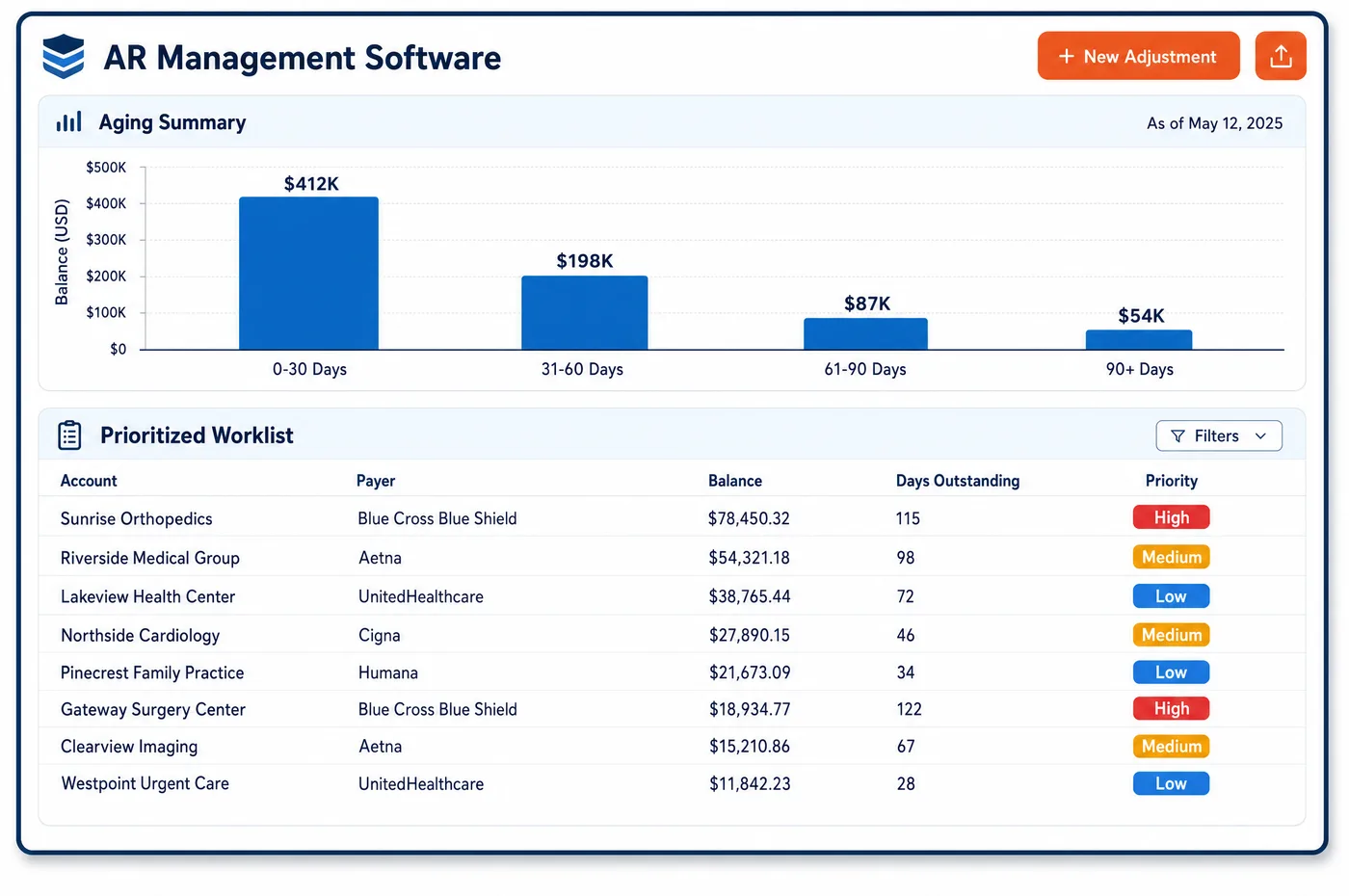
AR Management in a Addiction Medicine Practice
Open AR in an addiction practice is spread across payer types that act very differently. A Medicare OTP claim has a federal filing limit. A Medicaid managed care plan has its own limit in its provider contract. A carve-out vendor may never have received the claim at all because it went to the medical plan first. Unlimited Systems builds daily worklists from all of these, ordered by balance, payer and days left to file. Claim status requests (276) go out in bulk, and the 277 replies sort claims into paid, pending, denied or not on file. Denied drug tests go to a queue with the order and the clinician's reason attached. Wrong-payer claims go to rebilling. Balances that insurance will not pay are checked against grant rules before they move to the patient. Collectors spend their time on claims that can still be paid.
Why Is AR Management Different in Addiction Medicine?
Payer type decides how a claim ages here. Medicaid is a major payer for addiction treatment, and many states carve behavioral health out of the managed care package. A claim can be denied by the medical plan, rebilled to a behavioral health vendor, and denied again for a missing authorization before anyone pays. Each hop uses filing time. AR that is worked oldest-first, with no view of payer type, lets these claims run out of time.
Drug-test claims are a large share of denials in many programs, and each one is small. A Medicare contractor's LCD can require an individualized written order and a documented reason for definitive testing. An appeal without those papers will fail. Good AR management sorts these claims by what is missing, so staff fix the order or the note problem once rather than writing many appeals that cannot win.
Grant-funded programs add one more rule. Block grant money is meant to be the payment of last resort, and funded programs must make reasonable efforts to collect from insurance first. A balance cannot simply be moved to the grant because a payer is slow. It has to be billed, followed up and denied or paid. The AR record is the proof that the program tried.
What Addiction Medicine AR Management Software Handles
- Medicare filing limit for OTP and office claims
- Under federal rules, a Medicare claim is due no later than one calendar year after its date of service. Medicare OTP and office claims carry that deadline on the worklist, and claims near it rise to the top. (eCFR: 42 CFR 424.44, Time limits for filing Medicare claims)
- Medicaid managed care and carve-out limits
- States can carve behavioral health out of the managed care benefit, so the right payer and its filing limit vary by state and plan. Each plan's limit from its provider contract is set up as a payer rule. (MACPAC: Types of managed care arrangements (benefit carve-outs))
- CARC 109 wrong-payer rebills
- Claims denied as belonging to another payer are rebilled to the carve-out vendor or Medicaid plan named on the remit. The worklist keeps the first filing date, so staff can show timely filing if the new payer asks. (X12 Claim Adjustment Reason Codes)
- Claim status inquiries (276/277)
- Status requests go out in bulk for unpaid claims. A not-on-file reply sends the claim back for resubmission, which often uncovers claims a carve-out never received. (X12 transaction sets: 835, 837, 276/277 and 270/271)
- Definitive drug-test appeals (G0480 to G0483)
- Under Novitas LCD L35006 for Medicare, definitive tests need an individualized order and a documented reason. Appeals are only built when the order and note are in the record. (CMS Medicare Coverage Database: LCD L35006, Controlled Substance Monitoring and Drugs of Abuse Testing (Novitas))
- Second OTP bundle in a week (modifier 59)
- Medicare allows a second weekly bundle in a run of seven days only with modifier 59 and a documented reason, such as moving a new patient onto the billing cycle. Denied second bundles are checked for that reason before an appeal. (CMS: Opioid Treatment Program (OTP) Billing and Payment)
- Block grant collection duty (45 CFR 96.137)
- Funded programs must try to collect from third-party payers and from patients by ability to pay. The AR trail of bills, status checks and denials supports the claim against the grant. (eCFR: 45 CFR 96.137, Payment schedule (block grant as payment of last resort))
How Does Addiction Medicine AR Management Software Work?
1. Build the daily worklist
Open claims are ordered by balance, payer type and days left to file. Medicare, Medicaid plan, carve-out, commercial and grant claims each follow their own timely filing rules.
2. Check status in bulk
Claim status requests go out for unpaid claims before anyone calls. Replies sort each claim into paid, pending, denied or not on file.
3. Send each denial to its fix
Wrong-payer claims go to rebilling and authorization denials go to the clearance team. Drug-test denials go to a coding queue, and true clinical disputes go to appeal work.
4. Bill secondary and grant payers
After the primary pays, any secondary payer is billed off the posted remit. Balances no payer will cover are checked against grant and state program rules before anything moves to the patient.
5. Watch aging by payer type
Aging is shown by payer type and program, with aging buckets for each. Managers see where claims stall, such as a carve-out that is slow to pay or a plan that keeps losing claims.
Addiction Medicine AR Management Software vs. Generic Software
| Area | Generic approach | Unlimited Systems |
|---|---|---|
| Worklist order | Claims worked oldest first. | Claims ordered by balance, payer type and filing deadline. |
| Carve-out claims | Wrong-payer denials rebilled when someone notices. | CARC 109 claims sent to rebilling with the right payer named. |
| Status checks | Phone calls and portal lookups one claim at a time. | Bulk 276 requests with replies sorted by status. |
| Drug-test appeals | Appeals written without checking the order. | Appeals built only when the order and reason are documented. |
| Grant balances | Slow claims moved to the grant to clear AR. | Grant claims made only after insurance is billed and resolved. |
Who Uses It in a Addiction Medicine Practice
- AR collector: One worklist ordered by what can still be paid, with status replies already sorted. Wrong-payer and drug-test claims arrive with the fix they need.
- Revenue cycle manager: Aging by payer type, program and site, with denial reasons broken out. The addiction medicine RCM view shows which payers hold the most money and why.
- Grants and compliance lead: A record that each grant-funded service was billed to insurance first. That trail supports grant claims and audits.
Addiction Medicine AR Management Software FAQs
AR management ranks open claims by balance, payer type and days left before the filing limit. A Medicare OTP claim near its deadline comes before a newer commercial claim. Carve-out and Medicaid plan claims follow the limits in each payer's contract. Collectors work from that list, so claims that can still be paid get attention first.
A not-on-file status reply or a wrong-payer denial sends the claim to rebilling. Staff send it to the carve-out vendor or Medicaid plan that holds the benefit and keep the original filing date on the record. Some payers accept proof of timely filing to the wrong payer, so that date can matter.
Some drug-test denials can be won and some cannot. Under the Novitas LCD for Medicare, definitive testing needs an individualized written order and a documented reason. If both are in the record, an appeal has a real basis. If either is missing, the better fix is to correct the ordering process so the same denial stops coming back.
Block grant money is meant to be the payment of last resort. Programs must make reasonable efforts to collect from insurance and other third parties first. A claim that is merely slow should be followed up, not shifted to the grant. Once the payer has denied or paid, the remaining balance can be handled under grant rules.
Medicare requires claims to be filed within one calendar year after the date of service, and CMS notes that a contractor may deny late OTP claims. AR worklists carry that deadline for each Medicare OTP and office claim. Claims close to it rise to the top, so they are fixed and filed before the window closes.
When the primary payer's remit posts, any secondary payer on file is billed for the remaining amount. For patients with both Medicare and Medicaid, this keeps the Medicaid claim moving without manual filing. The secondary claim then shows on the same worklist with its own filing limit.
Related Addiction Medicine Software
Payments & AR
In the revenue cycle
AR Management for related specialties
Sources
- eCFR: 42 CFR 424.44, Time limits for filing Medicare claims
- MACPAC: Types of managed care arrangements (benefit carve-outs)
- X12 Claim Adjustment Reason Codes
- X12 transaction sets: 835, 837, 276/277 and 270/271
- CMS Medicare Coverage Database: LCD L35006, Controlled Substance Monitoring and Drugs of Abuse Testing (Novitas)
- CMS: Opioid Treatment Program (OTP) Billing and Payment
- eCFR: 45 CFR 96.137, Payment schedule (block grant as payment of last resort)
GET STARTED
See Unlimited Systems in Action
Whether you're actively evaluating new technology or simply preparing for your next vendor renewal, Unlimited Systems can help you understand where your current workflows may be creating avoidable revenue risk.