

Analytics & value-based care
Addiction Medicine Reporting Software
Funder, state, payer and board reports for addiction programs, built from billing data and sent on a schedule.
Addiction Medicine Reporting Software produces the reports an addiction program owes its funders, state agency, payers and board. It runs standard financial and operational reports, builds custom ones, and sends each on a schedule. Reports are built from the same billing and scheduling data staff work in, split by program, site and funding source.



 6,500+ specialty providers

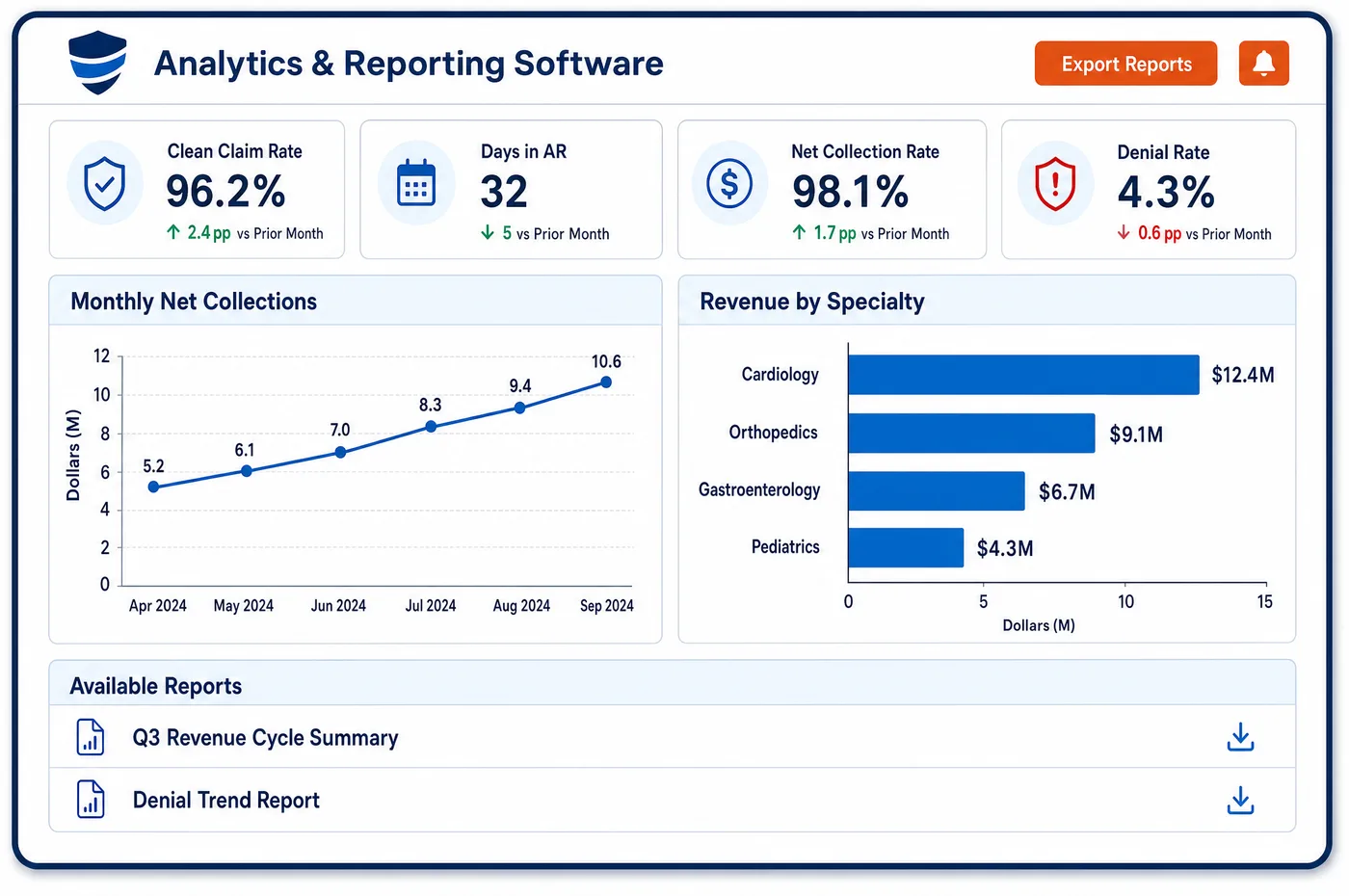
Reporting in a Addiction Medicine Practice
An addiction program reports to more audiences than most practices. The board wants collections, AR and margin by program. A grant funder wants services and people served under its award. The state agency collects admission and discharge records from publicly funded programs. Medicaid plans and carve-out vendors may ask for quality data, and MIPS clinicians report their own measures. Reporting for addiction medicine starts from one data set, so the counts in each report agree. Staff pick a standard report, such as services by funding source or AR by payer type, or build their own with filters for program, site, clinician and payer. Reports can run on a schedule and go to the people who need them in PDF or CSV form. Patient-level reports respect Part 2 limits, and summary reports can be built from de-identified counts when a funder only needs totals.
Why Is Reporting Different in Addiction Medicine?
Funding makes reporting heavier here. A program with a block grant, a state contract and county money may owe each funder a report on its own schedule and format. Each wants to know what its money bought. Building those reports by hand from billing exports takes staff time and often produces counts that do not match each other.
Quality reporting adds another layer. The 2026 Medicaid Adult Core Set includes treatment initiation and engagement, use of pharmacotherapy for OUD, and follow-up after an emergency visit for substance use. States report those measures, and plans often look to providers for data. Clinicians in MIPS may also report measure 468 on continuity of OUD medication. Each measure has its own logic, and each needs clean visit and medication data.
Privacy shapes what can go where. Records covered by 42 CFR Part 2 can only be disclosed as the rule allows, and the 2024 rule permits disclosure of de-identified records to public health authorities. Reporting tools have to let staff build patient-level lists for internal use and de-identified totals for outside audiences. Program analytics explain why numbers moved, and reports deliver them to the people who need them.
What Addiction Medicine Reporting Software Handles
- State TEDS admission and discharge data
- States collect admission and discharge records from publicly funded treatment programs and submit them to SAMHSA's Treatment Episode Data Set. Admission and discharge counts by program come from the same episodes billing uses, which helps staff check state submissions. (SAMHSA: Treatment Episode Data Set (TEDS))
- Medicaid Adult Core Set SUD measures (IET-AD, OUD-AD, FUA-AD)
- The 2026 Adult Core Set lists SUD initiation and engagement, a HEDIS measure, along with use of pharmacotherapy for OUD, and follow-up after an emergency visit for substance use. Patient lists for each measure help staff answer plan data requests. (Medicaid.gov: 2026 Core Set of Adult Health Care Quality Measures for Medicaid)
- MIPS 468 submission
- MIPS measure 468 is submitted at least once per performance period for eligible patients. Reports list each patient with their treatment start, days covered and any gap of more than seven days. (CMS QPP: 2026 Quality ID 468, Continuity of Pharmacotherapy for Opioid Use Disorder (MIPS CQM))
- Block grant service reports
- Block grant funds must be the payment of last resort. Grant reports show each service with its insurance result, so the funder sees that payers were billed first. (eCFR: 45 CFR 96.137, Payment schedule (block grant as payment of last resort))
- De-identified data under Part 2
- The 2024 Part 2 rule permits disclosure of de-identified records to public health authorities. Summary reports for outside audiences can be built from de-identified counts rather than patient lists. (Federal Register: Confidentiality of Substance Use Disorder Patient Records, final rule (February 16, 2024))
How Does Addiction Medicine Reporting Software Work?
1. Pick or build the report
Staff start from a standard report, such as services by funding source or AR by payer type, or build a custom one. Filters cover program, site, clinician, payer and date range.
2. Set the audience and privacy level
Each report is marked for internal use or outside sharing. Outside reports use summary or de-identified data where Part 2 requires it.
3. Schedule delivery
Reports run on a set schedule and go to named people in PDF or CSV form. Board packets, funder reports and payer data requests each get their own schedule.
4. Check the numbers
Totals in each report tie back to posted claims and payments. When a funder's count and a state count differ, staff can drill to the episodes behind each, using drill-down views.
5. Roll up across sites
Multi-site groups get one roll-up across every location, with each program still visible. Data can also be exported to the organization's data warehouse over HIPAA-secure links.
Addiction Medicine Reporting Software vs. Generic Software
| Area | Generic approach | Unlimited Systems |
|---|---|---|
| Funder reports | Built by hand from billing exports. | Run from posted billing data by funding source. |
| Quality data requests | Pulled from charts for each plan request. | Patient lists built for each SUD measure. |
| Privacy | Patient-level data sent when totals would do. | De-identified summaries for outside audiences. |
| Delivery | Emailed by staff when someone remembers. | Scheduled delivery to named people. |
| Multi-site | Each site sends its own spreadsheet. | One roll-up across every location. |
Who Uses It in a Addiction Medicine Practice
- Grants manager: Funder reports that run from billing data on schedule, with each service tied to its funding source and insurance result.
- Quality lead: Patient lists for core set measures and MIPS 468, ready when a plan or the state asks for data.
- Board and executive team: A regular packet with collections, AR and margin by program, built from the same numbers the billing office uses.
Addiction Medicine Reporting Software FAQs
Most programs need board reports on collections, AR and margin, funder reports on services by grant or contract, state admission and discharge data, and quality data for payers. Reporting from one data set keeps those counts consistent. Each report can be scheduled and sent to the people who need it, in the format they use.
Grant reports can be built from billing data when each service carries its funding source. The report lists services, people served and amounts charged to the grant, along with the insurance result for each service. That shows the funder what the award paid for and that other payers were billed first.
The 2026 Medicaid Adult Core Set includes initiation and engagement of SUD treatment, use of pharmacotherapy for opioid use disorder, and follow-up after an emergency visit for substance use. States report these measures. Plans often ask providers for data, so patient lists for each measure make those requests easier to answer.
Reports are marked for internal use or outside sharing. Patient-level lists stay inside the program, and access is set by role. For outside audiences, summary reports can use de-identified counts. The 2024 Part 2 rule permits disclosure of de-identified records to public health authorities, which fits many state and funder requests.
Reports can run on a set schedule and go to named people as PDF or CSV files. A board packet can go out before each meeting, and a funder report can run at the end of each period. Staff can still run any report on demand when a question comes up.
Multi-site groups get a roll-up across every location, with each site and program still shown on its own. The OTP, the outpatient clinic and the intensive outpatient program can be compared side by side. Data can also be exported to the organization's data warehouse for its own analysis.
Related Addiction Medicine Software
Analytics & value-based care
In the revenue cycle
Reporting for related specialties
Sources
- SAMHSA: Treatment Episode Data Set (TEDS)
- Medicaid.gov: 2026 Core Set of Adult Health Care Quality Measures for Medicaid
- CMS QPP: 2026 Quality ID 468, Continuity of Pharmacotherapy for Opioid Use Disorder (MIPS CQM)
- eCFR: 45 CFR 96.137, Payment schedule (block grant as payment of last resort)
- Federal Register: Confidentiality of Substance Use Disorder Patient Records, final rule (February 16, 2024)
GET STARTED
See Unlimited Systems in Action
Whether you're actively evaluating new technology or simply preparing for your next vendor renewal, Unlimited Systems can help you understand where your current workflows may be creating avoidable revenue risk.