

Analytics & value-based care
Psychiatry Reporting Software
Build, schedule and send psychiatric reports: MIPS measures, collaborative care time, payer follow-up and month-end.
Psychiatry Reporting Software produces the standard and ad hoc reports a psychiatric practice runs on, and sends them to the right people on a schedule. It covers MIPS mental health measures, collaborative care minutes, follow-up after hospitalization, telehealth volume, AR by carve-out payer and provider productivity by code.



 6,500+ specialty providers

Reporting in a Psychiatry Practice
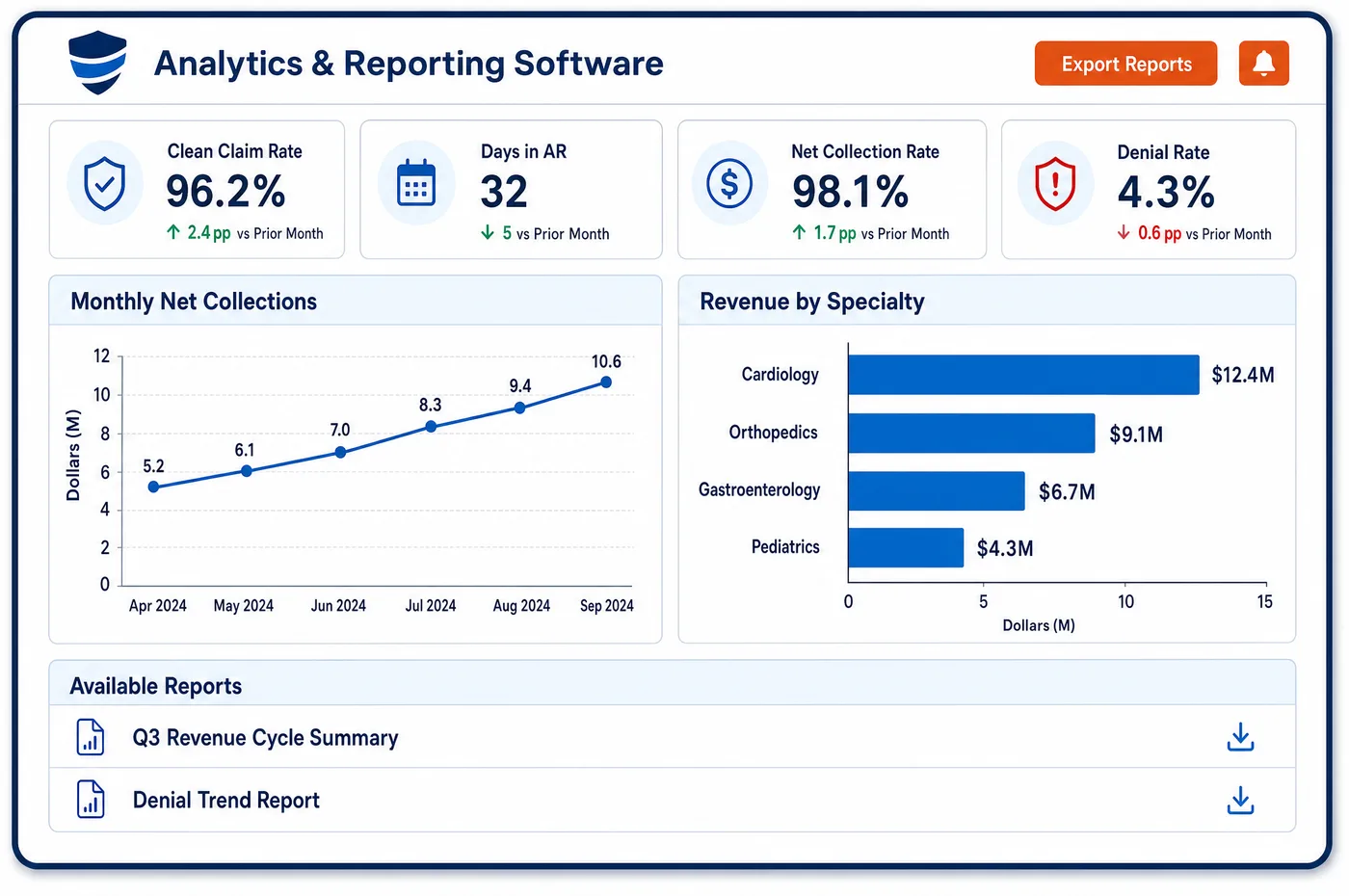
In psychiatry, reporting serves three audiences at once. Leaders need month-end results. Payers and CMS need quality data, such as MIPS measures and follow-up after a psychiatric stay. Care teams need running totals, such as how many collaborative care minutes each patient has this month. Unlimited Systems keeps standard reports for each of these and adds a drag-and-drop builder for one-off questions. Reports can be scheduled and sent by role, so a medical director gets quality measures and a billing manager gets AR by payer, each with only the data their role allows. Every report reads from the same data as the claims, so a quality count and a billing count never disagree. For deeper work, data can sync to a warehouse such as Snowflake, Synapse or Redshift. What the numbers mean is the job of psychiatric analytics, and live charts belong to dashboards.
Why Is Reporting Different in Psychiatry?
Psychiatric practices report to more outside bodies than their size suggests. A small group may submit MIPS quality data, send follow-up visit data to health plans, and track collaborative care time for every enrolled patient. Each has its own rules about which patients count. When reports are built by hand from exports, the counts drift and nobody can show how they were made.
Time is the unit that matters most. Psychotherapy codes, collaborative care codes and Spravato observation all depend on documented minutes or hours. A report that shows visits but not time cannot tell a care manager whether a patient has reached the threshold for 99493 this month. Reporting in psychiatry has to total time by patient, by code and by calendar month.
Privacy shapes reporting too. Substance use disorder records covered by 42 CFR Part 2, and psychotherapy details, need tighter handling than routine billing data. HIPAA's minimum necessary standard applies to most routine reports. A report that is fine for the billing office may be wrong to send to a referring clinic. Role-based delivery keeps each report with the people who need it.
What Psychiatry Reporting Software Handles
- MIPS MVP M1369
- The Quality Care in Mental Health and Substance Use Disorders MVP groups the measures many psychiatric clinicians report. Reports track each eligible patient against the measures the practice chose. (CMS QPP: Quality Care in Mental Health and Substance Use Disorders MVP (M1369))
- Quality IDs 134 and 370
- Depression screening and follow-up (134) and depression remission at twelve months (370) both depend on a PHQ-9 at the right points. Reports list the patients who are missing a score. (CMS QPP: Quality Care in Mental Health and Substance Use Disorders MVP (M1369))
- Collaborative care minutes: 99492, 99493 and 99494
- For the practice that bills them, code 99492 needs the first 70 minutes in the first calendar month, 99493 the first 60 minutes in a later month, and 99494 each added 30 minutes. Running totals by patient show who has met each threshold. (CMS MLN909432: Behavioral Health Integration Services)
- Follow-up after hospitalization (FUH)
- Health plans measure whether patients are seen after a psychiatric discharge. Reports list recent discharges and whether a follow-up visit is booked or done. (NCQA HEDIS: Follow-Up After Hospitalization for Mental Illness (FUH))
- CMS Innovation in Behavioral Health Model
- The IBH Model aligns Medicare and Medicaid payment for behavioral health practices in Michigan, New York and South Carolina. Practices in the model screen for conditions such as diabetes, hypertension and tobacco use, and reports track that screening. (CMS Innovation in Behavioral Health (IBH) Model)
- HIPAA minimum necessary
- Routine reports carry only the data their audience needs. Delivery is set by role, so clinical detail stays out of reports meant for billing staff or outside parties. (HHS: HIPAA minimum necessary requirement)
How Does Psychiatry Reporting Software Work?
1. Pick a standard report or build one
Standard reports cover AR by payer, productivity by code, telehealth volume and quality measures. A drag-and-drop builder handles one-off questions.
2. Define who counts
Each quality report applies the measure's own patient rules. MIPS and payer measures each use their own denominator and exclusions.
3. Total time where time matters
Collaborative care minutes, psychotherapy time and observation time are summed by patient, code and month. Thresholds appear next to the totals.
4. Schedule and send by role
Reports run on a set schedule and land in each role's inbox. Access rules decide what each person can see.
5. Submit or share
Quality data is compiled for MIPS reporting. Payer reports export as standard files.
6. Sync to the warehouse
Groups with their own data team can sync report data to Snowflake, Synapse or Redshift. The same definitions follow the data there.
Psychiatry Reporting Software vs. Generic Software
| Area | Generic approach | Unlimited Systems |
|---|---|---|
| Quality measures | Counted by hand from chart exports. | Built from the same data as the claims. |
| Collaborative care time | Tracked on a spreadsheet per care manager. | Totaled by patient and month against each code threshold. |
| Distribution | Emailed attachments sent to everyone. | Scheduled delivery by role with access rules. |
| Ad hoc questions | A request to IT and a long wait. | A drag-and-drop builder the practice uses itself. |
| Sensitive data | The same report goes to every audience. | Clinical detail limited to roles that need it. |
Who Uses It in a Psychiatry Practice
- Medical director: Quality measures and follow-up gaps on a schedule, with the patients behind each count, for value-based programs.
- Collaborative care manager: A running list of enrolled patients and their minutes this month, with each code threshold beside it.
- Billing manager: AR by carve-out and plan, productivity by code, and month-end reports that arrive without being built by hand.
Psychiatry Reporting Software FAQs
Most psychiatry practices rely on a core set of reports: AR by payer and carve-out, provider productivity by code, telehealth volume by place of service, collaborative care minutes by patient, and quality measures such as depression screening and remission. Reporting software keeps these as standard reports and lets staff build new ones as questions come up.
MIPS reporting for psychiatrists often uses the mental health and substance use MVP, which includes depression screening and depression remission measures. Reports list each eligible patient, the scores on file and any gaps. Because the data comes from the same visits as the claims, the quality counts and the billing counts agree.
Collaborative care time is totaled by patient and calendar month, with each code threshold beside the total. A care manager can see which patients have met the time for the initial or subsequent monthly code, and which need more contact. That keeps claims accurate and keeps the caseload moving.
Scheduled reports go to the roles that need them. A medical director might get quality measures, a billing manager AR by payer, and an owner month-end results. Access rules decide what each person can see, so clinical detail and substance use data stay with the people allowed to view them.
Substance use disorder records covered by 42 CFR Part 2 carry tighter rules on use and disclosure than other health data. Reports that could include those records are limited by role. Reports meant for outside parties should leave such records out unless the patient's consent allows the disclosure, and role-based delivery helps hold that line.
Ad hoc reports are built with a drag-and-drop builder, without writing SQL. Staff pick the fields, filters and groupings they need, such as therapy visits by modality and payer last quarter. A useful report can be saved and scheduled, so the next run takes no extra work.
Related Psychiatry Software
Analytics & value-based care
In the revenue cycle
Reporting for related specialties
Sources
- CMS QPP: Quality Care in Mental Health and Substance Use Disorders MVP (M1369)
- CMS MLN909432: Behavioral Health Integration Services
- NCQA HEDIS: Follow-Up After Hospitalization for Mental Illness (FUH)
- CMS Innovation in Behavioral Health (IBH) Model
- HHS: HIPAA minimum necessary requirement
- HHS: Confidentiality of Substance Use Disorder Patient Records (42 CFR Part 2)
GET STARTED
See Unlimited Systems in Action
Whether you're actively evaluating new technology or simply preparing for your next vendor renewal, Unlimited Systems can help you understand where your current workflows may be creating avoidable revenue risk.