

Analytics & value-based care
Psychiatry Value-Based Care Software
Run MIPS, collaborative care, IBH and payer quality contracts from the same data that bills each psychiatric visit.
Psychiatry Value-Based Care Software gathers the quality data psychiatric practices are paid on: PHQ-9 response and remission, depression screening, follow-up after hospitalization, and collaborative care time. It feeds MIPS, the CMS Innovation in Behavioral Health Model and commercial quality contracts from the same visits and claims the practice already bills.



 6,500+ specialty providers

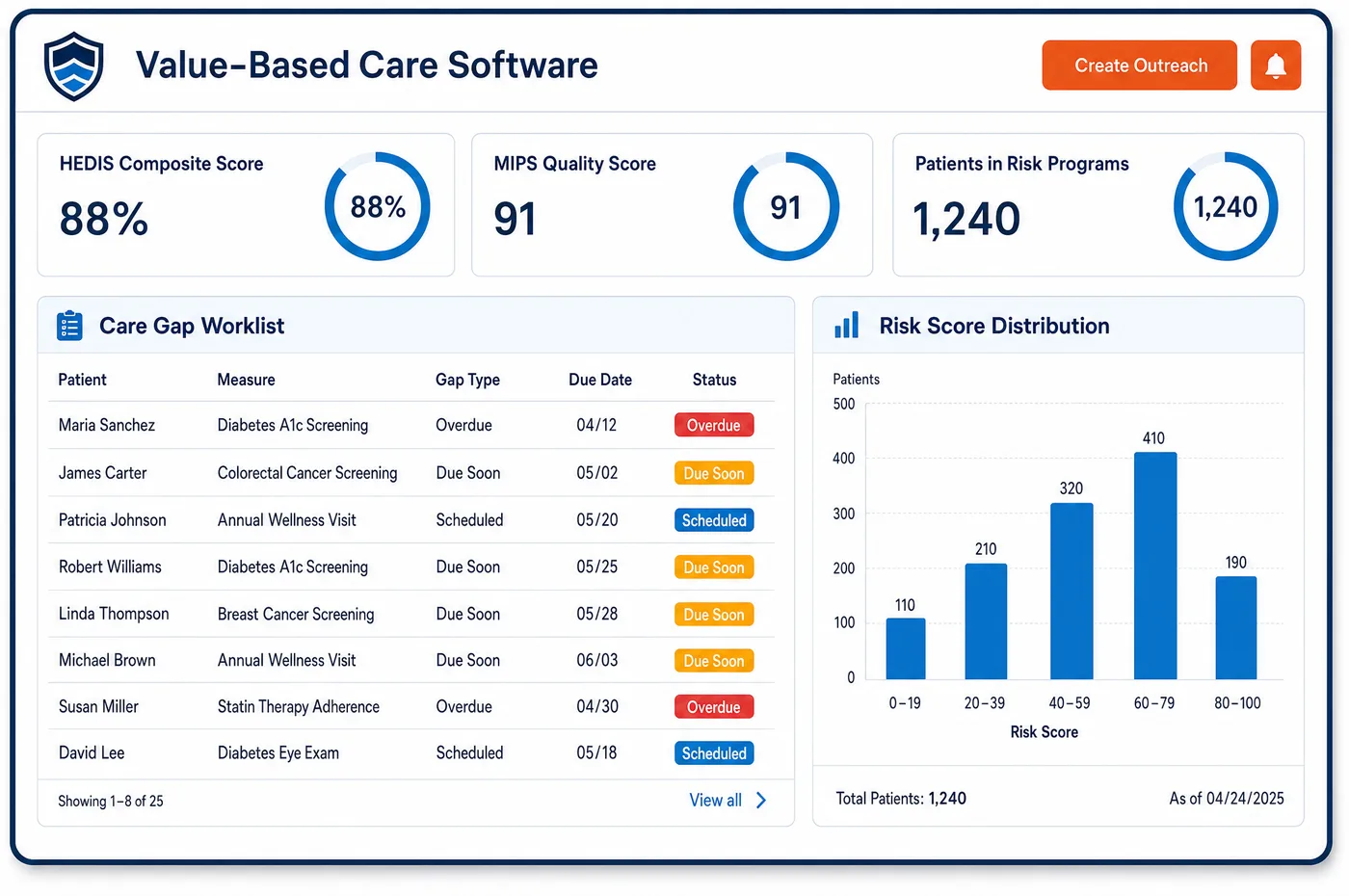
Value-Based Care in a Psychiatry Practice
Value-based care in psychiatry rests on one habit: measuring symptoms the same way at the right moments. Under MIPS measure 370, a patient with a baseline PHQ-9 above 9 counts as in remission only if a PHQ-9 below 5 is recorded at twelve months. Unlimited Systems makes the required quality fields part of the visit, so a score or a screening result is captured while the encounter is still open, not hunted down at year end. Patient-reported scores can arrive before the visit over FHIR feeds. Collaborative care minutes and registry status are kept for each enrolled patient. Discharges from inpatient psychiatric stays can be tracked so follow-up visits are booked and counted. For risk contracts, shared savings and any downside terms are tracked in the financial ledger beside the claims. The result is one record that serves the claim, the measure and the contract at once. Score trends also feed practice analytics and the scheduled quality reports leaders review.
Why Is Value-Based Care Different in Psychiatry?
Psychiatry came late to value-based payment because its results are hard to count. There is no lab value for depression. Programs now use validated scales instead, mostly the PHQ-9 for depression and often the GAD-7 for anxiety. That turns quality into a data task: the right scale, given at the right time, stored as structured data the program can read.
Psychiatric value programs also cross care settings. Collaborative care pays a primary care practice for work done partly by a psychiatric consultant. Follow-up after a psychiatric hospital stay depends on a hospital telling the practice about a discharge. The IBH Model asks behavioral health practices to screen for physical conditions too. A practice that only sees its own visits misses much of what these programs measure.
Then the money has to tie back. MIPS adjusts Medicare payment in a later year based on this year's score. Commercial and carve-out contracts may pay per measure or share savings. Value-based care in psychiatry works when the practice can see, in its own ledger, what each program has paid and what it still stands to earn.
What Psychiatry Value-Based Care Software Handles
- MVP M1369 for mental health
- The Quality Care in Mental Health and Substance Use Disorders MVP sets the measure menu for many psychiatric clinicians. Each chosen measure is tracked per eligible patient through the year. (CMS QPP: Quality Care in Mental Health and Substance Use Disorders MVP (M1369))
- Quality ID 370: remission at twelve months
- Remission depends on a baseline PHQ-9 and a later score inside the measure window. Patients with a baseline but no follow-up score appear on a gap list. (CMS QPP: Quality Care in Mental Health and Substance Use Disorders MVP (M1369))
- Collaborative care: 99492 to 99494 and G2214
- Medicare pays these codes to the treating practitioner, often in primary care, for care manager time and psychiatric consultation each month; the consultant is paid by contract. G2214 covers the first 30 minutes in a month for patients who need less time. Minutes and registry status are kept for each patient. (CMS MLN909432: Behavioral Health Integration Services)
- IBH Model
- The CMS Innovation in Behavioral Health Model tests aligned Medicare and Medicaid payment for behavioral health practices, with a Medicare performance payment. Participating practices screen for diabetes, hypertension and tobacco use alongside behavioral care. (CMS Innovation in Behavioral Health (IBH) Model)
- HEDIS FUH in payer contracts
- Health plans count whether members are seen after a psychiatric discharge. Discharge alerts start the follow-up booking, and the visit is matched to the stay. (NCQA HEDIS: Follow-Up After Hospitalization for Mental Illness (FUH))
- PHQ-9 as structured data
- Scores are stored with LOINC 44261-6, the code for the PHQ-9 total. Programs and payers can read them without chart review. (LOINC 44261-6: PHQ-9 total score)
How Does Psychiatry Value-Based Care Software Work?
1. Enroll patients in programs
Each patient is tied to the programs that apply: MIPS, collaborative care, IBH or a payer contract. The rules for each program follow the patient.
2. Capture measures at the visit
Required quality fields are enforced while the encounter is still open. For an MVP, that means the screening or score the measure needs.
3. Collect scores before the visit
Patient-reported PHQ-9 and GAD-7 scores can arrive over FHIR before the patient is seen. The clinician starts with the latest score in hand.
4. Track time and follow-up
Collaborative care minutes, registry status and post-discharge follow-up are tracked for each patient. Gaps show while there is still time to close them.
5. Report to each program
Measure results are compiled for MIPS and for payer contracts from the same data. Nothing is retyped from the chart.
6. Tie results to money
Shared savings, incentive payments and downside terms are tracked in the financial ledger. Leaders see what each program has paid.
Psychiatry Value-Based Care Software vs. Generic Software
| Area | Generic approach | Unlimited Systems |
|---|---|---|
| Quality capture | Measures found missing at year end. | Required fields enforced while the visit is open. |
| Symptom scales | Scores scanned as paper forms. | Scores stored as structured, coded data. |
| Collaborative care | Minutes tracked informally by care managers. | Minutes and registry status kept per patient. |
| Hospital follow-up | Discharges learned about too late. | Discharges tracked, with follow-up booked and counted. |
| Contract money | Incentives tracked in a separate spreadsheet. | Program payments tracked in the ledger beside claims. |
Who Uses It in a Psychiatry Practice
- Medical director: Measure gaps by clinician and patient while they can still be closed, plus outcome trends for each program.
- Collaborative care team: Each enrolled patient's minutes, scores and status in one place, with scores that flow in through the EHR connection.
- Practice owner: What MIPS, IBH and payer contracts are worth to the practice, tracked in the same ledger as the claims.
Psychiatry Value-Based Care Software FAQs
Value-based care in psychiatry pays practices partly on results, measured with validated scales such as the PHQ-9. It includes MIPS for Medicare clinicians, collaborative care codes, the CMS Innovation in Behavioral Health Model where it runs, and commercial or carve-out quality contracts. Each one needs structured data captured at the right visit.
Many psychiatrists report through the Quality Care in Mental Health and Substance Use Disorders MVP. Its measures include depression screening and follow-up, and depression remission at twelve months. Both depend on PHQ-9 scores captured at the right points, which is why scores are stored as structured data at each visit.
Under Medicare, collaborative care is billed monthly by the treating practitioner for care manager time and psychiatric consultation, and it depends on a registry and regular symptom scores. A psychiatric consultant is paid by contract, and a psychiatric practice that bills the codes itself needs the same record. The software keeps minutes, registry status and scores for each enrolled patient. That record supports the monthly claim and the quality measures the program is judged on.
The Innovation in Behavioral Health Model is a CMS Innovation Center model that aligns Medicare and Medicaid payment for behavioral health practices. It runs in Michigan, New York and South Carolina, with more states planned. Practices screen for physical conditions as well as behavioral ones and can earn performance-based payments.
Discharges from psychiatric stays are tracked so the practice can book a follow-up visit quickly. When the visit happens, it is matched to the stay. Health plans use this follow-up measure in many contracts, so the practice can show its own results instead of waiting for the plan's report.
Shared savings, incentive payments and downside terms are tracked in the financial ledger, next to the claims that drive them. A practice can see what each contract has paid and what it is on track to earn. That keeps value-based care from living in a separate spreadsheet that nobody trusts.
Related Psychiatry Software
Analytics & value-based care
In the revenue cycle
Value-Based Care for related specialties
Sources
GET STARTED
See Unlimited Systems in Action
Whether you're actively evaluating new technology or simply preparing for your next vendor renewal, Unlimited Systems can help you understand where your current workflows may be creating avoidable revenue risk.