

Analytics & value-based care
Behavioral Health Value-Based Care Software
Manage CCBHC quality bonus measures, measurement-based care, Medicaid plan incentives and MIPS from the same data used to bill.
Behavioral Health Value-Based Care Software helps an organization earn quality-based payments from the work it already does. It tracks repeated PHQ-9 and other outcome scores, follow-up after hospital and emergency visits, and CCBHC quality bonus measures. Care gaps show up on the schedule while a visit can still close them, and contract results sit in the ledger.



 6,500+ specialty providers

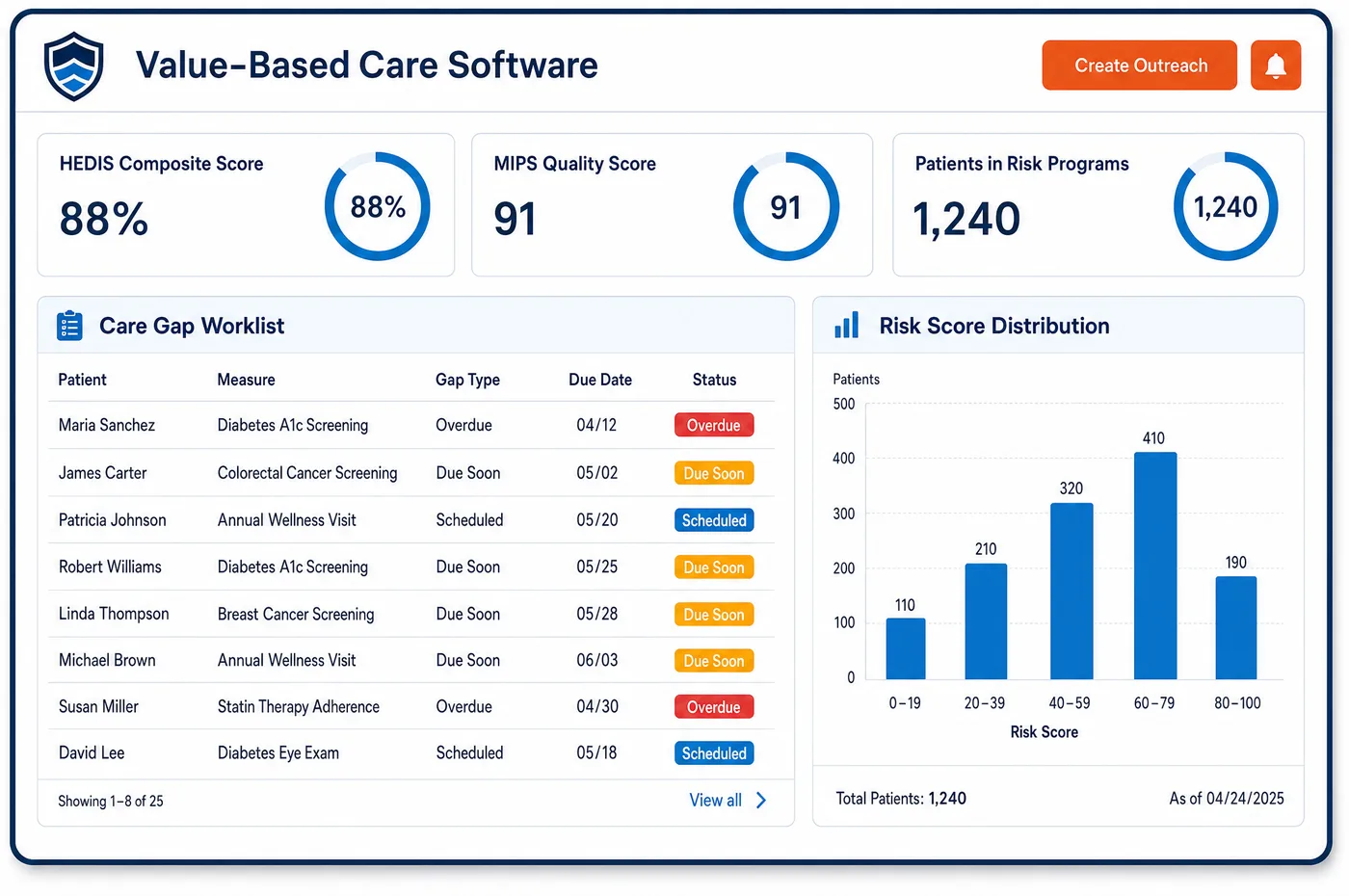
Value-Based Care in a Behavioral Health Practice
Value-based care in behavioral health rests on outcome data that has to be collected over time. A CCBHC may earn quality bonus payments when it meets state thresholds. Medicaid health plans often reward follow-up after a hospital stay for mental illness. Medicare clinicians in MIPS can report depression remission. Unlimited Systems ties these programs to daily work. Required measure fields are checked while the encounter is still open, so a missing PHQ-9 is caught before the client leaves. Symptom surveys can be collected electronically over FHIR and saved as scores. Clients due for a follow-up score, or who left a hospital without a visit booked, appear as care gaps on the scheduler. Shared-savings and downside-risk terms in a plan contract are tracked in the ledger, so finance sees how quality results affect revenue. The same outcome scores also support the measurement-based care that accreditors expect.
Why Is Value-Based Care Different in Behavioral Health?
Behavioral health outcomes take time to show. Remission from depression is measured months after the first high score, and follow-up after a hospital stay depends on what happens in the days after discharge. A program cannot prove results from one visit. Value-based care for behavioral health depends on scores and contacts collected again and again, in a form a measure can use.
The programs are spread across payers. CCBHC quality bonus payments come from the state, under rules CMS sets for the demonstration. Medicaid health plans run their own incentive programs, often built on HEDIS measures. Medicare runs MIPS, whose eligible clinicians include clinical social workers and clinical psychologists. CMS's Innovation in Behavioral Health Model adds another track in a few states. An organization may answer to several of these at once.
Care quality and payment are also tightly linked. A client who is lost after a crisis visit is both a clinical risk and a missed measure. A therapist whose clients never get a repeat PHQ-9 may be helping them, but the program cannot show it. Measurement-based care, with standard tools given on a schedule and used in treatment, is the shared base for good care and for value-based payment.
What Behavioral Health Value-Based Care Software Handles
- CCBHC quality bonus payments
- QBPs are required under the monthly CC PPS-2 and CC PPS-4 options and optional under the daily options, and a clinic must meet the state threshold to earn them. Measure status is tracked during the year, not after it closes. (Medicaid.gov: CCBHC Prospective Payment System and Quality Bonus Payments)
- DEP-REM-6 and MIPS measure 370
- DEP-REM-6 counts remission as a PHQ-9 or PHQ-9M score below five at six months after an initial score above nine. MIPS 370 uses the same logic at twelve months, so one score history serves both. (SAMHSA: Quality Measures for Behavioral Health Clinics, Technical Specifications and Resource Manual (2024), DEP-REM-6 (based on MIPS 370))
- Follow-Up After Hospitalization for Mental Illness (FUH)
- FUH is a HEDIS measure many Medicaid plans use in incentive programs, and it is a state-collected CCBHC measure. Clients discharged with no visit booked appear as care gaps for outreach. (NCQA HEDIS: Follow-Up After Hospitalization for Mental Illness (FUH))
- Innovation in Behavioral Health (IBH) Model
- The CMS model runs from 2025 to 2032 in Michigan, New York and South Carolina, with monthly payments for screenings and later value-based payments. Participating practices track the screenings and measures the model requires. (CMS Innovation in Behavioral Health (IBH) Model)
- Measurement-based care (CTS.03.01.09)
- The Joint Commission standard requires behavioral health organizations to track outcomes with a standardized instrument and use the data to guide care. Scheduled PHQ-9 and GAD-7 scores serve that standard and the payment measures. (The Joint Commission: Measurement-Based Care, Standardized Tools and Instruments (CTS.03.01.09))
- Quality Care in Mental Health and SUD MVP
- MIPS Value Pathway M1369 groups mental health and substance use measures for Medicare clinicians. Clinicians who report through MVPs draw on the same outcome data. (CMS QPP: Quality Care in Mental Health and Substance Use Disorders MVP (M1369))
How Does Behavioral Health Value-Based Care Software Work?
1. Pick the programs and measures
Each contract, bonus program and MIPS measure is set up with its rules, payers and attributed clients. Measures are linked to the visits and scores that feed them.
2. Collect scores on a schedule
PHQ-9, GAD-7 and other tools are given at set points and saved as structured scores. Clients can complete them before a visit through secure check-ins.
3. Catch gaps during the visit
Required measure fields are checked while the encounter is open. A missing score or screening raises an alert before the client leaves.
4. Work the care gaps
Clients due for a follow-up score, or discharged with no visit booked, show up on the scheduler and in outreach lists. Hospital alerts arrive through data exchange with hospitals.
5. Track contract results
Quality results, shared savings and downside risk are tracked in the ledger next to fee-for-service revenue. Leaders see results during the year and in quality reports.
Behavioral Health Value-Based Care Software vs. Generic Software
| Area | Generic approach | Unlimited Systems |
|---|---|---|
| Outcome scores | Given when a clinician remembers, often on paper. | Collected on a schedule and saved as structured scores. |
| Measure gaps | Found in a report after the year closes. | Flagged while the encounter is still open. |
| Post-discharge follow-up | Clients lost after a hospital stay. | Discharged clients with no visit appear as care gaps. |
| Multiple programs | Each program tracked in its own spreadsheet. | CCBHC, plan, MIPS and model measures in one place. |
| Contract finances | Risk terms modeled outside the books. | Shared savings and downside risk tracked in the ledger. |
Who Uses It in a Behavioral Health Practice
- Quality director: One view of CCBHC, Medicaid plan and MIPS measures, with gaps listed by clinician and program.
- Clinician: A prompt when a client is due for a repeat score, and a trend that shows whether treatment is working.
- CFO: Bonus and risk results next to fee-for-service revenue, so value-based contracts are judged on real numbers. Results also flow into behavioral health analytics.
Behavioral Health Value-Based Care Software FAQs
Value-based care software for behavioral health tracks outcome scores such as the PHQ-9, follow-up after hospital and emergency visits, screenings and other quality measures. It ties them to the CCBHC, Medicaid plan, MIPS or model programs that pay for results. Care gaps appear during visits and on the schedule, and contract results sit in the ledger.
States that pay CCBHC quality bonuses require clinics to meet set thresholds on chosen measures. Each measure is tracked during the year from live data, so the clinic knows where it stands well before results are final. Gaps such as missing follow-up scores show up as work while there is still time to close them.
One history of PHQ-9 scores can serve several measures. DEP-REM-6 looks for remission near six months after an initial score above nine, and MIPS 370 uses the same logic at twelve months. The same scores also show progress to the clinician and support the measurement-based care standard used in accreditation.
When a hospital alert shows a client was discharged, the client appears on a care gap list if no follow-up visit is booked. Staff reach out and book the visit. Because FUH is used in many Medicaid plan programs and is a state-collected CCBHC measure, closing these gaps helps both the client and the organization's quality results.
The IBH Model applies to specialty behavioral health practices that a participating state selects. Michigan, New York and South Carolina are taking part, and the model runs from 2025 to 2032. Practices receive monthly payments for required screenings and assessments, with value-based payments later in the model.
Measurement-based care means using standard tools, such as the PHQ-9 or GAD-7, on a schedule and using the results to guide treatment. The Joint Commission requires it for accredited behavioral health organizations. The same scores feed depression remission measures, so good clinical practice and value-based payment rest on the same data.
Related Behavioral Health Software
Analytics & value-based care
In the revenue cycle
Value-Based Care for related specialties
Sources
- Medicaid.gov: CCBHC Prospective Payment System and Quality Bonus Payments
- SAMHSA: Quality Measures for Behavioral Health Clinics, Technical Specifications and Resource Manual (2024), DEP-REM-6 (based on MIPS 370)
- NCQA HEDIS: Follow-Up After Hospitalization for Mental Illness (FUH)
- CMS Innovation in Behavioral Health (IBH) Model
- The Joint Commission: Measurement-Based Care, Standardized Tools and Instruments (CTS.03.01.09)
- CMS QPP: Quality Care in Mental Health and Substance Use Disorders MVP (M1369)
GET STARTED
See Unlimited Systems in Action
Whether you're actively evaluating new technology or simply preparing for your next vendor renewal, Unlimited Systems can help you understand where your current workflows may be creating avoidable revenue risk.