

Analytics & value-based care
Addiction Medicine Value-Based Care Software
Track SUD initiation, engagement and medication continuity, close care gaps, and see contract results for addiction treatment.
Addiction Medicine Value-Based Care Software tracks the quality measures and contract terms that payers use to reward addiction treatment. It follows new SUD episodes through initiation and engagement, watches medication continuity for OUD, lists patients with open care gaps, and shows how each value-based contract is performing against the practice's own ledger.



 6,500+ specialty providers

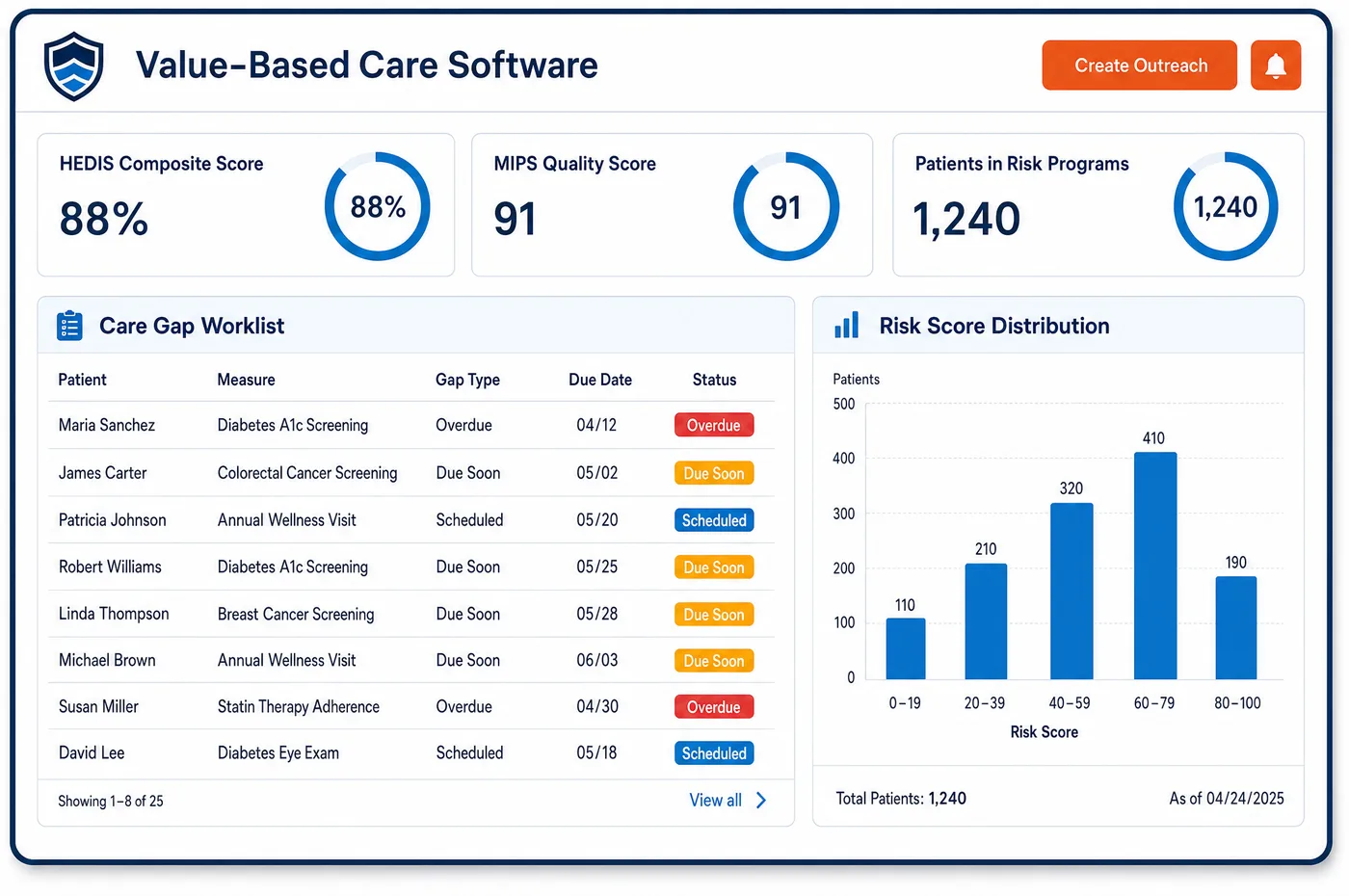
Value-Based Care in a Addiction Medicine Practice
Value-based programs for addiction care mostly reward one thing: getting patients into treatment fast and keeping them there. The HEDIS initiation and engagement measure asks whether a new SUD episode led to treatment within fourteen days and to ongoing care soon after. MIPS 468 asks whether patients on OUD medication stayed on it for at least one hundred eighty days without a gap of more than seven days. Medicaid's Adult Core Set adds pharmacotherapy use and follow-up after an emergency visit for substance use. Value-based care for addiction medicine turns each of these into a patient list. New patients who have not had a second visit show up as a gap. Patients whose medication supply is running out show up before the gap opens. Staff work those lists through outreach and scheduling. Contract results, such as quality bonuses or shared savings, are tracked in the ledger, so leaders can see what each contract is worth.
Why Is Value-Based Care Different in Addiction Medicine?
Quality measures for SUD care run on tight clocks. Initiation, engagement and continuity are all defined by the days between events, not by what happened at a single visit. A patient who comes in once and then waits three weeks for a second visit can fail a measure even if the care was good. Practices need to see the clock for each patient while there is still time to act.
The data also comes from more than one place. OTP weekly services, office visits, injections, prescriptions and counseling may all count toward a measure, and some sit in different systems or are paid by different payers. A plan's carve-out vendor may see the counseling claims but not the medication claims. Practices that track measures from their own billing data, rather than waiting for a plan's report, can find and fix gaps first.
Contracts vary by payer and by state. A Medicaid plan may pay a bonus on engagement rates, a commercial plan may share savings on emergency visits, and MIPS adjusts Medicare payments. Each has its own terms, and each needs its results tracked against what the practice was actually paid. Value-based care only pays off when someone can show the result.
What Addiction Medicine Value-Based Care Software Handles
- Initiation and engagement of SUD treatment (IET)
- Initiation counts treatment within fourteen days of a new SUD episode, and engagement counts further treatment within thirty-four days after initiation. New patients appear on a list until both steps are met. (Oregon Health Authority: 2026 Initiation and Engagement of SUD Treatment specification (follows HEDIS IET))
- Date of service for weekly and monthly OUD services
- For OTP weekly and monthly office-based services billed over a range of dates, the IET specification uses the earliest date as the date of service. The tracker applies the same rule when it counts OTP and office-based weeks. (Oregon Health Authority: 2026 Initiation and Engagement of SUD Treatment specification (follows HEDIS IET))
- Continuity of pharmacotherapy for OUD (MIPS 468)
- Patients need at least one hundred eighty days of continuous OUD medication with no gap of more than seven days. Patients deliberately phased out of treatment are a denominator exception (M1035), so staff record that reason when it applies. (CMS QPP: 2026 Quality ID 468, Continuity of Pharmacotherapy for Opioid Use Disorder (MIPS CQM))
- MIPS 468 eligibility
- A patient counts only after a qualifying encounter in the performance year, since administering or prescribing medication alone does not make the case eligible. The list shows whether each patient's encounter has been billed. (CMS QPP: 2026 Quality ID 468, Continuity of Pharmacotherapy for Opioid Use Disorder (MIPS CQM))
- Medicaid Adult Core Set SUD measures
- The 2026 Adult Core Set includes IET-AD, use of pharmacotherapy for OUD (OUD-AD) and follow-up after an emergency visit for substance use (FUA-AD). Practices track the same measures their Medicaid plans report. (Medicaid.gov: 2026 Core Set of Adult Health Care Quality Measures for Medicaid)
How Does Addiction Medicine Value-Based Care Software Work?
1. Load the contract terms
Each value-based contract is set up with its measures, targets and payment terms. MIPS, Medicaid plan bonuses and commercial shared savings each have their own setup.
2. Count the measures from claims
Visits, OTP weeks, injections and counseling are counted against each measure's rules. Episode start dates and gaps are worked out per patient.
3. List open care gaps
Patients who have not met initiation, engagement or continuity show on care gap worklists. Each list shows how many days remain before the measure is missed.
4. Close gaps through outreach
Staff call, text or book visits for patients on the list. Reminders go through patient engagement for addiction care, and each contact is logged.
5. Track contract results
Quality bonuses, shared savings and MIPS adjustments are tracked in the ledger against each contract. Leaders see what each contract paid next to what it was expected to pay, with program analytics behind each result.
Addiction Medicine Value-Based Care Software vs. Generic Software
| Area | Generic approach | Unlimited Systems |
|---|---|---|
| Measure tracking | Waiting for a plan's quarterly report. | Measures counted from the practice's own claims. |
| Care gaps | Found after the measure period ends. | Listed while there is still time to act. |
| Medication continuity | Checked by chart review. | Gaps flagged from dosing, refill and injection dates. |
| Contract terms | Kept in a binder. | Set up per contract with measures and payment terms. |
| Contract results | Estimated from plan letters. | Tracked in the ledger against expected payments. |
Who Uses It in a Addiction Medicine Practice
- Quality lead: Patient lists for each measure, with days remaining, so staff work the gaps that can still be closed.
- Medical director: A view of initiation, engagement and continuity by clinician and site, linked to the patients behind each rate.
- Executive director: Results for each value-based contract next to what it paid, so leaders know which contracts are worth keeping.
Addiction Medicine Value-Based Care Software FAQs
Common value-based care measures for addiction treatment include initiation and engagement of SUD treatment, continuity of OUD medication under MIPS 468, use of pharmacotherapy for OUD, and follow-up after an emergency visit for substance use. Medicaid plans, commercial plans and MIPS each use some of these. Payer contracts may add their own measures as well.
The measure starts with a new SUD episode. Initiation means treatment within fourteen days of that episode. Engagement means, within thirty-four days after initiation, one weekly or monthly OUD service with medication, one long-acting medication event, or at least two more engagement visits or medication events. The tracker counts both from claims and lists patients who have not yet met each step.
MIPS 468 looks for at least one hundred eighty days of continuous OUD medication. A gap of more than seven days without medication on hand, or an injection more than seven days late, breaks continuity. Patients who are deliberately tapered off treatment are an exception, and staff should record that reason in the chart.
Measures can be counted from the practice's own claims and visit data as care happens. That gives staff a current list of patients with open gaps, rather than waiting for a plan report after the period ends. Plan results may still differ when the plan sees claims the practice does not.
Quality bonuses, shared savings and MIPS payment adjustments are tracked in the ledger against each contract. Leaders see what each contract was expected to pay and what it did pay. That shows whether the extra work on a contract is paying off, and where to focus next.
Gap outreach reaches patients who missed a visit, have not returned after intake, or are close to running out of medication. Staff call, text or book the next visit. Each contact is logged, and the patient leaves the list once the gap is closed. That supports both the patient's care and the measure.
Related Addiction Medicine Software
Analytics & value-based care
In the revenue cycle
Value-Based Care for related specialties
Sources
GET STARTED
See Unlimited Systems in Action
Whether you're actively evaluating new technology or simply preparing for your next vendor renewal, Unlimited Systems can help you understand where your current workflows may be creating avoidable revenue risk.