
Analytics & value-based care
Chiropractic Analytics Software
See care-plan completion, Medicare active versus maintenance mix, visit-limit denials and injury-case cash, and find out why each one moved.
Chiropractic Analytics Software measures how a chiropractic practice turns visits into cash. It tracks care-plan completion, collections per visit, the mix of Medicare active and maintenance care, visit-limit denials and injury-case payments. It then drills from each number down to the payer, the doctor and the claim, so leaders can see why it changed.



 6,500+ specialty providers

Analytics in a Chiropractic Practice
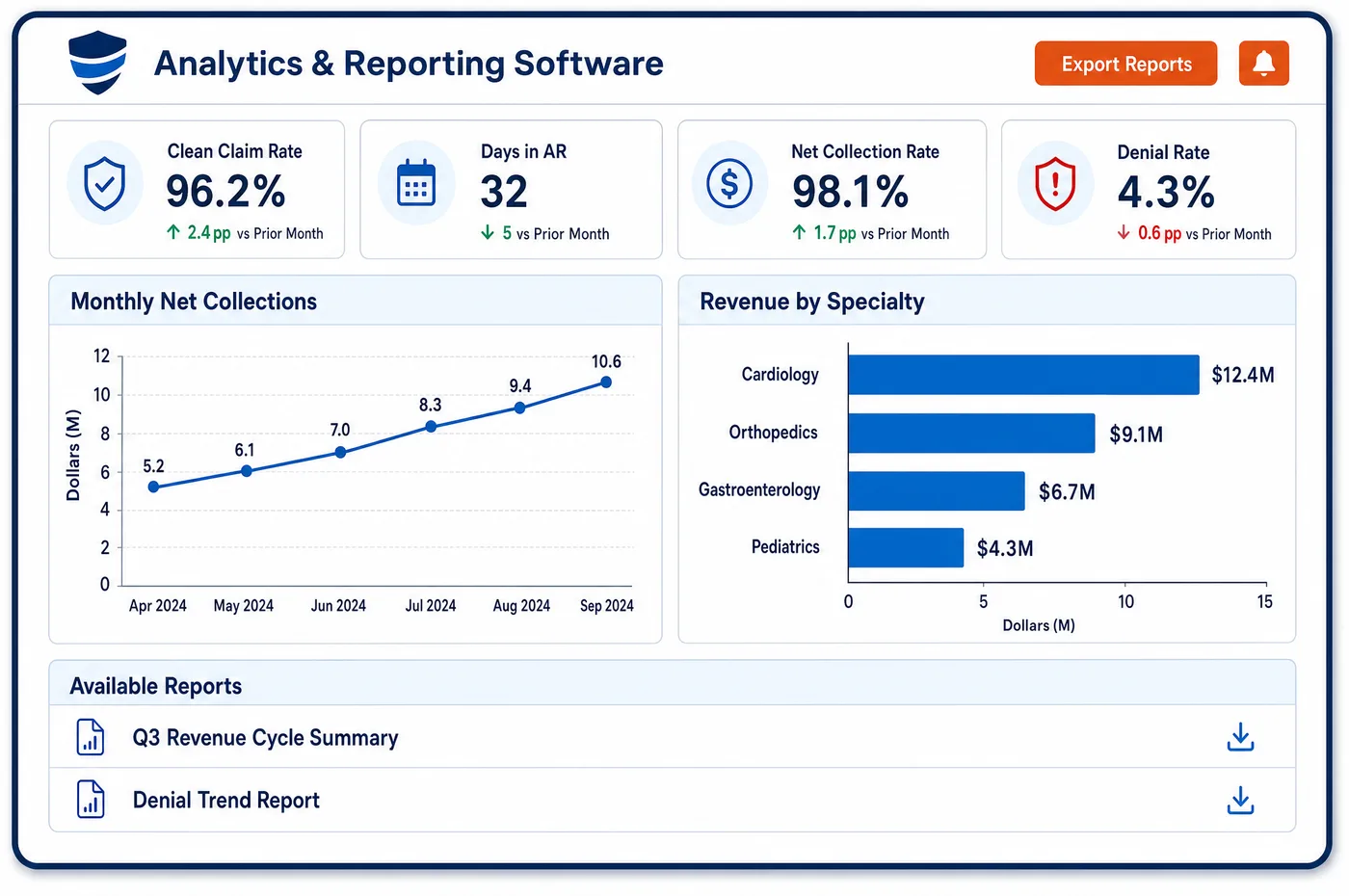
A chiropractic practice lives on repeat visits, so the key numbers are about patterns, not single claims. Unlimited Systems builds its analytics on the same data staff work in every day: the schedule, posted payments and denials. A care-plan view compares visits planned with visits kept, by doctor and by clinic. A payer view splits health plan, Medicare, auto, workers' compensation and self-pay revenue, with collections per visit for each. For Medicare, it shows how many manipulation visits went out with AT and how many with GA. Denial trends highlight visit-limit and authorization problems while they can still be fixed. Each chart links down to the claims behind it. Results can be compared with the practice's own history and with peer practices, so a drop in collections can be traced to its cause rather than guessed at.
Why Is Analytics Different in Chiropractic?
Chiropractic revenue depends on whether patients finish their care plans. A plan of many visits that stops halfway leaves both care and income on the table. Most billing systems report charges and payments, not plan completion. Analytics that tie the schedule to the ledger show where patients drop off, such as after the first re-exam or when a plan limit is reached.
Payer mix in chiropractic is unusual. One clinic may draw from health plans, Medicare, auto carriers, workers' compensation and cash-pay patients all at once. Each pays on its own timeline and at its own rate. A blended collections figure hides this. A month with many new auto cases can look like a slump, when the cash is simply waiting on a settlement. Splitting the numbers by payer type shows what is really happening.
Medicare patterns need watching too. Medicare pays only for active or corrective manipulation, and CMS notes that long or repeated courses of care are more likely to be reviewed. A practice should know how its AT and GA mix compares with its own past and with peers. The same goes for missing initial treatment dates and bundling denials. Analytics turn those patterns into a short list of things to fix, and the chiropractic reporting team can send the results on a schedule.
What Chiropractic Analytics Software Handles
- AT and GA mix on Medicare visits
- Medicare pays for 98940 through 98942 only with AT, and maintenance visits go out with GA after an ABN. Analytics show the share of each by doctor and clinic over time. (CMS Medicare Benefit Policy Manual, Chapter 15, Section 240.1.3 (Necessity for Treatment))
- Long courses of active care
- CMS warns that prolonged or repeated treatment is more likely to undergo medical review. Patients with long runs of AT visits are listed so the doctor can check that the notes show ongoing improvement. (CMS MLN1232664: Medicare Documentation Checklist and Guidelines for Chiropractic Doctors (April 2025))
- CARC 119 visit-limit denials
- Benefit-maximum denials are trended by payer and plan. A rise points to visit counts that front desk checks are missing. (X12 Claim Adjustment Reason Codes)
- Missing initial treatment dates
- Medicare denials with CARC 16 and remark MA122 are counted by clinic and biller. A cluster points to a setup or training gap, not a payer problem. (CMS Medicare Claims Processing Manual, Chapter 12, Section 220 (Chiropractic Services))
- 97140 bundling with manipulation
- Bundling denials on manual therapy billed with manipulation are tracked by doctor. A pattern can mean the note does not show a separate region. (CMS NCCI Policy Manual for Medicare Services, Chapter XI, Section S (Chiropractic Manipulative Treatment))
- Injury payer codes 19, 20 and 21
- Health plan denials that name a work, liability or no-fault carrier are counted by intake source. A rise means injury questions at check-in are being skipped. (X12 Claim Adjustment Reason Codes)
How Does Chiropractic Analytics Software Work?
1. Connect schedule and ledger
Visits planned, visits kept and payments posted are joined by patient and care plan. That gives a single view of plan completion and cash.
2. Split by payer type
Revenue, collections per visit and days in AR are shown for health plan, Medicare, auto, workers' compensation and self-pay. Injury cases are kept apart so they don't skew routine AR.
3. Trend the denials
Denials are trended by reason, payer and doctor. Visit-limit, authorization and bundling patterns rise to the top.
4. Drill to the claim
Each figure opens the payers, doctors and claims behind it. The drill-down dashboards link straight to the accounts that need work.
5. Compare and explain
Results are compared with the practice's own history and with peer practices. Leaders see whether a change is seasonal, payer-driven or a process problem.
Chiropractic Analytics Software vs. Generic Software
| Area | Generic approach | Unlimited Systems |
|---|---|---|
| Care plans | Completion not measured, so drop-off goes unseen. | Visits planned and kept compared by doctor and clinic. |
| Payer mix | One blended collections figure. | Health plan, Medicare, auto, work injury and self-pay shown apart. |
| Medicare patterns | AT and GA use never reviewed. | AT and GA mix trended and compared with peers. |
| Denials | Counted, not explained. | Trended by reason, payer and doctor, with claims one click away. |
| Benchmarks | None, or a number from a trade magazine. | Own history and peer practices side by side. |
Who Uses It in a Chiropractic Practice
- Clinic owner: Collections per visit and care-plan completion by clinic and doctor, so growth plans rest on facts.
- Billing manager: Denial trends by reason and payer, with the claims behind each one, so fixes start where problems begin.
- Clinic director: A view of which doctors' patients finish their plans and which stop early, to guide patient outreach.
Chiropractic Analytics Software FAQs
Chiropractic analytics should start with care-plan completion, collections per visit by payer type, and denial trends. Plan completion shows whether patients finish the care they started. Collections per visit shows what each payer really pays. Denial trends show where visit limits, authorizations or Medicare modifiers are costing money. Together they explain most changes in chiropractic revenue.
Care-plan completion compares the visits in each patient's plan with the visits they kept. It can be viewed by doctor, clinic and payer. A drop at a certain point, such as after a re-exam or when a plan's visit limit is reached, tells the practice where to focus outreach and front desk checks.
Auto, liability and workers' compensation cases often pay much later than health plans, and some wait on a settlement. Mixed into routine figures, they make collections look weak and AR look old. Shown on their own, routine performance is clear, and injury work can be judged by what it finally collects.
Analytics can show patients with long runs of AT visits and doctors whose AT and GA mix differs from their peers. CMS notes that prolonged or repeated treatment is more likely to be reviewed. The list is a prompt for the doctor to check the notes, not a finding, and the decision stays with the clinician.
Benchmarks compare the practice with its own history and with peer practices. A clinic can see whether its collections per visit, denial rate or days in AR are moving with the market or against it. That helps leaders tell a seasonal dip, such as deductibles resetting in January, from a process problem that needs fixing.
Most views are self-service dashboards that a clinic owner or billing manager can filter without writing queries. Users pick a date range, clinic, doctor or payer and drill down to the claims. Questions that need a new layout can be saved as a custom view or scheduled as a report for others to receive.
Related Chiropractic Software
Analytics & value-based care
In the revenue cycle
Analytics for related specialties
Sources
- CMS Medicare Benefit Policy Manual, Chapter 15, Section 240.1.3 (Necessity for Treatment)
- CMS MLN1232664: Medicare Documentation Checklist and Guidelines for Chiropractic Doctors (April 2025)
- X12 Claim Adjustment Reason Codes
- CMS Medicare Claims Processing Manual, Chapter 12, Section 220 (Chiropractic Services)
- CMS NCCI Policy Manual for Medicare Services, Chapter XI, Section S (Chiropractic Manipulative Treatment)
GET STARTED
See Unlimited Systems in Action
Whether you're actively evaluating new technology or simply preparing for your next vendor renewal, Unlimited Systems can help you understand where your current workflows may be creating avoidable revenue risk.