

Payments & AR
Chronic Care Payment Posting Software
Post monthly care management and remote monitoring payments line by line, with coinsurance, crossovers and overlap denials sorted as each 835 arrives.
Chronic Care Payment Posting Software applies each monthly 835 to the care management and remote monitoring lines it pays. It posts CCM, PCM, RPM and APCM lines on their own, moves coinsurance to the right payer or patient, flags overlap denials, and ties each payment to the deposit it came in.



 6,500+ specialty providers

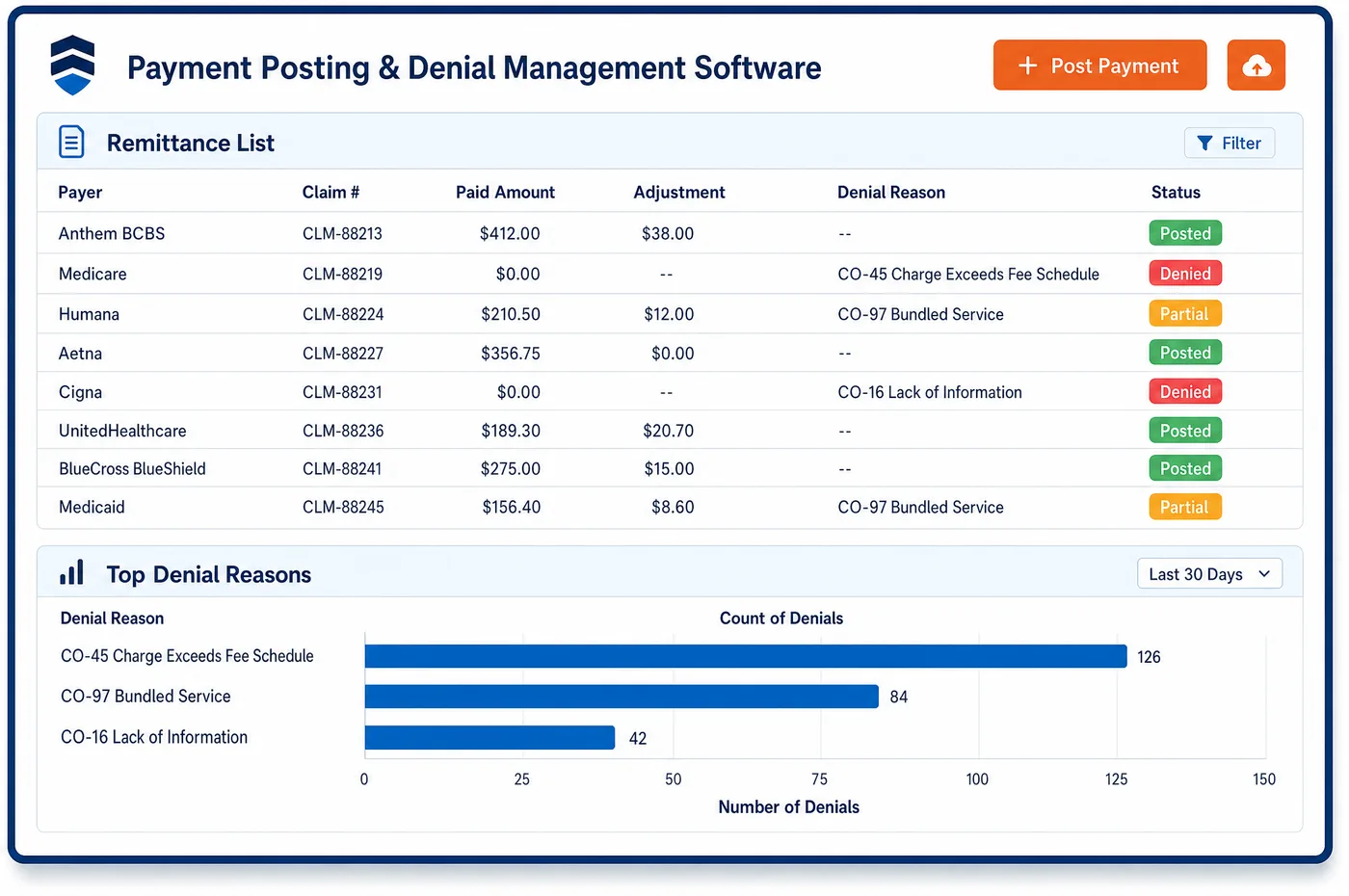
Payment Posting in a Chronic Care Practice
A chronic care program bills one claim per patient per month, often with several lines. A Medicare claim might carry 99490 with a 99439 add-on, plus 99454 and 99457 for remote monitoring. Each line comes back on the electronic remittance with its own allowed amount and adjustments. Unlimited Systems imports the 835, matches it to the claim and posts every line. Part B coinsurance moves to a supplemental payer when the remittance shows a crossover, or to the patient's balance when it does not. A January claim may apply the whole allowed amount to the Part B deductible, and that posts as patient responsibility too. Lines the payer denies because another service already covered the month go to a queue with the reason code shown. At the close of each day, posted totals are matched to the bank deposit by the EFT trace number, so cash and the ledger agree.
Why Is Payment Posting Different in Chronic Care?
Care management produces a large count of small, repeating claims. A practice with a big enrolled panel posts one claim per patient every month, and many of those claims also carry remote monitoring lines. Each line pays a modest amount, so a poster can't afford to touch them one at a time. Yet each one still has its own coinsurance, its own crossover and sometimes its own denial. Payment posting has to handle volume and detail at once.
The patient's share is unusual, too. Monthly care management carries Part B coinsurance even in a month when the patient never came in. Many patients have Medigap, which picks up that share after Medicare pays, and dually eligible patients may have Medicaid as the next payer. A Qualified Medicare Beneficiary owes no Medicare cost sharing at all, even when the state pays little of it. Posting decides where each coinsurance amount goes, and a wrong choice sends a bill to someone who should never get one.
Overlap rules add a third layer. Medicare lets CCM be billed in the same month as TCM or remote monitoring, as long as no minute is counted twice. It does not let CCM run alongside home health or hospice supervision codes, and only one practitioner may bill CCM for a patient each month. When those rules break, the denial or takeback lands at posting. A poster who sees the reason code beside the line can send it to the right person instead of writing it off.
What Chronic Care Payment Posting Software Handles
- Coinsurance on care management lines (CARC 2)
- Coinsurance posts with group code PR and CARC 2 on each monthly line. When the 835 also shows a crossover remark, the amount waits for the supplemental payer instead of going to a statement. (X12 Claim Adjustment Reason Codes)
- Crossover remark MA18
- RARC MA18 says the claim was forwarded to the patient's supplemental insurer. Those lines are tagged as crossover claims, so the Medigap or Medicaid remittance posts against them when it comes. (X12 Remittance Advice Remark Codes)
- Qualified Medicare Beneficiaries
- For QMB patients, Medicaid is responsible for Medicare cost sharing on CCM, and the patient is not billed for it. Coinsurance that the state does not pay is adjusted off instead of moved to the patient. (CMS: Frequently Asked Questions About Practitioner Billing for Chronic Care Management Services (updated 2022-08-16))
- Overlap denials (CARC 97 and CARC 18)
- CARC 97 means the payer counted the service as part of another one, and CARC 18 marks an exact duplicate. Both post at zero and go to follow-up with the code and service month shown. (X12 Claim Adjustment Reason Codes)
- RPM or RTM, not both
- Medicare allows remote physiologic monitoring or remote therapeutic monitoring alongside CCM, but not both. A takeback on one of the two posts as a negative line tied to the original payment, so the month's history stays readable. (CMS MLN Booklet: Telehealth & Remote Monitoring (MLN901705, December 2025))
- Sequestration reduction (CARC 253)
- Medicare payments carry a sequestration adjustment under CARC 253. It posts as a contractual reduction, not patient responsibility, so it never inflates a coinsurance balance. (X12 Claim Adjustment Reason Codes)
How Does Chronic Care Payment Posting Software Work?
1. Import each 835
Remittances from Medicare, Medicare Advantage plans and supplemental payers are imported as they arrive. Each one is matched to the monthly claim by claim number and service line.
2. Post every line on its own
CCM, PCM, RPM and APCM lines post with their own paid amount and adjustments. A month that paid 99490 but denied 99439 shows both lines, not a blended total.
3. Route the patient share
Coinsurance and deductible amounts go to the next payer when a crossover is shown, or to the patient when none is. Balances left for the patient flow on to monthly patient statements.
4. Send denials and takebacks to owners
Zero-pay lines and recoupments are sorted to their owners by reason code. Overlap and duplicate denials go to the team that works open claims, with the service month attached.
5. Reconcile to the bank
EFT payments are paired with their 835 using the trace number. Cash, adjustments and recoveries then post as double-entry lines for the general ledger.
Chronic Care Payment Posting Software vs. Generic Software
| Area | Generic approach | Unlimited Systems |
|---|---|---|
| Monthly line volume | Each CCM and RPM line keyed by hand from the remittance. | Lines matched and posted from the 835, with only exceptions left for staff. |
| Coinsurance routing | Every coinsurance amount billed to the patient by default. | Crossover remarks hold the amount for Medigap or Medicaid first. |
| QMB patients | Statements sent for cost sharing the patient doesn't owe. | QMB coinsurance adjusted off when the state does not pay it. |
| Overlap denials | Zero-pay lines written off as small balances. | Denials routed by reason code with the service month shown. |
| Deposits | Bank totals matched in a spreadsheet at month end. | EFT trace numbers pair each deposit with its 835. |
Who Uses It in a Chronic Care Practice
- Payment poster: A short list of lines that did not post cleanly, each with its CARC and RARC already turned into a next step.
- Billing manager: Overlap and duplicate denials by payer and code, so consent or concurrency problems get fixed before next month's claims go out.
- Practice owner: Program cash that ties to the bank, and a clear view of what Medicare and each supplemental payer actually pay for care management.
Chronic Care Payment Posting Software FAQs
Payment posting reads the coinsurance on each care management line from the 835, where it shows as group code PR with CARC 2. If the remittance says the claim crossed over to a supplemental insurer, the amount waits for that payer. If not, it moves to the patient's balance. Each line is handled on its own, so a 99490 line and a 99454 line can land differently.
The line posts at zero with its reason code, such as CARC 97 when the payer counts it as included in another service. It then goes to a follow-up queue with the service month shown. Staff check whether another practitioner billed CCM that month, whether a home health or hospice supervision code was paid, or whether minutes were counted twice.
A Qualified Medicare Beneficiary is not responsible for Medicare cost sharing, including the coinsurance on CCM. Medicaid is responsible for that share, though many states pay little or none of it. When the state pays less than the coinsurance, the rest is adjusted off rather than moved to the patient, so no statement goes out for an amount the patient does not owe.
A takeback posts as a negative amount tied to the line it reverses, whether it comes as a claim reversal or a provider-level adjustment on a later 835. Medicare allows RPM or RTM alongside CCM but not both, so a takeback on one of them is common when both were billed. The month's history keeps the original payment, the reversal and the reason together.
The Part B deductible starts over each calendar year. Early in the year, Medicare may apply the full allowed amount of a CCM or RPM line to the deductible and pay nothing. That amount posts as patient responsibility under CARC 1, or crosses over to a supplemental plan that covers it. It is not a denial, so it should not go to the denial queue.
Each electronic funds transfer carries a trace number that also appears in its 835. Payment posting pairs the two, so every deposit is linked to the remittance and the lines it paid. Cash, contractual adjustments and recoveries post as double-entry lines. Month-end close then starts from a ledger that already agrees with the bank.
Related Chronic Care Software
Payments & AR
In the revenue cycle
Payment Posting for related specialties
Sources
- X12 Claim Adjustment Reason Codes
- X12 Remittance Advice Remark Codes
- CMS: Frequently Asked Questions About Practitioner Billing for Chronic Care Management Services (updated 2022-08-16)
- CMS MLN Booklet: Telehealth & Remote Monitoring (MLN901705, December 2025)
- CMS MLN Booklet: Chronic Care Management Services (MLN909188, June 2025)
GET STARTED
See Unlimited Systems in Action
Whether you're actively evaluating new technology or simply preparing for your next vendor renewal, Unlimited Systems can help you understand where your current workflows may be creating avoidable revenue risk.