
Payments & AR
Chronic Care AR Management Software
Work open care management and remote monitoring claims by service month, payer and filing deadline, before small balances age out unseen.
Chronic Care AR Management Software tracks every unpaid care management and remote monitoring claim from submission to payment. It sorts open claims by service month, payer, code and filing deadline, runs claim status checks in bulk, and groups repeated denials, so a backlog of small monthly claims gets worked before it expires.



 6,500+ specialty providers

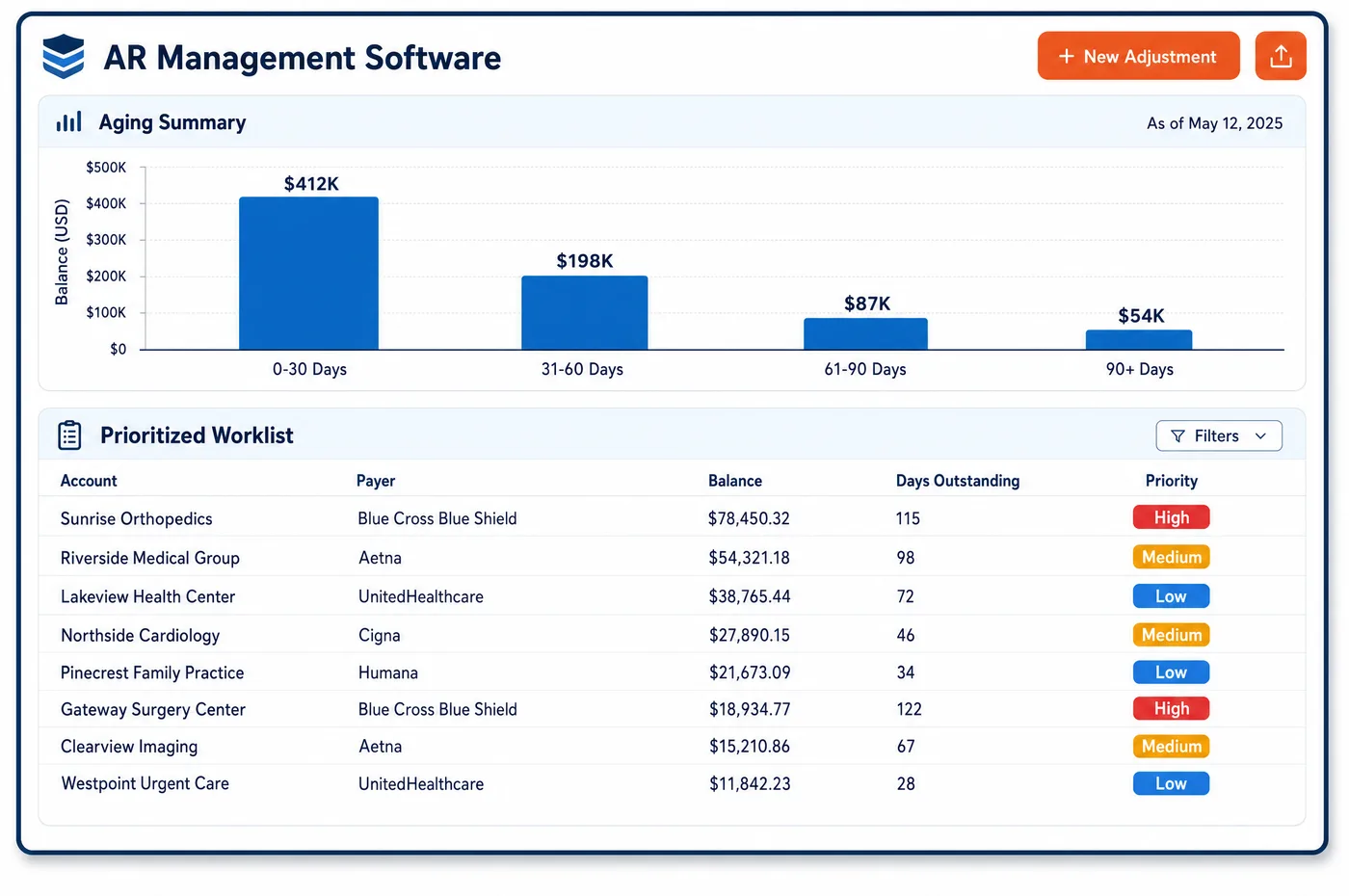
AR Management in a Chronic Care Practice
Open AR in a chronic care program looks different from a clinic's. It is made of many small claims, one per patient per month, for codes like 99490, 99487 and 99454. A single claim rarely seems worth a phone call. But a payer that stops paying one code can leave a long run of claims unpaid at once. Unlimited Systems builds worklists that group open claims by payer, code and service month, then orders them by total value and by how close each group is to the filing limit. Bulk 276 status requests run before anyone calls, and the 277 replies sort claims into paid, pending and denied. A pattern, such as one Medicare Advantage plan pending every RPM claim, shows as one task rather than a stack of separate claims. Supplemental balances that should have crossed over but never paid show up too, so the Medigap share is chased while it can still be collected.
Why Is AR Management Different in Chronic Care?
The problem in chronic care AR is scale, not size. One unpaid CCM claim is a small amount. A panel of enrolled patients produces a fresh set of claims every month, and a payer problem repeats on every one of them. If no one sees the pattern, a whole year of one code can sit unpaid. AR management here means looking at groups of claims by payer and code, not reading an aging report line by line.
Filing limits matter because of that volume. For Medicare, a claim must be filed within one calendar year of the date of service, and Medicare Advantage and commercial plans set their own limits in their contracts. Complex CCM is billed after the month closes, and some practices hold every monthly claim until month end. A claim rejected at the front end and never fixed can pass its timely filing limit before anyone notices it never became a real claim.
Second payers are easy to lose. Most monthly care management leaves coinsurance that a Medigap or Medicaid payer is expected to cover after Medicare. When the crossover fails, nobody gets a denial. The balance just sits there. AR management in chronic care has to watch for missing second payments as closely as it watches for denials from the first payer.
What Chronic Care AR Management Software Handles
- Medicare filing limit (42 CFR 424.44)
- A Medicare claim has to be filed no later than one calendar year after the date of service. Each open claim carries its filing deadline, and groups near the limit move up the worklist. (eCFR: 42 CFR 424.44, Time limits for filing claims)
- CARC 29 timely filing denials
- CARC 29 means the time limit for filing has expired. These denials are tracked by payer and code, so the gap that let a claim age out gets fixed upstream. (X12 Claim Adjustment Reason Codes)
- Claim status 276/277
- Bulk 276 requests ask payers where each open claim stands, and the 277 replies sort them into paid, pending and denied. Electronic status checks replace calls on small claims, and staff call only about replies that explain nothing. (X12 transaction sets: 835, 837, 276/277 and 270/271)
- Complex CCM billed at month end (99487, 99489)
- CMS says complex CCM is reported at the end of the service period, since medical decision-making spans the month. Those claims enter AR later than 99490 claims, so a cluster of new claims early each month is expected, not a warning sign. (CMS: Frequently Asked Questions About Practitioner Billing for Chronic Care Management Services (updated 2022-08-16))
- One practitioner per month
- Only one practitioner can bill CCM for a patient in a calendar month. When a claim denies because another practice billed first, AR staff confirm consent and enrollment before deciding to appeal or adjust. (CMS MLN Booklet: Chronic Care Management Services (MLN909188, June 2025))
- Crossover follow-up (RARC MA18)
- A Medicare line with MA18 should be followed by a supplemental payment. Lines with MA18 and no second payment after the practice's set wait go to a crossover follow-up queue. (X12 Remittance Advice Remark Codes)
How Does Chronic Care AR Management Software Work?
1. Group open claims
Open claims are grouped by payer, code and service month. A payer problem with 99454 shows as one group, not a long list of single claims.
2. Order by value and deadline
Groups are sorted by total open value and by the nearest filing limit. Collectors start with the group that would cost the most to lose.
3. Check status in bulk
276 requests go out for open claims before anyone calls. The 277 replies show which claims are pending for records, which were denied and which already paid.
4. Chase the second payer
Coinsurance that should have crossed over to Medigap or Medicaid is tracked as its own balance. Missing supplemental payments get followed up, and what the patient truly owes moves to chronic care patient billing.
5. Fix the cause upstream
Repeated denials, such as missing consent or an overlap with another practitioner, go back to the team that validates monthly charges. The next month's claims then go out clean instead of repeating the problem.
Chronic Care AR Management Software vs. Generic Software
| Area | Generic approach | Unlimited Systems |
|---|---|---|
| Worklist design | Aging report read line by line, oldest claim first. | Open claims grouped by payer, code and month, then sorted by value and deadline. |
| Small claims | Single small claims ignored as not worth the call. | Small claims worked in groups, so their total value is visible. |
| Status checks | Calls and portal lookups, one claim at a time. | Bulk 276 requests with 277 replies sorted before anyone calls. |
| Crossovers | Missing Medigap payments noticed only when a patient calls. | Lines with MA18 and no second payment flagged for follow-up. |
| Filing limits | Deadlines found when CARC 29 denials arrive. | Each group shows its nearest filing limit up front. |
Who Uses It in a Chronic Care Practice
- AR specialist: Worklists of grouped claims with status replies attached, so time goes to the groups that are worth the most to resolve.
- Billing manager: Denial and pending patterns by payer and code, with the upstream cause named, for chronic care denial management and charge fixes.
- Practice owner: A clear view of open program revenue by month and payer, and early warning when a payer stops paying a care management code.
Chronic Care AR Management Software FAQs
AR management for chronic care deals with many small monthly claims rather than a few large ones. A single CCM claim may not seem worth a call, but a payer problem repeats every month for every enrolled patient. Grouping open claims by payer, code and service month shows the pattern, so staff fix one cause instead of chasing a long list of claims.
Medicare requires claims to be filed within one calendar year of the date of service. For CCM, the date of service can be the day the time threshold was met, or the end of the month. Medicare Advantage and commercial plans set their own filing limits in their contracts, so each open claim is tracked against its own payer's limit.
After Medicare pays a care management line, the coinsurance often crosses over to a Medigap plan or to Medicaid. When the crossover fails, no denial arrives, and the balance just stays open. Lines that show the MA18 crossover remark but have no second payment are tracked, so staff can send the claim to the supplemental payer directly.
Bulk 276 claim status requests answer most questions without a call. The 277 reply shows whether each claim is paid, pending or denied, and often why. Staff only call about claims the reply doesn't explain. That matters in care management, where each claim is small and the enrolled panel can be large.
Only one practitioner can bill CCM for a patient in a calendar month. If a claim denies because another practice billed first, staff check the consent record and talk with the patient, who may have enrolled elsewhere. The claim is then appealed or adjusted, and the enrollment is updated so the next month's claim isn't sent in error.
RPM device supply codes cover a thirty-day period, while CCM and RPM treatment management codes follow the calendar month. So RPM device claims can go out on different dates than CCM claims for the same patient. AR tracks each claim from its own date of service, so a late RPM claim is not mistaken for an old one.
Related Chronic Care Software
Payments & AR
In the revenue cycle
AR Management for related specialties
Sources
- eCFR: 42 CFR 424.44, Time limits for filing claims
- X12 Claim Adjustment Reason Codes
- X12 Remittance Advice Remark Codes
- X12 transaction sets: 835, 837, 276/277 and 270/271
- CMS: Frequently Asked Questions About Practitioner Billing for Chronic Care Management Services (updated 2022-08-16)
- CMS MLN Booklet: Chronic Care Management Services (MLN909188, June 2025)
- CMS MLN Booklet: Telehealth & Remote Monitoring (MLN901705, December 2025)
GET STARTED
See Unlimited Systems in Action
Whether you're actively evaluating new technology or simply preparing for your next vendor renewal, Unlimited Systems can help you understand where your current workflows may be creating avoidable revenue risk.