

Analytics & value-based care
Chronic Care Reporting Software
Run and send the standard reports a care management program needs: monthly billing lists, consent and care plan audits, quality tracking and finance packs.
Chronic Care Reporting Software produces and delivers the reports a care management program runs on. It builds monthly billing-ready lists, consent and care plan audit reports, remote monitoring day counts and payer reports. It schedules each one to the right people, and it supports quality tracking for MIPS, ACO and CMS model programs.



 6,500+ specialty providers

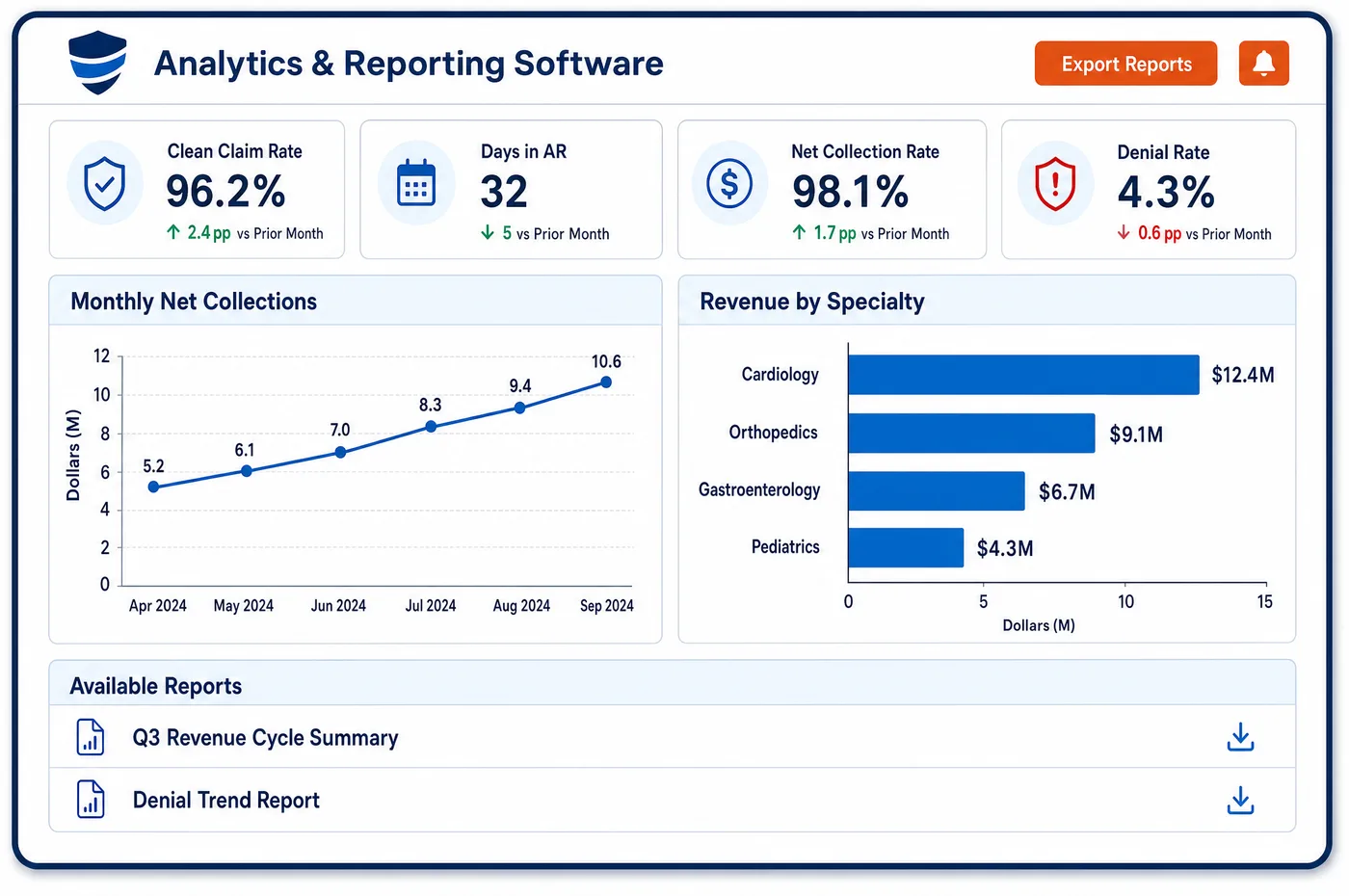
Reporting in a Chronic Care Practice
Care management runs on a monthly rhythm, and so does its reporting. Near the end of each month, care managers need a list of patients still short of a threshold. After the month closes, billing needs a list of patient-months ready to claim, with consent, initiating visit and care plan status beside each one. Finance needs program revenue and cost. Unlimited Systems keeps a library of standard reports and a self-service designer for new ones. Reports run on a schedule and go to inboxes as PDF or CSV, with access controls on who sees patient detail. Audit reports gather what a reviewer asks for: consent date, care plan date and time logs for each billed month. Quality reports track MIPS measures and the measures that Shared Savings Program ACOs report. When a payer or CMS asks for program data, the report is built from the same records that produced the claims, so the numbers match.
Why Is Reporting Different in Chronic Care?
A care management claim rests on records that never appear on the claim. Consent, the initiating visit, the care plan and the time log all have to exist for each billed month. A reviewer from a Medicare contractor may ask for them long after payment. Reporting in chronic care has to pull those records together by patient and month, quickly, from the same data that billed the claim.
These reports keep a calendar. Mid-month reports help care managers plan calls. Month-end reports tell billing what is ready. Year-end reports feed quality programs, and model participants report on their own schedules. A report that arrives after its moment is useless, so delivery has to be scheduled, not left to someone remembering to run it.
Audiences differ, too. A care manager needs a short list of their own patients. A billing manager needs codes and payers. A medical director needs quality measures, and a board needs program margin. Each report should go to the people who need it, with patient detail shown only to those allowed to see it.
What Chronic Care Reporting Software Handles
- CCM consent documentation
- CMS requires the patient's consent to be documented in the medical record, including the cost-sharing talk. A consent audit report lists billed patients with consent date and source, and flags any gap. (CMS MLN Booklet: Chronic Care Management Services (MLN909188, June 2025))
- Electronic care plan
- CCM requires an electronic, patient-centered comprehensive care plan that is shared promptly within and outside the practice. A care plan report shows each billed patient's last plan date, so stale plans surface before billing. (CMS MLN Booklet: Chronic Care Management Services (MLN909188, June 2025))
- Controlling High Blood Pressure (Quality ID 236)
- The measure counts adults aged 18 to 85 with hypertension whose most recent blood pressure was below 140/90. Reports track the rate across the enrolled panel during the year, not just at submission time. (eCQI Resource Center: CMS165v14 Controlling High Blood Pressure (MIPS Quality ID 236), 2026 performance period)
- APM Performance Pathway measures
- Shared Savings Program ACOs report quality through the APM Performance Pathway. Its measures include risk-standardized hospital admission rates for patients with multiple chronic conditions, which care management aims to lower. (CMS Quality Payment Program: APM Performance Pathway quality requirements, 2026)
- ACCESS Model reporting
- CMS plans to publicly report aggregated, risk-adjusted results for the ACCESS Model, and it uses CMS APIs for eligibility, enrollment and reporting. A practice taking part can build its data from the same patient records its claims use. (CMS Innovation Center: ACCESS (Advancing Chronic Care with Effective, Scalable Solutions) Model)
How Does Chronic Care Reporting Software Work?
1. Pick from the library
Standard reports cover the monthly billing list, threshold near-misses, consent and care plan audits, remote monitoring day counts and program finance. New reports are built in a self-service designer.
2. Schedule by the calendar
Each report runs when it is useful: mid-month for care managers, after month end for billing, quarterly for leadership. Delivery is automatic.
3. Send to the right people
Reports go to inboxes as PDF or CSV, with access controls on patient detail. A care manager gets their own panel, while a board gets totals.
4. Answer audits from the source
When a contractor or payer asks for records, an audit report pulls consent, care plan and time logs for the billed months. It draws on the same records that built the claims.
5. Feed analysis and dashboards
Report data flows into care management analytics for trend work and into chronic care dashboards for daily use.
Chronic Care Reporting Software vs. Generic Software
| Area | Generic approach | Unlimited Systems |
|---|---|---|
| Monthly billing list | Built by hand from spreadsheets at month end. | Standard report of ready patient-months, with consent and care plan status. |
| Audit response | Staff hunt through charts for each record. | Audit report pulls consent, care plan and time logs by billed month. |
| Delivery | Reports run when someone remembers. | Reports scheduled and sent to inboxes automatically. |
| Access | One report with full patient detail sent to everyone. | Access controls limit patient detail by role. |
| Quality | Measures checked once a year at submission. | Quality measures tracked across the year. |
Who Uses It in a Chronic Care Practice
- Care manager: A mid-month list of their own patients still short of a threshold, with time left to reach them.
- Compliance lead: Consent, care plan and time-log reports that answer an audit request from the same data that billed the claim.
- Board or physician owner: Scheduled program reports on revenue, cost and quality, without asking anyone to build them.
Chronic Care Reporting Software FAQs
Chronic care reporting covers a monthly billing list, threshold near-misses, consent and care plan audits, remote monitoring day counts, payer and denial reports, and program finance. Quality reports track MIPS and ACO measures. Each runs on a schedule tied to the program's monthly rhythm, so the right list reaches the right person on time.
An audit report gathers, for each billed patient-month, the consent record, the care plan date and the time logs that support the code. These come from the same records that produced the claim. Staff can answer a contractor's request without searching each chart by hand, and gaps show up before a reviewer finds them.
Reports can be scheduled to run and go out by email as PDF or CSV files. A care manager can get a mid-month list, billing a month-end list, and leadership a quarterly program summary. Access controls decide who sees patient detail, so each person gets only what their role needs.
Controlling High Blood Pressure (Quality ID 236) and the diabetes glycemic status measure (Quality ID 001) are common for chronic care panels. Shared Savings Program ACOs also face a measure of hospital admission rates for patients with multiple chronic conditions. Reports track these through the year, so the program can act before the period closes.
A self-service designer lets staff build new reports from clinical, scheduling and billing data without writing code. They can pick fields, add filters and save the layout. Saved reports can be scheduled and shared like the standard ones, and they sync to a data warehouse when the practice uses one.
Remote monitoring reports list, for each patient, the days with readings in each period and the management minutes in each month. They show which device code fits, 99445 or 99454, and which patients sent too little to bill. A separate report lists patients billed for both RPM and RTM, which Medicare does not allow together.
Related Chronic Care Software
Analytics & value-based care
In the revenue cycle
Reporting for related specialties
Sources
- CMS MLN Booklet: Chronic Care Management Services (MLN909188, June 2025)
- eCQI Resource Center: CMS165v14 Controlling High Blood Pressure (MIPS Quality ID 236), 2026 performance period
- eCQI Resource Center: CMS122v14 Diabetes Glycemic Status Assessment (MIPS Quality ID 001), 2026 performance period
- CMS Quality Payment Program: APM Performance Pathway quality requirements, 2026
- CMS Innovation Center: ACCESS (Advancing Chronic Care with Effective, Scalable Solutions) Model
- CMS MLN Booklet: Telehealth & Remote Monitoring (MLN901705, December 2025)
GET STARTED
See Unlimited Systems in Action
Whether you're actively evaluating new technology or simply preparing for your next vendor renewal, Unlimited Systems can help you understand where your current workflows may be creating avoidable revenue risk.