
Analytics & value-based care
Chronic Care Analytics Software
See why care management revenue moves: enrollment, minutes per patient, thresholds met, transmission days and denials, by month, payer and care manager.
Chronic Care Analytics Software explains why a care management program's numbers move from month to month. It tracks enrolled patients billed each month, minutes logged against each code's threshold, add-on capture, remote monitoring transmission days, consent and care plan gaps, and denials by payer, then traces each change to its cause.



 6,500+ specialty providers

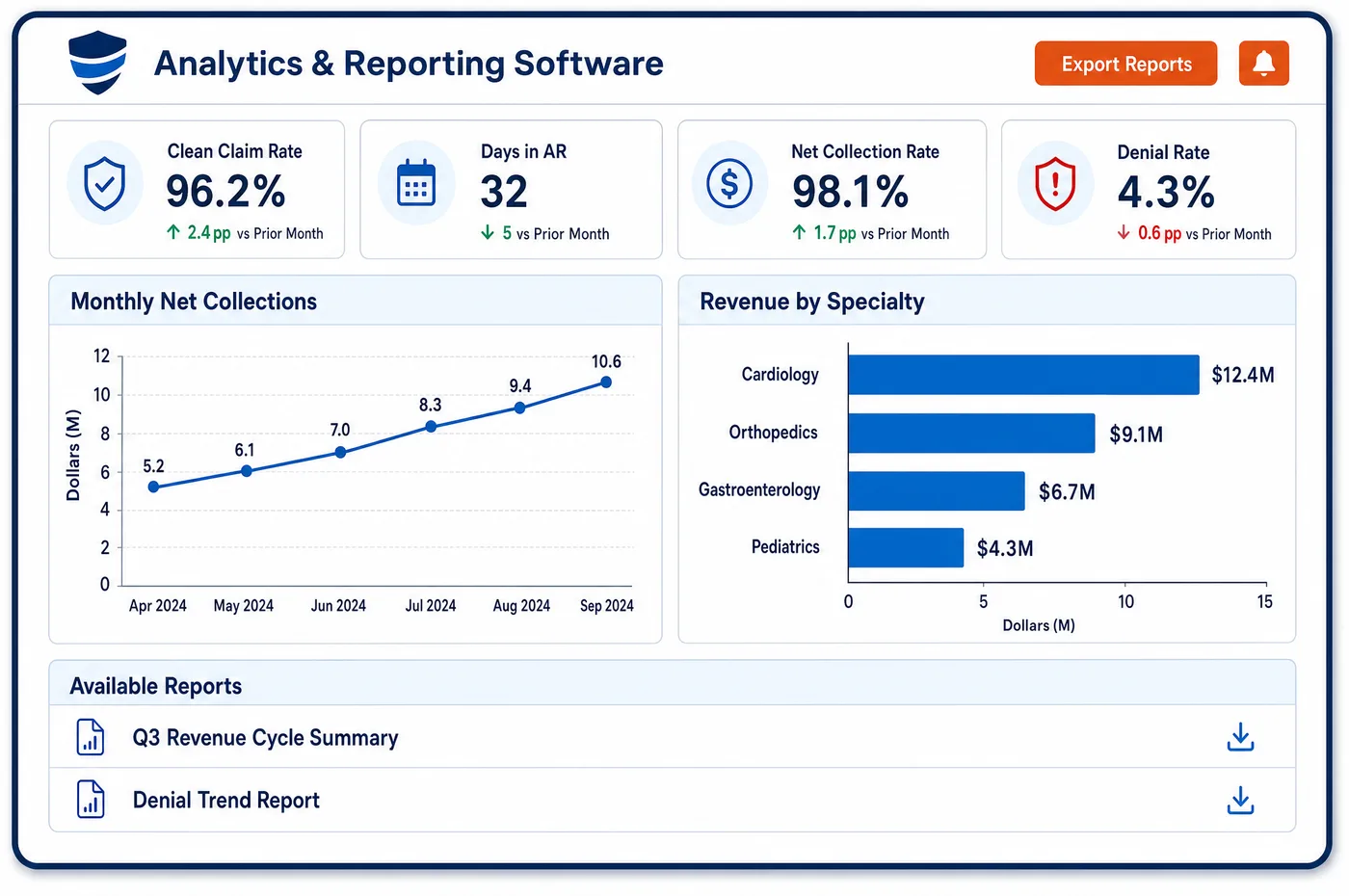
Analytics in a Chronic Care Practice
A care management program has a simple revenue formula with many moving parts. Revenue depends on how many patients are enrolled, how many reach a billable threshold each month, which codes they reach and what each payer pays. Unlimited Systems brings the clinical, scheduling and billing data for the program into one place. Time logged by the care team arrives from the EHR, beside the claims it produced. Leaders can see enrolled patients against patients billed, and the gap between them. They can see how many patients reached the 20 minutes that 99490 needs, how many went on to a 99439 add-on, and how many fell a few minutes short. For remote monitoring, they see who sent readings on sixteen or more days, who fell in the band 99445 covers, and who sent too little to bill. Each number drills down to payer, care manager, patient and claim. When collections drop, the cause shows plainly.
Why Is Analytics Different in Chronic Care?
Most care management revenue is lost before a claim exists. A patient who is enrolled but gets only fifteen minutes of time-based care management in a month produces no CCM claim at all. That loss never shows on a denial report. Analytics in chronic care has to measure what didn't get billed, such as near-misses on time thresholds and enrolled patients with no claim, not just what did.
The numbers also move for reasons that have nothing to do with staff effort. The Part B deductible resets in January, so early-year collections fall even when billing is steady. A short month leaves fewer working days to reach a threshold. RPM device supply runs on a thirty-day period, while treatment management runs on the calendar month, so the two can drift apart. Without that context, a normal dip can look like a problem.
New codes changed the picture in 2026. Medicare now pays 99445 for two to fifteen days of readings and 99470 for the first 10 minutes of RPM treatment management. Months that used to earn nothing may now earn something. Chronic care analytics has to show how much of the program runs on these lower-threshold codes, and whether patients who once reached sixteen days are slipping into the lower band.
What Chronic Care Analytics Software Handles
- 99490 and 99439 thresholds
- Code 99490 covers the first 20 minutes of clinical staff CCM time in a calendar month, and 99439 each additional 20 minutes. Analytics counts patients who reached each step, and patients who stopped just short. (CMS MLN Booklet: Chronic Care Management Services (MLN909188, June 2025))
- Complex CCM (99487, 99489)
- Code 99487 needs at least 60 minutes of clinical staff time plus moderate or high complexity decision-making, and 99489 adds each further 30 minutes. The mix of complex months shows whether patient acuity and documentation line up. (CMS MLN Booklet: Chronic Care Management Services (MLN909188, June 2025))
- RPM day bands (99445, 99454)
- Code 99445 covers two to fifteen days of readings and 99454 covers sixteen to thirty, with one reported per period. Analytics shows how remote monitoring patients spread across the bands, and which ones sent too little to bill. (Noridian Medicare (Jurisdiction F Part B): Remote Physiologic Monitoring (RPM) 2026 Evaluation and Management Updates)
- RPM management time (99470, 99457)
- Code 99470 covers the first 10 minutes of RPM treatment management in a calendar month, for months that fall short of the 20 that 99457 needs. Trends show whether management time is shrinking toward the lower code. (Noridian Medicare (Jurisdiction F Part B): Remote Physiologic Monitoring (RPM) 2026 Evaluation and Management Updates)
- Consent and initiating visit coverage
- CCM needs documented consent and, for new patients or those not seen within the prior year, an initiating visit. Analytics counts enrolled patients missing either, since their months can't be billed. (CMS MLN Booklet: Chronic Care Management Services (MLN909188, June 2025))
- Denial patterns on care management codes
- Denials are grouped by payer, code and reason, such as CARC 97 for a service counted as part of another. A rise in one group points to a consent, overlap or payer setup problem. (X12 Claim Adjustment Reason Codes)
How Does Chronic Care Analytics Software Work?
1. Bring the program data together
Enrollment, consent and time logs arrive from the EHR, device day counts from the monitoring vendor, and claims from billing. Each patient-month becomes one row that can be counted.
2. Measure the billing funnel
Each month shows enrolled patients, patients who reached a threshold, patients billed and patients paid. The drop between each step is where revenue is lost.
3. Find the cause
Each gap drills down by care manager, payer and patient. A care manager with many near-misses, or a payer with many denials, stands out quickly.
4. Compare and benchmark
Results compare with the program's own history and with national benchmarks. Seasonal effects, such as January deductibles, are shown in context.
5. Hand off what you find
Findings reach the people who act on them through scheduled chronic care reports and role dashboards for care teams. Repeated denial causes go back to charge validation.
Chronic Care Analytics Software vs. Generic Software
| Area | Generic approach | Unlimited Systems |
|---|---|---|
| What gets measured | Billed and paid totals only. | The whole funnel, from enrolled to threshold met to billed to paid. |
| Near-misses | Months that fell short are invisible. | Patients a few minutes short of 99490 are counted and listed. |
| Remote monitoring | Readings checked one patient at a time. | Patients spread across the 99445 and 99454 bands, with non-billable periods shown. |
| Seasonality | A January dip treated as a crisis. | Deductible resets and short months shown in context. |
| Comparison | No outside view of program results. | Trends against the program's history and national benchmarks. |
Who Uses It in a Chronic Care Practice
- Program director: Enrollment, threshold and billing trends by care manager, with near-misses that point to where coaching or staffing helps.
- Billing manager: Denial and payment patterns on care management codes by payer, so each fix reaches the right step.
- Physician owner: A plain answer to why program revenue rose or fell this month, traced down to the cause.
Chronic Care Analytics Software FAQs
Chronic care analytics should measure the steps before revenue: patients enrolled, patients who reached a time threshold, patients billed and patients paid. The gaps between those steps show where money is lost, such as near-misses on 99490 time or enrolled patients missing consent. Revenue alone shows the result but not the cause.
For each patient-month, minutes logged are compared with the threshold for the code the patient would qualify for. Patients who end the month just short of 99490 time are counted and listed by care manager. That shows whether the program needs better planning of calls or simply more staff time for its panel.
Each patient's Part B deductible resets on the first of the year. In January, Medicare often applies care management lines to the deductible, so the payer pays little and the patient or a supplemental plan owes the rest. Collections fall even when billing is steady. Analytics marks the effect, so a seasonal dip is not mistaken for a billing problem.
Since January 2026, Medicare pays 99445 for two to fifteen days of readings and 99470 for shorter monthly treatment management time. Months that once earned nothing can now be billed. Analysis now has to show how many patients fall in each band, and whether patients are sliding from 99454 to 99445 over time.
Results can be broken out by care manager, including panel size, patients reaching each threshold and near-misses. The point is to find where support is needed, such as a care manager with too large a panel. Comparisons use the same rules for everyone, so differences come from the work, not the counting.
Care management minutes are documented by the care team in the EHR or care management tool, along with who did the work and what it was. That activity reaches Unlimited Systems through the EHR connection. Device day counts come from the monitoring vendor. Both are read against the claims that billing produced.
Related Chronic Care Software
Analytics & value-based care
In the revenue cycle
Analytics for related specialties
Sources
GET STARTED
See Unlimited Systems in Action
Whether you're actively evaluating new technology or simply preparing for your next vendor renewal, Unlimited Systems can help you understand where your current workflows may be creating avoidable revenue risk.