

Front office
Diabetes Care Financial Clearance Software
Check education hours, lab frequency, device criteria and drug plan approvals before the visit, the class or the order goes ahead.
Diabetes Care Financial Clearance Software confirms coverage and limits before diabetes services are given. It checks eligibility and cost sharing, counts DSMT and nutrition therapy hours used, watches A1c frequency limits, confirms device criteria are documented before an order leaves, and tracks drug plan prior authorization for GLP-1s.



 6,500+ specialty providers

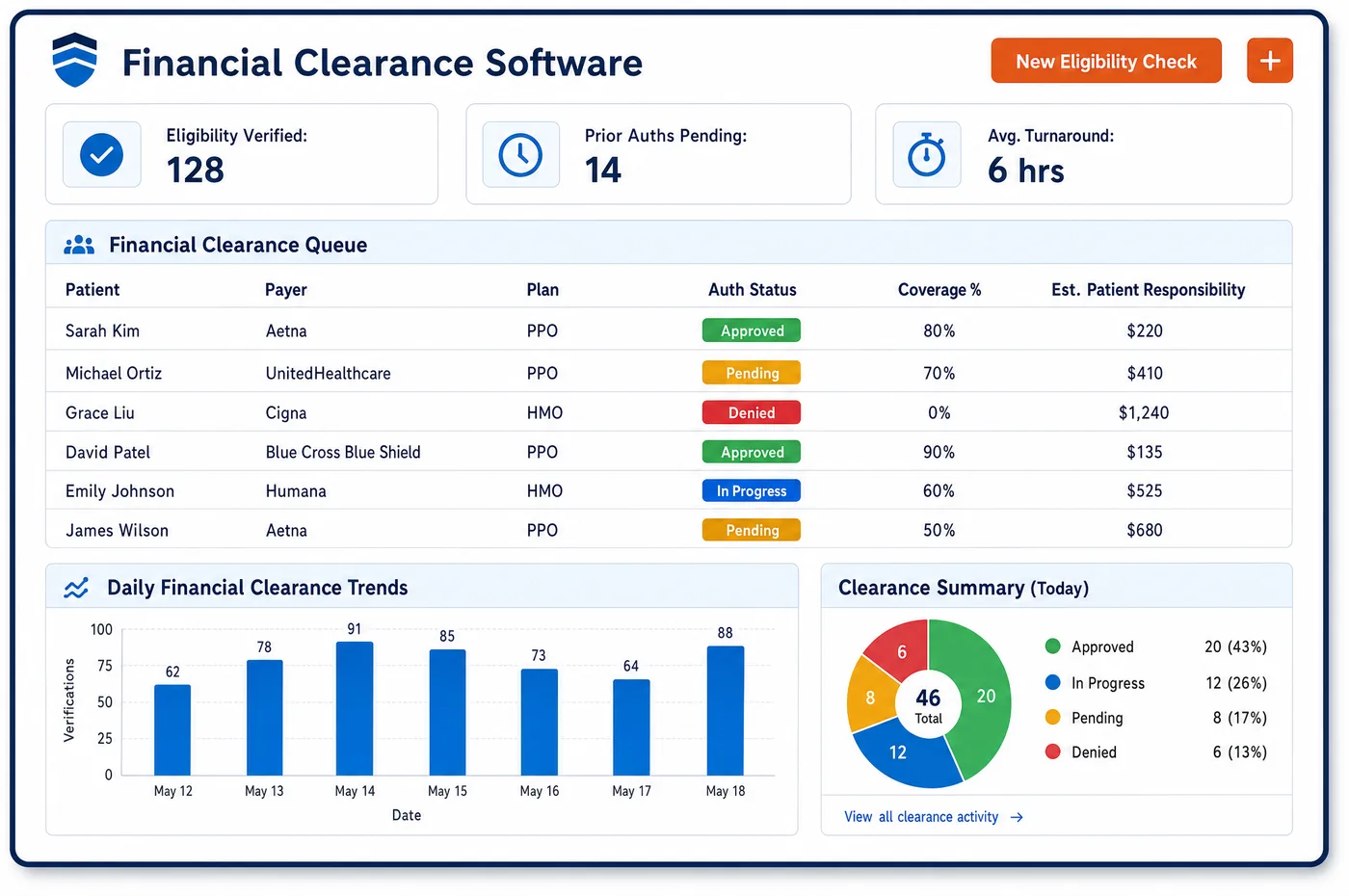
Financial Clearance in a Diabetes Care Practice
Clearance in a diabetes practice is mostly about limits. Medicare covers up to ten hours of initial DSMT and two follow-up hours a year after that. Nutrition therapy has its own yearly hours and needs a fresh physician referral each calendar year. A1c tests have a national frequency limit for patients whose diabetes is controlled. Hours or tests beyond a limit are the patient's to pay only if a valid ABN was signed first. Diabetes care financial clearance software runs an eligibility check when the visit is booked and shows the hours left on each referral beside the result. For a new CGM or pump, staff confirm the chart meets the coverage criteria before the order goes to the supplier. GLP-1 approvals are a different track: the drug plan decides, the prescriber's office asks, and the result is noted on the account so the pharmacy fill isn't a surprise.
Why Is Financial Clearance Different in Diabetes Care?
Most clearance work asks whether a service is covered. In diabetes care the harder question is often whether it is still covered this year. DSMT, nutrition therapy and A1c testing are all covered for people with diabetes, but each has a count or a frequency. A patient who has used their hours elsewhere can arrive with none left, and the practice won't know unless it asks and tracks. The Medicare liability notice has to be signed before the service, not after the denial.
Device orders shift the risk. The practice doesn't bill for a CGM or insulin pump, but its notes decide whether the supplier is paid. Medicare's CGM policy asks for diabetes, insulin treatment or problematic hypoglycemia, enough training, and a qualifying visit before the order. Pump policy asks for a C-peptide or beta cell autoantibody test, a completed diabetes education program, and a history of multiple daily injections with frequent glucose checks. Clearing the order means checking the chart first.
Drug approvals add a third payer path. GLP-1s and many insulin products are filled under the drug plan, which can require prior authorization, step therapy or quantity limits. The practice doesn't bill these drugs, yet the prescriber is the one who files the request and the supporting statement. Clearance tracks that request so the patient learns the answer from the practice, not at the pharmacy counter.
What Diabetes Care Financial Clearance Software Handles
- DSMT hours and ABN (G0108, G0109)
- Medicare edits stop initial DSMT past 10 hours and follow-up past 2 hours a year, and the patient is liable for hours denied over the limit only when a valid ABN was given. Staff check hours left before each class and give the ABN when the plan runs past them. (CMS Medicare Claims Processing Manual, Chapter 18, Section 120: Diabetes Self-Management Training Services)
- Nutrition therapy referral and hours (97802, 97803, 97804)
- MNT (97802 to 97804) covers 3 hours in the first calendar year and 2 hours in later years, and every year needs a new physician referral. Clearance checks that the current year's referral is on file and how many hours remain. (CMS Medicare Claims Processing Manual, Chapter 4, Section 300: Medical Nutrition Therapy Services)
- A1c frequency (83036)
- Medicare's lab NCD does not consider A1c testing more often than every three months reasonable for a patient whose diabetes is controlled. More frequent testing can be covered after a regimen change, so clearance looks at the date of the last A1c and the reason for the next one. (CMS National Coverage Determination 190.21: Glycated Hemoglobin/Glycated Protein)
- CGM order criteria
- A Medicare CGM order needs diabetes, insulin treatment or problematic hypoglycemia, enough training, and an in-person or approved telehealth visit in the six months before ordering. Staff confirm each is in the chart before the order is sent. (CMS Medicare Coverage Database, LCD L33822: Glucose Monitors)
- Insulin pump criteria (E0784)
- Medicare pump coverage asks for a qualifying C-peptide or a positive beta cell autoantibody test, plus a completed diabetes education program and a history of multiple daily injections with frequent self-testing. Clearance checks the results and notes before the supplier receives the order. (CMS Medicare Coverage Database, LCD L33794: External Infusion Pumps)
- GLP-1 prior authorization at the drug plan
- Under Part D, the prescriber may request a coverage determination, including one about a prior authorization rule. The practice files the request, records the decision on the account, and bills nothing for the drug itself. (CMS: Medicare Part D Coverage Determinations)
How Does Diabetes Care Financial Clearance Software Work?
1. Check eligibility at booking
An eligibility check runs when the visit is booked and returns active coverage, deductible and cost sharing. Medicare patients' Part B and drug plan details are both confirmed.
2. Count hours on each referral
For DSMT and nutrition visits, the hours ordered and used appear beside the eligibility result. If the patient has had training elsewhere this year, staff ask and record it.
3. Give the ABN when limits are reached
If a class, a nutrition visit or an A1c will pass a Medicare limit, staff explain the cost and have the patient sign an ABN before the service. The claim later carries the modifier that shows a notice is on file.
4. Clear device orders against the chart
Before a CGM or pump order goes to the supplier, staff confirm the chart has the visit, results and history the policy asks for. Missing items go to the clinician as a task.
5. Track drug plan decisions and estimates
Prior authorization requests for GLP-1s are logged with their status. Patients get a cost estimate for visits and classes, and the decision on their medicine, through patient engagement messages.
Diabetes Care Financial Clearance Software vs. Generic Software
| Area | Generic approach | Unlimited Systems |
|---|---|---|
| Education hours | Hours checked after a denial comes back. | Hours left on each referral shown at booking. |
| ABN timing | Notice forgotten, so the practice absorbs the loss. | Limits flagged before the service, with time to give the notice. |
| A1c frequency | Tests run whenever ordered. | Last A1c date and the reason for the next test checked. |
| Device orders | Orders sent, then the supplier asks for missing notes. | Coverage criteria checked against the chart before the order leaves. |
| GLP-1 approvals | Patients find out at the pharmacy. | Drug plan requests tracked on the account, with patients told the result. |
Who Uses It in a Diabetes Care Practice
- Front desk: Eligibility, cost sharing and education hours on one screen when the visit is booked.
- Diabetes educator: A clear sign before each class of whether the patient has hours left, and whether an ABN is needed.
- Prescribing clinician: Drug plan requests tracked to a decision, and device orders that reach the supplier with the chart already in order, which keeps denials down.
Diabetes Care Financial Clearance Software FAQs
Financial clearance before a DSMT class checks that the patient is covered, that a valid order is on file, and how many hours remain. Under Medicare, initial training is capped at ten hours and follow-up at two hours a year. If the class would pass that limit, staff explain the cost and get a signed ABN first.
The practice usually doesn't bill GLP-1s. They are filled by a pharmacy under the patient's drug plan, which can require prior authorization or step therapy. The prescriber's office files the request and any supporting statement, then tracks the plan's decision so the patient hears the result before arriving at the pharmacy.
Medicare's national lab policy treats an A1c more often than every three months as not reasonable for a patient whose diabetes is controlled. More frequent tests can be covered when the regimen has changed or control has been disrupted. Clearance checks the date of the last test and the reason, and staff give an ABN when the test may not be covered.
The supplier is paid only if the practice's records meet Medicare's CGM policy. That means documented diabetes, insulin treatment or problematic hypoglycemia, enough training, and a qualifying visit in the six months before the order. Checking the chart before the order leaves avoids a round of record requests and a delayed start for the patient.
Medicare's pump policy asks for a C-peptide test that meets its threshold or a positive beta cell autoantibody test. It also asks for a completed diabetes education program and a history of multiple daily injections with frequent self-testing, unless the patient used a pump before Medicare. Staff confirm these are in the chart before sending the order.
Under Medicare, nutrition therapy hours run by calendar year and unused hours don't carry over. Each new year of follow-up hours needs a new physician referral, and extra hours in the same year need a second referral for a change in condition or treatment. Clearance checks that the current referral is on file before each visit.
Related Diabetes Care Software
Front office
In the revenue cycle
Financial Clearance for related specialties
Sources
- CMS Medicare Claims Processing Manual, Chapter 18, Section 120: Diabetes Self-Management Training Services
- CMS Medicare Claims Processing Manual, Chapter 4, Section 300: Medical Nutrition Therapy Services
- CMS National Coverage Determination 190.21: Glycated Hemoglobin/Glycated Protein
- CMS Medicare Coverage Database, LCD L33822: Glucose Monitors
- CMS Medicare Coverage Database, LCD L33794: External Infusion Pumps
- CMS: Medicare Part D Coverage Determinations
GET STARTED
See Unlimited Systems in Action
Whether you're actively evaluating new technology or simply preparing for your next vendor renewal, Unlimited Systems can help you understand where your current workflows may be creating avoidable revenue risk.