
Analytics & value-based care
Diagnostic Imaging Value-Based Care Software
Quality and cost measures that reach imaging: the CT dose measure, breast screening gaps, mammography audits, and hospital episodes that count imaging spend.
Diagnostic Imaging Value-Based Care Software helps imaging groups and centers track the quality and cost measures that touch their work. It follows MIPS data such as CT dose and image quality, screening gaps for payer programs, mammography audit counts, and imaging spend inside hospital episodes, so staff can see what each program asks of them.



 6,500+ specialty providers

Value-Based Care in a Diagnostic Imaging Practice
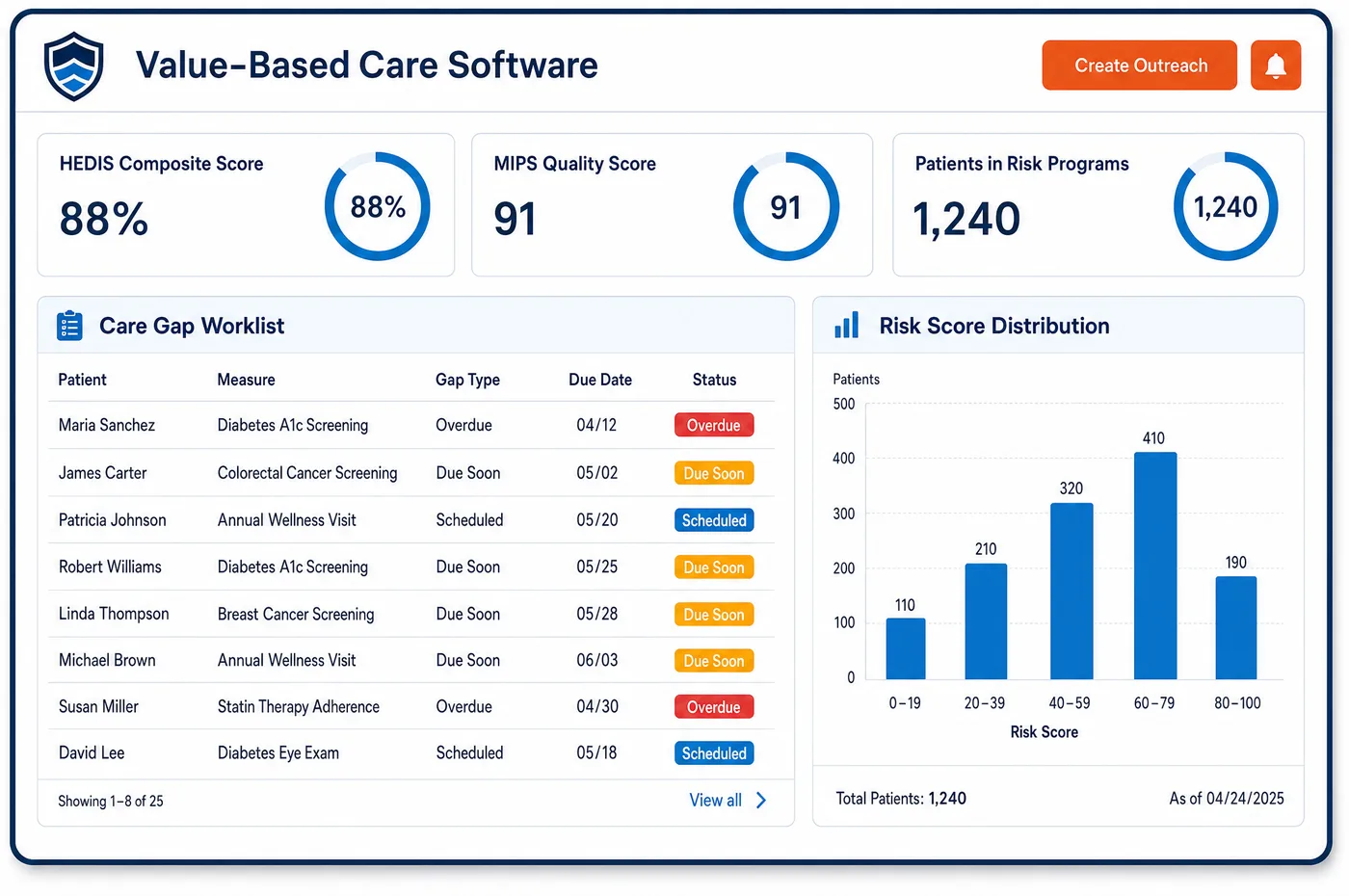
Imaging is a different fit for value-based care than most specialties. Radiologists rarely manage a patient over time, and the referring physician owns most outcomes. What imaging does own is quality and use. How much radiation did the CT scanner deliver, and was the image good enough? Was a follow-up scan advised for an incidental finding? Did a woman due for screening get her mammogram? Value-based care software for imaging keeps these measures in one place and ties each to the studies behind it. Staff see which measures the group reports under MIPS, which gaps payer programs track, and which counts the mammography audit needs. They also see imaging spend by payer and referrer, which health systems and risk-bearing contracts ask about. Gaps are listed while the encounter is recent, when a record can still be fixed. Clinical data that is held in other systems is added by the clinical team before anything is reported.
Why Is Value-Based Care Different in Diagnostic Imaging?
Most value-based programs assume a physician who follows a patient across visits. Diagnostic imaging rarely fits that mold. A patient may see a radiologist once, and the order came from someone else. So the measures that apply to imaging are about the quality of the study and the safety of the process. Radiation dose is the clearest case. A MIPS electronic measure for CT looks at whether exams fall outside dose and image-quality limits for the clinical reason. It is built from data that scanners and special software produce, not from claims, and billing staff cannot calculate it alone.
Payers and health systems care about imaging for a different reason, which is cost. An advanced scan ordered without need adds spend without adding value. For years, Medicare's appropriate use criteria program was meant to push ordering physicians toward better choices. It is now paused. CMS rescinded the rules at 42 CFR 414.94 effective January 1, 2024, and providers no longer report the consultation data on claims. Imaging groups still meet the goal through payer approval programs and hospital partners, so each group needs its own view of use by referrer, modality and payer.
Hospital models add a third layer. The Transforming Episode Accountability Model began on January 1, 2026 and is mandatory for acute care hospitals in selected areas. Its target prices cover Part A and Part B items and services in an episode, so imaging is part of the spending a hospital reviews. A reading group that serves a participating hospital may be asked how its studies fit the episodes. Imaging dashboards can show the studies by episode date and by referrer.
What Diagnostic Imaging Value-Based Care Software Handles
- CT dose and image quality measure (MIPS quality 494)
- Quality 494 is an electronic measure of diagnostic CT exams that fall outside dose or image-quality limits for the clinical indication. It is the only outcome measure in the Diagnostic Radiology MVP, and the dose data comes from third-party software rather than billing. (eCQI Resource Center: Excessive Radiation Dose or Inadequate Image Quality for Diagnostic Computed Tomography (CT) in Adults (Clinician Level), CMS1056v3)
- Diagnostic Radiology MIPS Value Pathway
- A MIPS Value Pathway asks a group to report four quality measures instead of six, and one must be an outcome measure. Staff track the measures, the eligible exams and the submission method, and the clinical team supplies the dose data. (American College of Radiology: MIPS Value Pathways (MVP) overview, including the Diagnostic Radiology MVP)
- Appropriate use criteria program status
- CMS paused the imaging AUC program and rescinded 42 CFR 414.94 effective January 1, 2024. Claims no longer carry AUC consultation data, so the practice does not report it. Staff watch for any restart notice. (CMS: Appropriate Use Criteria Program)
- Breast cancer screening gaps (HEDIS BCS-E)
- NCQA widened its breast cancer screening measure to women ages 40 to 74. Health plans use mammography claims to close a gap, so a center lists patients due or overdue for payer outreach. (NCQA: Notification of changes to HEDIS measures, including Breast Cancer Screening age range)
- Mammography outcomes audit
- Mammography facilities must follow positive mammograms and review three measures: positive predictive value, cancer detection rate per 1,000 patients and recall rate. Billing supplies the screening and callback counts, and clinical staff add pathology. (21 CFR 900.12: Quality standards for mammography, including the medical outcomes audit)
- TEAM episodes and imaging spend
- TEAM is mandatory for acute care hospitals in selected areas from January 1, 2026. Its target prices include Part A and Part B items and services in each episode, so imaging within a window is part of the hospital's spending. (CMS: Transforming Episode Accountability Model (TEAM))
How Does Diagnostic Imaging Value-Based Care Software Work?
1. List the programs in play
Staff note which programs apply, such as MIPS, a payer screening program, a hospital episode model or a risk contract. Each one gets an owner and a reporting date.
2. Link each measure to its studies
A measure is tied to the CPT codes, sites and readers that count toward it. A list of eligible studies shows what is in the numerator and denominator.
3. Add outside data
Dose records, pathology results and follow-up advice often live in other systems. The clinical team adds them to the list, and billing does not guess at them.
4. Close gaps early
Gaps such as a missing dose record or a patient overdue for screening are listed while the visit is recent. Staff fix what can be fixed and pass the rest to the referring office.
5. Review spend and results
Leaders review imaging use by payer and referrer through imaging analytics, and send partners the lists they ask for through imaging reporting.
Diagnostic Imaging Value-Based Care Software vs. Generic Software
| Area | Generic approach | Unlimited Systems |
|---|---|---|
| MIPS tracking | A spreadsheet kept by one person. | Measures tied to the eligible studies, with an owner for each. |
| Dose data | Assumed to be in the billing system. | Added by the clinical team from the dose software, then listed with the study. |
| Screening gaps | Found when a payer sends a letter. | Listed by patient while outreach can still help. |
| Mammography audit | Built once a year by hand. | Screening and callback counts kept current. |
| Hospital episodes | Imaging spend unknown to the group. | Studies listed by referrer and date for hospital partners. |
Who Uses It in a Diagnostic Imaging Practice
- Quality coordinator: One list of the measures the group reports, with the studies behind each and the outside data still needed.
- Radiology group leader: A clear picture of which programs apply and which affect payment, so choices are not made from a payer's one-page summary.
- Hospital contract manager: A view of the group's studies by referrer and episode date, ready for talks with a participating hospital. Related measures also appear in MIPS reporting work.
Diagnostic Imaging Value-Based Care Software FAQs
Value-based care for radiology groups usually means MIPS. The Diagnostic Radiology MIPS Value Pathway includes an electronic measure of CT exams that fall outside dose or image-quality limits. Other programs include payer breast screening measures and hospital episode models. Each group should check its own participation status and the measures offered for the year.
Medicare does not require it now. CMS paused the appropriate use criteria program and rescinded the rules at 42 CFR 414.94, effective January 1, 2024. Claims no longer carry the consultation data. The statute remains on the books, and CMS has given no restart date, so the practice watches for any new notice.
Health plans measure breast cancer screening with claims for mammography. A center lists patients due or overdue and gives that list to the plan or the referring office for outreach. When the exam is done, the claim closes the gap. The list helps outreach staff but does not replace the physician's order.
Billing staff cannot calculate it. The measure depends on dose and image-quality data produced by scanners and special software. Billing can list the eligible CT studies and track the submission, while the clinical team and the software vendor supply the data. Staff then review the counts before the group reports.
Hospital episode payments cover Part A and Part B services, so imaging within an episode becomes part of the spending a hospital reviews. A reading group may be asked how many studies its readers handle for the hospital's episodes. Having studies listed by referrer and date makes that conversation easier.
Mammography facilities must review positive predictive value, cancer detection rate and recall rate. Billing data supplies screening and callback counts by reader and date. Clinical staff add biopsy and pathology results from the record, since those are not billing data. Together they give the audit team a complete list.
Related Diagnostic Imaging Software
Analytics & value-based care
In the revenue cycle
Value-Based Care for related specialties
Sources
- eCQI Resource Center: Excessive Radiation Dose or Inadequate Image Quality for Diagnostic Computed Tomography (CT) in Adults (Clinician Level), CMS1056v3
- American College of Radiology: MIPS Value Pathways (MVP) overview, including the Diagnostic Radiology MVP
- CMS: Appropriate Use Criteria Program
- NCQA: Notification of changes to HEDIS measures, including Breast Cancer Screening age range
- 21 CFR 900.12: Quality standards for mammography, including the medical outcomes audit
- CMS: Transforming Episode Accountability Model (TEAM)
GET STARTED
See Unlimited Systems in Action
Whether you're actively evaluating new technology or simply preparing for your next vendor renewal, Unlimited Systems can help you understand where your current workflows may be creating avoidable revenue risk.