

Payments & AR
Clinical Research AR Management Software
Work open research claims and unpaid sponsor invoices from one aging view, with trial-coding returns, routine-cost denials and holdbacks sorted by study.
Clinical Research AR Management Software works the two kinds of open balance a research site carries: insurance claims for routine trial care, and sponsor invoices due under the clinical trial agreement. Both age by study and by payer, so staff can chase a missing NCT number and an unpaid screen-failure fee from the same worklist.



 6,500+ specialty providers

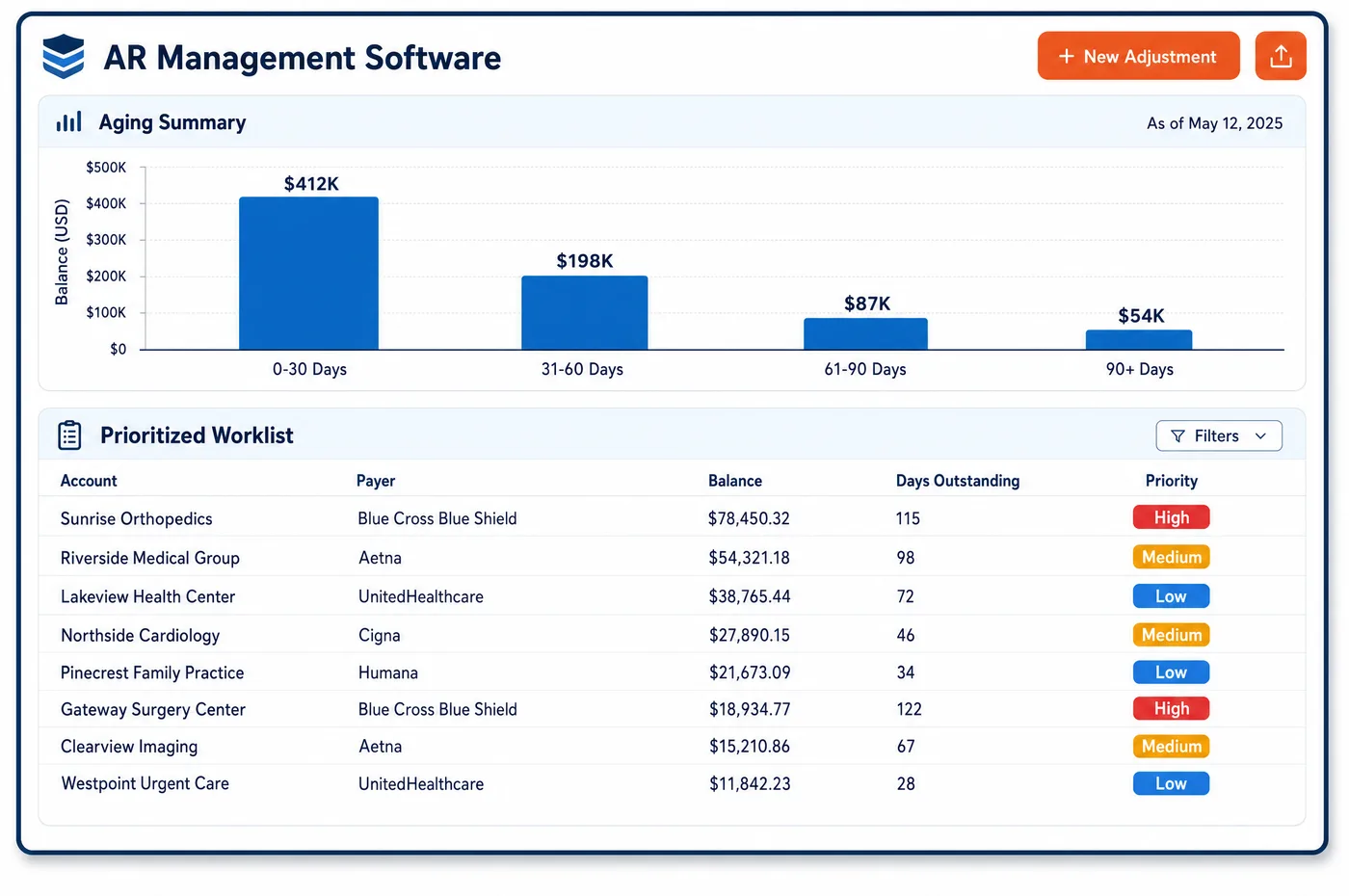
AR Management in a Clinical Research Practice
Research AR splits into two ledgers that age by different rules. Insurance claims for routine care age against each payer's timely filing limit, the same as any claim. Sponsor invoices age against the payment terms in the clinical trial agreement, and the follow-up goes to a CRO or sponsor contact, not a payer line. Unlimited Systems keeps both on worklists sorted by study, payer, age and value. Trial claims that Medicare returns as unprocessable are flagged apart from true denials, since they need a new claim, not an appeal. A commercial denial that calls a routine trial service experimental is tagged for appeal, because federal law limits when a plan can refuse those costs. Claims still held in research billing review are counted as unbilled, not as AR, so a slow coverage review shows up as its own number. Sponsor invoices past their terms list the visits and items they cover, so the coordinator can answer the CRO in one reply.
Why Is AR Management Different in Clinical Research?
A research site has two kinds of debtor. Insurers owe for routine care, and the rules for chasing them are the familiar ones: claim status, appeals and filing limits. Sponsors owe for research work under a contract, and the rules come from the agreement and the budget. A practice that runs AR management only from claim data never sees the sponsor side, which is often where the larger study balances sit.
Trial claims also fail in ways ordinary claims do not. Medicare returns a claim with no trial number or no Z00.6 as unprocessable, and an unprocessable claim has no appeal rights. Staff who treat it like a denial lose time on an appeal that can't work. On the commercial side, a plan may deny a routine scan because the patient is in a trial, even though most group and individual plans must cover routine costs for a qualified participant in an approved trial.
Timing works against research claims, too. A claim that waits in coverage review for the study team to confirm what the sponsor pays is not yet AR, but the filing clock still runs from the date of service. Medicare Advantage enrollees add a further step for hospital-based sites, since outpatient trial and non-trial services must go on separate claims. Each of these needs its own queue, or it gets lost among routine follow-up.
What Clinical Research AR Management Software Handles
- Unprocessable trial claims (CARC 16 with MA130)
- A claim returned with MA130 has no appeal rights, and CMS says to send a new claim with complete, correct data. These returns get their own queue, apart from denials, with the missing trial number or diagnosis shown. (CMS Medicare Claims Processing Manual, Chapter 32, Section 69: Qualifying Clinical Trials)
- Erroneous denials of trial services
- If a covered trial service billed with correct trial coding is denied for something like medical necessity, the MAC is told to adjust the claim. If the trial coding was missing, the service goes back on a new claim with it. (CMS Medicare Claims Processing Manual, Chapter 32, Section 69: Qualifying Clinical Trials)
- Routine-cost denials by commercial plans
- Federal law bars group health plans and insurers from denying or limiting routine patient costs for a qualified individual in an approved phase I to IV trial for cancer or another life-threatening condition. Denials that cite trial status are routed for appeal. (42 U.S.C. 300gg-8: Coverage for individuals participating in approved clinical trials)
- Medicaid routine patient costs
- Since January 1, 2022, state Medicaid programs must cover routine patient costs in qualifying trials. A state may not deny them because the trial is out of state or the investigator is out of network, which helps when a managed care plan denies. (CMS State Medicaid Director Letter 21-005: Mandatory Medicaid Coverage of Routine Patient Costs in Qualifying Clinical Trials)
- Medicare Advantage split billing
- For Medicare Advantage enrollees, institutional providers must not put outpatient trial and non-trial services on one claim. A mixed claim is rejected, so the trial portion is billed fee-for-service and the rest goes to the plan. (CMS Medicare Claims Processing Manual, Chapter 32, Section 69: Qualifying Clinical Trials)
How Does Clinical Research AR Management Software Work?
1. Split research AR from routine AR
Each open claim carries its study tag from billing, and sponsor invoices sit beside them on the same study. Collectors see research balances by study, payer and age, apart from the practice's routine aging buckets.
2. Resubmit returns, don't appeal them
Claims Medicare returned as unprocessable go back to billing with the missing item named, such as the NCT number or Z00.6. A new claim goes out, and the old one is closed so it doesn't age twice.
3. Appeal routine-cost denials with trial facts
Commercial and Medicaid denials of routine care are appealed with the trial's NCT number, phase and condition. Recurring causes go to research denial management so the claim setup can be fixed.
4. Chase sponsor invoices against the agreement
Sponsor invoices past their payment terms go to a queue for the research finance team. Each one lists the visits and items it covers, and payments are applied when posted to the study.
5. Watch filing limits on held claims
Claims still in research billing review show the date of service and the payer's filing limit. When a claim gets close, it goes to a shared work queue for the coordinator who owns the review.
Clinical Research AR Management Software vs. Generic Software
| Area | Generic approach | Unlimited Systems |
|---|---|---|
| Sponsor balances | Tracked in a spreadsheet by the research office, outside AR. | Sponsor invoices aged by study beside insurance claims. |
| Unprocessable returns | Appealed like denials, with no result. | Queued apart and resent as new, complete claims. |
| Routine-cost denials | Written off as not covered because the patient is in a trial. | Tagged for appeal under federal and Medicaid trial coverage rules. |
| Claims in coverage review | Invisible until they age out. | Counted as unbilled, with filing limits shown by payer. |
| Medicare Advantage claims | Mixed trial and non-trial lines rejected and rebilled by hand. | Trial lines split to fee-for-service at billing, with rejects queued. |
Who Uses It in a Clinical Research Practice
- AR specialist: Research claims sorted apart from routine ones, with returns, denials and filing risks each in their own queue.
- Research finance manager: Sponsor invoices aged against the agreement terms, so overdue CRO balances get chased before close-out.
- Practice administrator: One view of what each study is owed, from insurers and sponsors together, without merging two spreadsheets.
Clinical Research AR Management Software FAQs
AR management at a research site keeps both on worklists sorted by study. Insurance claims age against payer filing limits, and sponsor invoices age against the payment terms in the clinical trial agreement. Collectors see the full balance owed on a study, from every source, and each item goes to the right person, whether that is a claims follow-up specialist or the research finance team.
An unprocessable trial claim should not be appealed. When Medicare returns a claim with CARC 16 and MA130, the claim has no appeal rights, and CMS asks for a new claim with the missing information. That is usually the 8-digit NCT number or diagnosis Z00.6. The new claim goes out, and the returned one is closed.
Most group and individual health plans may not deny or limit routine patient costs for a qualified individual in an approved clinical trial for cancer or another life-threatening condition. The law does not cover the investigational item itself or services done only for data collection. A denial of a routine visit or scan because of trial status is worth appealing.
State Medicaid programs have had to cover routine patient costs in qualifying clinical trials since January 1, 2022. The determination uses an attestation from the treating provider and the principal investigator, and states may not require the full protocol. Coverage also can't be denied because the trial is out of state or the investigator is outside the plan's network.
Held research claims have not been sent to a payer yet, so they are not AR. They wait for the research team to confirm which services the sponsor pays for. Showing them as unbilled keeps that delay visible. Each held claim also shows the payer's filing limit, so a long review does not turn into a timely filing write-off.
Medicare Advantage enrollee claims are split when a hospital-based site bills outpatient trial services. Trial services and non-trial services must go on separate claims. The trial services are billed fee-for-service to Original Medicare, and the unrelated services go to the plan. A mixed claim is rejected, so the split happens at billing, and any reject goes to its own queue.
Related Clinical Research Software
Payments & AR
In the revenue cycle
AR Management for related specialties
Sources
GET STARTED
See Unlimited Systems in Action
Whether you're actively evaluating new technology or simply preparing for your next vendor renewal, Unlimited Systems can help you understand where your current workflows may be creating avoidable revenue risk.